
The price of silver has developed far more dynamically in recent years than had long been expected—driven by industrial demand, geopolitical uncertainties, and a growing role as an investment alternative. This development has not left the coin world unaffected. Silver has traditionally been the central metal of modern commemorative coins as significantly more affordable than gold, yet more valuable than base metal alloys. It is precisely this position that is now under pressure.
Rising material costs are colliding with fixed face values, long-term issuance programs, and a price-sensitive collector base. The result is increasing pressure on mints worldwide to adapt: prices are being raised, mintages reduced, alloys altered, or entire programs called into question. Silver has thus shifted from a background factor to a defining element of numismatic supply strategies. But how are countries around the world responding? The strategies are surprisingly diverse.
Germany: Months of Uncertainty
After several months of uncertainty and repeated adjustments, there is finally a plan for German silver commemorative coins. The silver content of special coins in the standard Brilliant Uncirculated version will be reduced from .925 to .500 fine silver, while the annual Christmas coins will shift from .999 fine silver to an alloy of .625 silver. In the coming weeks, production of future designs is expected to begin, and the reminting of already produced designs that were melted due to the adjustment of specifications. Most recently, on September 11, 2025, the €20 coin “Elly Heuss-Knapp” was issued, while the coin commemorating “125 Years of the Wuppertal Suspension Railway” was postponed. The already minted €25 Christmas coins dated 2025 were also withheld.
Officials at the Federal Ministry of Finance faced an unenviable task: either abandon silver in the standard version of the coins or retain a high silver content at premium prices. However, the Federal Republic of Germany has had poor experiences with the first option on multiple occasions. Both the transition from silver to the base metal alloy “Magnimat” in the 1970s for Deutsche Mark commemorative coins and the switch from silver to a copper-nickel alloy for €10 coins in 2011 failed decisively. The base metal commemoratives were unable to come close to matching the popularity of their silver predecessors.
How sensitive and controversial this decision is—and how differently mints approach their strategies—was illustrated, among other things, by a promotional email sent by the Austrian Mint shortly before the announcement of the new weights and fineness standards of German commemorative coins. Under the subject line, “High Silver Quality That Endures: Austrian Mint with Sterling Silver .925,” Austria sent numismatic greetings from Vienna to Berlin. “While others are reducing, we maintain quality: .925 sterling silver, top-tier artistry, and insured shipping to Germany.”
Austria: High Price, Same Silver Content
However, the confident marketing message from Austria can easily obscure the fact that Germany is not alone in facing the challenge of rethinking its commemorative coin production in light of rising silver prices. Other countries simply acted earlier and developed quite different strategies. Take Austria as an example: with the introduction of the euro, the Austrian Mint introduced the €5 commemorative coins with nine edges, originally in two versions: standard circulation strikes (500,000 pieces) and special “hand-lifted” versions in blister packaging (100,000 pieces). After mintages fluctuated significantly, June 2010 marked the last release of a standard-strike silver €5 coin. At that time, the silver price had risen to €15 per troy ounce at a fine weight of 8 grams; the silver value of the €5 coins was thus approaching €4. The Austrian Mint subsequently abandoned the production of standard strikes and reserved silver only for the higher-priced “hand-lifted” premium variant.
After the silver price climbed to as much as €26 by June 2011, the €5 silver coins had definitively reached a material value exceeding their face value. In December 2011, the €5 coins appeared for the first time in their standard version as exchange coins in copper. Anyone wishing to own the same coins in silver now had to pay significantly more. Currently, Austrian silver commemorative coins with a €5 face value are priced well above their silver value; the “Dürer’s Hare Trio” design costs €24.60, compared to €22.78 at the end of 2025. A look at the Austrian Mint’s online shop highlights the steady price increase in this product category. The 2023 New Year’s coin cost €19.80, while the previous year’s coin was priced at €18.60. Austria continues to rely on high silver content—but the price is equally high. A fine weight of 7.78 g / 0.25 oz for €24.60 corresponds to a price per ounce of just under €100.
Switzerland: A Commitment to Quality at a Cost
Swissmint in Switzerland faced a similar challenge—yet it continues to refrain from using “non-precious” alternatives for its silver coins. The 2026 20-franc silver coin “Lake Geneva” is priced at 65 francs (uncirculated) and 110 francs (proof). One year earlier, pricing looked quite different. The silver coin “Pioneers of Swiss Aviation” was priced at 25 francs (uncirculated) and 79 francs (proof). Switzerland maintains a high silver content (.999 fine silver) and was forced—due to the simultaneously high weight of 20 grams—to drastically increase the retail prices of its silver commemorative coins.
Rising silver prices are thus hitting numismatics at its core. What was long considered a calculable base material is increasingly becoming a risk—for margins, programs, and market positioning. Mints are by no means reacting uniformly. Rather, different strategic approaches can be identified, ranging from short-term price adjustments to fundamental systemic changes.
The Pricing Strategy
Some major mints rely on price. The United States Mint and the Royal Mint dynamically adjust their retail prices in line with rising silver prices. In plain terms, the coins are becoming significantly more expensive. The American Eagle Silver Proof was priced at $95 at issue in 2024; it is now $173. The Morgan/Peace Reverse Proof issue of 2025 cost $215; it is currently priced at $375. This strategy is painful for collectors but has two advantages: the product structure remains stable, and collector programs do not need to be altered. However, new tensions arise. The higher the issue price, the more the question of value comes into focus. Particularly for proof and collector issues, the gap between material value and retail price is widening significantly. For collectors, purchasing decisions are becoming less self-evident.
The Material Strategy
Germany’s strategy goes significantly further. The Federal Ministry of Finance is directly intervening in the material basis by drastically reducing the silver content of new issues. The objective is clear: stable retail prices despite rising raw material costs. The price is politically controlled, not market-driven. This decision has far-reaching consequences. The precious metal character recedes into the background. Commemorative coins increasingly become pure design and memory objects. This is particularly problematic for German coins, which have not necessarily stood out for their artistic appeal.
The Segmentation Strategy
Many countries such as France and Austria pursue a differentiated approach. The Monnaie de Paris deliberately divides its offerings into multiple segments: entry-level products with lower silver content or simpler execution, and high-quality collector issues in fine silver at significantly higher prices. France, for example, issues many €10 coins in “Qualité courante” for €13, with a weight of 13 g and a fineness of Ag .333. Alongside these are proof versions priced at €131, with a weight of 22.2 g and a fineness of Ag .999. This strategy makes it possible to serve different target groups simultaneously. Entry-level collectors remain in the market, while advanced collectors continue to receive high-quality products. The drawback lies in complexity. It becomes more difficult for buyers to directly compare products.
The Quantity Strategy
Smaller mints in particular rely on reducing mintages. Fewer coins mean lower financial risk, higher exclusivity, and faster sellouts. One example is the 1 oz “Český lev” from 2024, which cost 2,790 CZK and had a mintage of 16,500 pieces. In 2025, the issue price was increased to 3,190 CZK, but the mintage was reduced to 5,500. The result was a rapid sellout. This strategy shifts the focus from material value to availability. Coins are no longer purchased primarily for their silver content, but for their scarcity. This creates opportunities but also risks. If scarcity becomes the sole selling argument, confidence in the market may suffer in the long term.
The Innovation Strategy
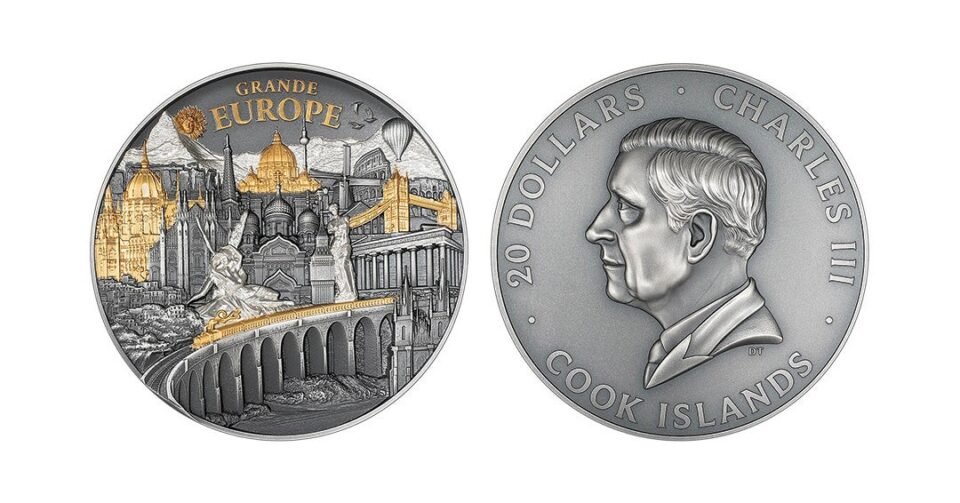
Issuing countries like Canada and Australia, as well as distributors such as CIT, are pursuing a different approach by focusing on innovation. Technical enhancements are intended to increase perceived value: color applications, high-relief minting, and special effects such as luminescent elements or holographic details. Silver remains the base, but loses importance as the sole value driver. What matters is the overall product. This strategy clearly targets collectors who are willing to pay for design and technology regardless of the pure metal price.
The Withdrawal Strategy
Alongside active adjustment strategies, a quiet but consistent withdrawal can be observed in Europe. Some countries are significantly reducing their activities in the field of modern silver commemorative coins or withdrawing entirely. This is particularly noticeable in Scandinavia. Danmarks Nationalbank has already discontinued the sale of commemorative coins via its own webshop and has significantly curtailed its issuance policy. Sveriges Riksbank has also pursued a highly restrictive approach to commemorative coins for years, with silver playing virtually no role.
Similar tendencies can be observed—albeit less consistently—in other smaller markets, where state coin programs are being scaled back or outsourced to private or semi-private structures. The background is multifaceted: rising metal prices, declining broad-based demand, higher logistical costs, and changing collecting behavior. High silver prices act as a catalyst. For numismatics, this development represents a structural loss. The state-issued, widely available silver commemorative coin is gradually disappearing in parts of Europe, not abruptly, but through gradual reduction and strategic reprioritization.
The Hybrid Strategy
At the same time, hybrid products are increasingly emerging. Classic bullion coins are being offered in enhanced versions, such as proof editions or limited mintages. This development can be observed particularly at the United States Mint and the Perth Mint. The goal is to appeal to investors and collectors simultaneously, generate higher margins, and tap into new target groups. The boundary between investment products and collector coins is becoming increasingly blurred, but the coin as a product has a future, because it will no longer matter whether it is a collector or bullion coin.
An important takeaway from the current situation is that, without silver, it does not work. “The conversion of the €10 commemorative coins to a copper-nickel alloy in 2011 led to a noticeable decline in demand, including for accessories such as cases, albums, and capsules,” reports Georg Motschmann, sales director B2B at Leuchtturm. With the switch to the €20 denomination and the return to the Ag .925 alloy, a slight trend reversal was achieved. “However, the collecting area never recovered to its previous level,” Motschmann concludes, while suggesting an alternative solution. “It would have made sense to retain the silver content of the coins while increasing the face value.” Motschmann is skeptical that the majority of collectors will accept the new .500 silver alloy, and that this “once very successful collecting area” will achieve a comeback.
The uncertainty of recent months (the albums for the Christmas series can only be completed by the end of 2026, and €20 collectors have seen no new releases since September 2025) has, according to observations by Leuchtturm GmbH, not been beneficial for €20 commemorative coins as a collecting theme. In addition, the issuance plan for €20 coins has been repeatedly reduced in recent years, with only three or four coins issued in some years instead of the originally planned five. The €25 Christmas coins, according to Georg Motschmann, have not been able to establish themselves as a replacement: “Collectors are not as strongly engaged here, because the series is too small and only one coin is issued per year.”
In addition to these retrospective observations, the question now arises as to how robust the new and apparently final plan for German silver commemorative coins really is. Whereas previously the blanks for the €20 and €25 coins could be produced in a single process for both Brilliant Uncirculated and Proof qualities, four different alloys will be used in the future: .999 for the €50 coins, .925 for the €35 proof coins, .625 silver for €50 coins in Brilliant Uncirculated, and .500 silver for €35 coins in standard finish. Most recently, mintages for regular silver coins of the Federal Republic were between 500,000 and 630,000 pieces in Brilliant Uncirculated and only 63,000 to 65,000 pieces in proof distributed across five mints.
If, in the future, blanks for proof coins must be sourced separately, a price jump for proof issues can be expected. The question remains: how will retail prices develop if silver prices continue to rise? Most recently, the €20 silver coins of the 2025 issue in proof were listed at €42.95 in the Münze Deutschland webshop, previously priced at €38.95. The €25 Christmas coins were most recently priced at €45.95 in proof. If face values are significantly increased and silver prices continue to rise, collectors may have to get used to prices of around €100 or more for proof silver coins. It remains uncertain how long the Federal Republic will be able to afford the luxury of silver coins issued at face value or premium issues with sharply declining mintages.
More Innovations in Numismatics: