
Global small-cap equities represent one of the most persistently overlooked corners of the public markets, and the current environment presents an unusually compelling entry point for allocators willing to look past the mega-cap names that dominate most portfolios. The case rests on three distinct but reinforcing arguments: small caps are trading at one of the widest valuation gaps relative to large caps seen in recent decades; the sheer scale of the global small-cap universe makes it structurally under-researched; and that thin coverage is compounded by inefficiencies built into how research gets organized globally. Together, these forces have created an environment where patient, well-resourced investors can still find significant mispricings, something increasingly rare in large-cap markets.
Relative Valuations Are at an Inflection Point
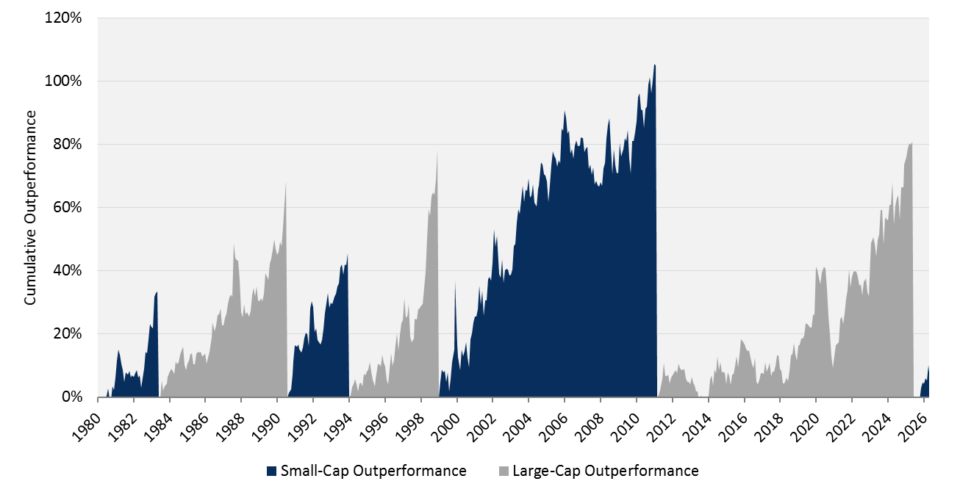
Historically, small-cap stocks have been a source of durable excess return. Going back to 1927, smaller companies have outperformed large caps by roughly three to four times on a cumulative basis, a record that spans multiple market regimes, currencies, and economic cycles. That long-run edge has never moved in a straight line, however. Since 1980, the relationship between small-cap and large-cap returns has moved through a series of extended cycles, with one side building a commanding lead over the other for years before the pendulum swings back. Periods of large-cap outperformance have historically tended to run for eleven to fifteen years and by that measure of magnitude and duration, the most recent cycle of large-cap dominance looks stretched. Small caps built a substantial lead over large caps from the early 2000s through roughly 2011, only to cede that ground steadily over the next decade-plus as a small number of mega-cap growth and technology names came to dominate index returns. That pattern is now showing signs of turning again, with small caps beginning to reassert themselves.
Small- and large-cap leadership has rotated in multi-year cycles

Source: S&P 500 vs. Russell 2000 indices; monthly closes.
Valuation data reinforces the point. The MSCI World Small Cap Index currently trades at a forward price-to-earnings multiple of 15.82x, versus 19.80x for the S&P 500, a 20.1% discount that is wide compared to prior market regimes. Investors do not need to call the exact turning point to find that combination of history and starting valuation attractive: when a segment of the market has spent over a decade underperforming, trades at a large discount to its more crowded counterpart, and has begun to show relative strength again, the risk/reward skews favorably for patient capital.
The Small-Cap Universe Is Too Large, Too Fragmented, and Not Economical for Most Firms to Properly Research, Which Creates Pricing Inefficiencies
Sell-side coverage follows trading volume, because that is where brokerage revenue comes from. Apple is followed by 70+ analysts; many small caps have one or two, and some have none. The financial media compounds the gap by concentrating on the largest companies. The buy side does the same, spending most of its time on large caps because small-cap strategies can’t absorb enough capital to justify the effort.
The scale of what goes overlooked is considerable. There are roughly 18,000 investable companies globally with market capitalizations below $10 billion, and that breadth creates real opportunity for investors willing to do the work. Doing that work is resource-intensive, not a screening exercise. Narrowing thousands of companies to a portfolio of genuine opportunities requires sustained, dedicated effort across geographies and sectors: people, travel, and local knowledge that most generalist, large-cap-oriented managers aren’t built to provide. As a result, large parts of the small-cap universe go unexamined by institutional capital. The opportunities are there; covering them simply doesn’t scale the way large-cap research does.
Many investors avoid small caps because roughly 40% of Russell 2000 constituents have no earnings. That’s a sound reason to avoid the index, but not the asset class. The same fact points to one of the most durable return spreads in equities. Data from Kenneth French’s library going back to 1963 show that U.S. small caps in the top 30% by operating profitability returned roughly 14% annualized, versus about 9% for the bottom 30%. That’s a five-point annual gap, compounded over six decades. The pattern holds within the index itself: from 2004 to 2024, profitable Russell 2000 constituents outperformed loss-makers by roughly 6.5% a year. In an efficient market, prices would reflect all available information, and a characteristic as simple and observable as profitability would not reliably predict higher risk-adjusted returns. Additionally, the premium didn’t demand extra risk. Unprofitable small caps carry higher volatility, deeper maximum drawdowns, and materially higher downside capture.
Structural Inefficiencies Are Magnified at the Global Level
The third pillar builds on the first two. The inefficiencies in how small-cap research gets done are structural, not incidental, and they grow larger once the lens widens from a single country to the globe.
Investing across borders means navigating multiple regulatory regimes, cultures, languages, and reporting standards, along with real logistical barriers to trading. Doing that well takes extensive experience and specialized infrastructure. As a result, competition in many small-cap markets is largely limited to local investors, who often lack a global perspective.
Analyst coverage of small caps is already thin, but the more consequential problem is how the coverage that does exist is organized. Sell-side and buy-side small-cap research is built almost entirely along regional lines: some analysts cover U.S. or North American names, others Japan, others South Korea, others Eastern Europe. The structure makes administrative sense, but it means genuinely comparative, cross-border analysis is rare. Local market dynamics can heavily influence small-cap valuations, and few analysts are positioned to notice that two similar businesses competing in the same niche, but domiciled in different countries, trade at meaningfully different valuations, because no one is mandated to compare them.
Regional fragmentation feeds several related inefficiencies. Local investors, focused on their own markets, often miss global demand or supply-chain trends that are driving the performance of a small company in their own backyard. Conversely, analysis of a global theme or a single company can be traced along its supply chain to uncover additional opportunities in other markets. Trends also tend to roll across geographies like waves, so investors who have watched a trend play out in one market can identify likely winners and losers as it reaches the next, rather than waiting for confirmation. And many of the best opportunities are companies that dominate a narrow, growing niche: too small and too specialized to attract meaningful coverage, even though their competitive position would be obvious to anyone who looked closely. When those niche positions come under threat, the same companies can become attractive short candidates.
Finally, there is the discovery effect. Managers with the flexibility and conviction to do original work can invest where few institutional investors or brokers operate, and their positions benefit as the rest of the market eventually finds what they found first.
Together, thin coverage, regional silos, and niche obscurity make a genuinely global small-cap strategy expensive and complex to run, which is why so few long-only or alternative managers attempt one. Roughly $30 trillion of market capitalization sits in companies below $10 billion, yet only about $100 billion is managed in public vehicles with a dedicated global small-cap mandate. Far more capital owns these companies through regional and single-country funds, but almost none of it is mandated to compare a small-cap business in Tokyo with its competitor in London. That scarcity of dedicated capital is itself the reason the inefficiency persists: the barriers that make the space hard to cover are the same ones that keep it from being competed away.
Two implications follow. First, inefficiency cuts both ways. Thinly covered markets misprice weak businesses as readily as strong ones, which makes small caps well suited to long/short approaches, not only long-only exposure. Second, because these mispricings stem from an absence of research rather than a temporary anomaly, they are unlikely to be arbitraged away by quantitative strategies that rely on the same screened data everyone else can see, and passive flows do nothing to correct them.
What This Means for Allocators
The three arguments reinforce one another. Valuation says the entry point is unusually favorable. The research burden says the discount is unlikely to close quickly on its own. Global fragmentation says the returns available to investors who do the work are unlikely to be competed away.
That combination argues for active rather than passive implementation. A small-cap index buys the unprofitable and over-levered tail alongside the niche dominators, and it captures none of the discovery premium. It also argues for evaluating managers on the specific capabilities the asset class demands: multi-decade watch lists, genuine local access across many markets, a demonstrated willingness to hold positions others have not yet found, and a research process that has held up across more than one market regime.
Timing remains unknowable. Large-cap leadership has lasted longer than many expected and could last longer still. But investors sizing a global small-cap allocation today are doing so at relative multiples last seen after previous large-cap peaks, in a segment where careful research has more room to add value than in most of the public equity market.
Conclusion
Together, these arguments describe a segment that has quietly become both cheap and under-owned by the capital best equipped to find value in it. For allocators willing to commit to managers with the global reach, research infrastructure, and patience to cover this universe properly, global small caps offer a rare combination: a historically wide valuation discount, a large and thinly covered opportunity set, and structural inefficiencies that are unlikely to disappear soon.
About Agecroft Partners
Agecroft Partners is a consulting firm that works with hedge funds and institutional investors. Donald A. Steinbrugge, CFA, is Founder and CEO of Agecroft Partners, LLC.
See also: Agecroft Partners.