
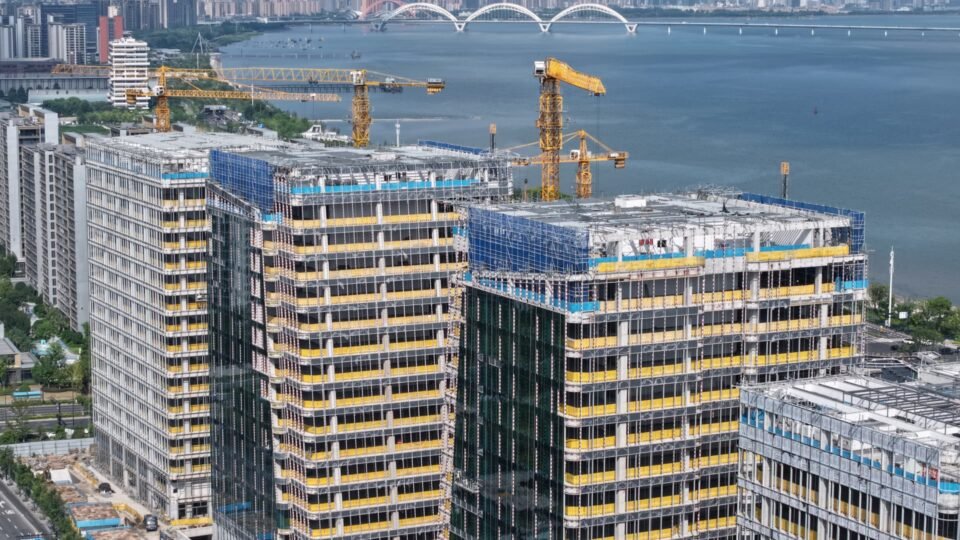
A real estate project under construction in Hangzhou, Zhejiang Province, China, on September 15, 2026.
Nurphoto | Nurphoto | Getty Images
BEIJING — An end is in sight for China’s yearslong property market slump, S&P Global Ratings analysts said in a report distributed Thursday.
Residential real estate prices may hit a bottom in the third quarter of 2028, the report said. It added that prices in China’s largest cities, such as Beijing and Shanghai, will likely recover as soon as next year.
That’s a big shift from February, when S&P said high levels of unsold housing kept “a property market recovery out of reach.”
What’s changed since are two government policies, according to the report’s author Edward Chan, a credit analyst at S&P Global Ratings.
In August, Beijing announced new restrictions on developers’ ability to sell unfinished properties. A month later, Chinese Premier Li Qiang said the government would roll out policies for stabilizing the real estate sector. Beijing subsequently launched a mortgage rate subsidy for first-time homebuyers of units less than 1.5 million yuan ($220,000) and smaller than 120 square meters (1291.67 square feet).
“Developers will now be very cautious in buying land, so they will basically buy less land and develop less new projects going forward,” Chan said in a phone interview with CNBC on Thursday. “That may not be good for the revenue but that will help China’s oversupplied property market.”
“Going forward in the next one to two years, the major factor in helping stabilize China’s home price is the continued reduction of supply,” he said, noting that despite a multi-year property slump, 2026 is the first year of real estate inventory destocking.
The oversupply challenge was so big that in 2023, Nomura estimated the scale of unfinished, pre-sold homes in China was about 20 times the size of Country Garden, as of the end of 2022. Country Garden was once the largest non-state-owned developer in China by sales.
Chinese property developers such as Evergrande long relied on sales of apartments before they were completed, fueling a debt-driven cycle of rapid growth. Homebuyers of one project in Tianjin city near Beijing previously told CNBC they were waiting years for the units they bought ahead of completion.
Comparison to Japan
The latest S&P forecast also compared the depth of China’s real estate downturn so far to how housing crises in Japan, the U.S. and Spain played out in recent decades.
Of the different factors that helped stabilize each of those market slumps, China is working on two: reducing supply and corporate deleveraging, the report said. “China’s supply contraction is occurring much earlier and with greater magnitude” than Japan’s housing crisis from 1991 to 2014, S&P said.
On the price front, China’s residential prices have already fallen by 22% since a 2021 peak, compared with a 67% drop in Japan’s after a far greater run-up in prices, the S&P report said.
By comparison, it said the U.S. real estate slump around the financial crisis saw a 26% drop in residential prices.
China’s efforts to subsidize mortgages along with wealth effects from the artificial intelligence boom are also helping lift property demand.
Also on Thursday, Guotai Junan International’s Chief Economist Hao Zhou published a report predicting the fourth quarter of this year could see the first growth in existing home prices for large, or “tier-one” cities, since the 2021 to 2023 slump.
He noted that since March, tier one cities were more likely than smaller cities to record flat or rising prices. In particular, he said existing home prices in Shanghai have narrowed their year-on-year decline, while those of Beijing have stabilized, rising by 1.4% from a low in January.
Hangzhou, home to DeepSeek and Alibaba, stood out with a record high in its new home sales index, while prices for new homes are only 14.2% below their peak and have fallen less than in most cities, Zhou said.
“The next three months are a key window,” he said. “If Shanghai, Shenzhen and Guangzhou avoid a monthly decline through the November 2026 data, this rebound will have outlasted the 2024–25 episode. In our view, that would be strong evidence of a Tier-1 bottom and an important signal for the wider market.”
However, it’s still uncertain whether demand will remain sustainable longer term.
The mortgage subsidy will bring forward planned purchases rather than creating substantial new demand, Morgan Stanley equity analyst Stephen Cheung said in a report Wednesday.
He cited data from Chinese research firm Bingshan that showed sales of existing homes in 25 cities rose by 50% from a year ago during the Oct. 1 to 6 public holiday period — picking up significantly from 20% growth in September.