
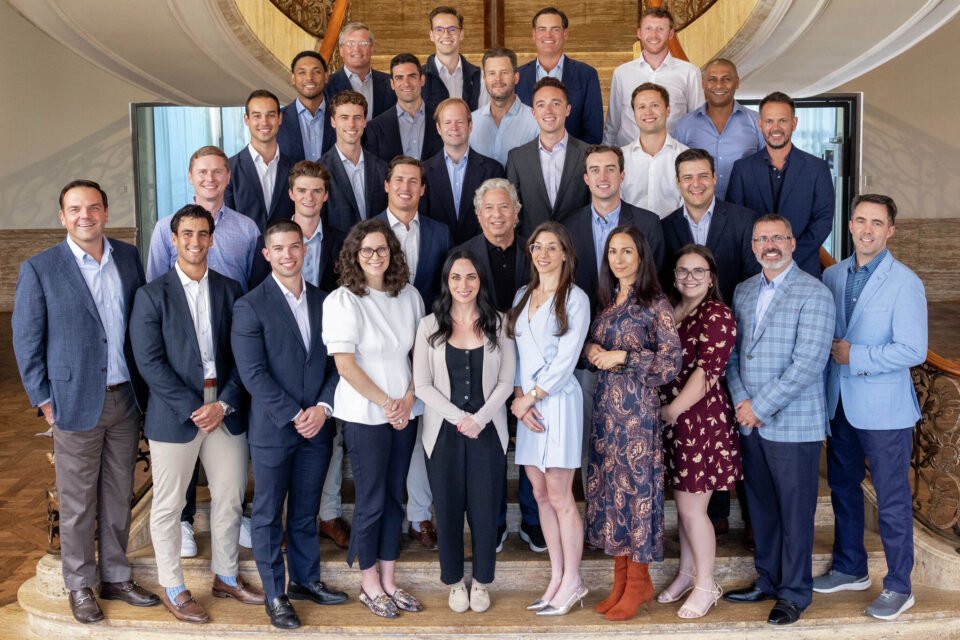

Doug Kennealey and Jim Waskovich met more than two decades ago as associates at a Boston private equity firm. For most of their careers, they were generalist investors.

Last month, their latest franchisor-focused private equity fund closed oversubscribed with $1.3 billion raised in two months.
As independent sponsors, Kennealey and Waskovich found themselves slowly narrowing their focus to franchisor businesses. In 2019, they started Princeton Equity Group, which is co-headquartered in Dallas and Princeton, New Jersey.
Article continues below this ad
“A lot of the firms that had focused on the franchisor business model had gone way upmarket, and so we thought there was a very attractive void to raise an institutional fund around this sector and business model focus,” Kennealey, co-founder and managing partner at Princeton Equity Group, said.
Princeton Equity Group started raising money for its first fund in January 2020, and closed in June 2021 with $352 million, Kennealey said. It took about five months to raise $575 million for its second fund three years ago.
While their strategy for the new fund won’t change, at least one aspect is new — 30% of the investors in Fund III were from outside of the United States.
With portfolio companies including Frisco-based child development program KidStrong, gym franchise D1 Training, Barry’s, Massage Envy, oil change chain Strickland Brothers and European Wax Center, the firm has continued to expand its team and use its FusionPoint AI software to identify fast-growing companies with founders that stand out to them. Princeton Equity Group has invested in more than 30 companies.
Kennealey, who moved to Dallas in 2010 because his wife is from the city, talked about Princeton Equity Group’s strategy with the Dallas Morning News. Answers have been edited for length and clarity.
Article continues below this ad
What made you want to invest in franchisors?
It’s a phenomenal business model. They tend to have high profit margins. They tend to be very cash-rich businesses. The business throws off a lot of free cash flow. Even at the time of our investment, they often have hundreds of locations already open across dozens and dozens of states, so there’s no customer concentration.
The franchisor business model holds up very well in recessions. We think it’s AI-resistant. You also have a lot of aligned incentives. If you decided to become a franchisee of KidStrong, one of our portfolio companies, you would use your own money, or get a loan, or borrow money to open up your KidStrong, and then you are running it, and we are collecting a royalty. But all the franchisees are incentivized to grow, so there’s just a wonderful incentive alignment with everybody that’s a franchisee. Franchising is a powerful force in the U.S. economy.
When you guys are evaluating businesses and franchisors to invest in, what are you looking for? What makes a company stand out?
We have our four lenses in our underwriting to determine if this is a Princeton investment. This is not all we look at, but we look first and foremost for businesses that have incredibly strong unit economics. The business at the unit level, at the franchisee level, has to be very compelling. The franchisees have to be making a healthy profit margin. It has to be an attractive return on their invested capital. They have to be able to break even pretty quickly. You cannot have a healthy and valuable franchisor unless you have healthy franchisees.
Article continues below this ad
The second lens we look for is some recession resilience. We really care about the recession resilience of those end markets. The third thing we look at is fad risk. We look for businesses that are durable, that are going to stand the test of time, that the service has been around for a long time. It’s not one of these hottest fitness thing in New York or LA that fuses hot yoga with Pilates and everyone’s talking about it. The businesses that we’ve invested in — mental health, hydraulic hose repair replacement — those types of things are going to be around for a very, very long time. The fourth lens, which is a new lens for us, is AI resilience. We think our strategy, because it is services and there’s a human touch element to it, is largely AI resilient.
We also look for businesses with a really strong founder or tight-knit management team. The last thing we talk a lot about here at Princeton is, is the business special? If you look at our portfolio, historical and current, you will see a lot of market leaders. You’ll see a lot of category-creating companies.
Why do you think you were able to raise so much so quickly, particularly at a challenging time for private equity?
I think it’s several things. We have a very strong team. We have a very compelling strategy, and we are among the most experienced, if not the most experienced in our space, so the body of work that we’ve developed and our ability to figure out what’s interesting is very, very compelling to investors. Our strategy offers a really attractive risk-adjusted return profile. When we’re making an investment, we believe that there’s a tremendous upside potential to generate really high returns, but also a very low risk of capital impairment, generally speaking.
Many of your investors had invested in previous funds, but you also had more international investors for this third fund. What drove that international interest in U.S. franchisors?
We had a concerted effort to try to broaden the LP base in Fund Three. But I also think for a lot of European investors and others, they don’t have this business model. It isn’t as prevalent in, let’s say, Europe outside of restaurants. Of course, Europe has McDonald’s and Burger King and things like that. I think they were attracted to all the things that the domestic investors were attracted to, but they weren’t used to seeing that in their home country, and it piqued their interest.
Article continues below this ad
Are there any particular industries or companies you’re eyeing for Fund III?
There’s not a particular focus area per se. Franchising touches most of the U.S. economy. We do a lot of direct outreach to privately owned companies, so we are sourcing a lot of our deals in a proprietary fashion, which we believe is differentiated. We’re talking to founders and CEOs, we’re meeting with them. We’re building those relationships over time.
How have you seen Dallas’ private equity landscape change, and how do you expect it to change going forward?
It’s remarkable how it’s evolved since I moved here 16 years ago. The number of institutional firms has grown dramatically. It’s also become a very compelling place for young professionals to work. It used to be Boston, New York, Chicago, San Francisco, L.A. Now I think top-tier talent wants to be in Dallas, and there are a lot of top-tier firms now in Dallas. It used to just be a handful of institutional firms and then smaller family offices. With Goldman and Morgan Stanley moving here, it’s put Dallas on the map in a great way.
Article continues below this ad