
Earlier this year, numerous bold predictions in the international financial markets outlined a scenario where precious metals would soon break through to $6,000 per ounce, and silver prices could even reach $100 per ounce by December.
However, the reality is unfolding in a completely different direction. Precious metals are currently struggling to maintain their position around the $4,000/ounce mark, forcing even seasoned experts to publicly admit their mistakes and lower their expectations.

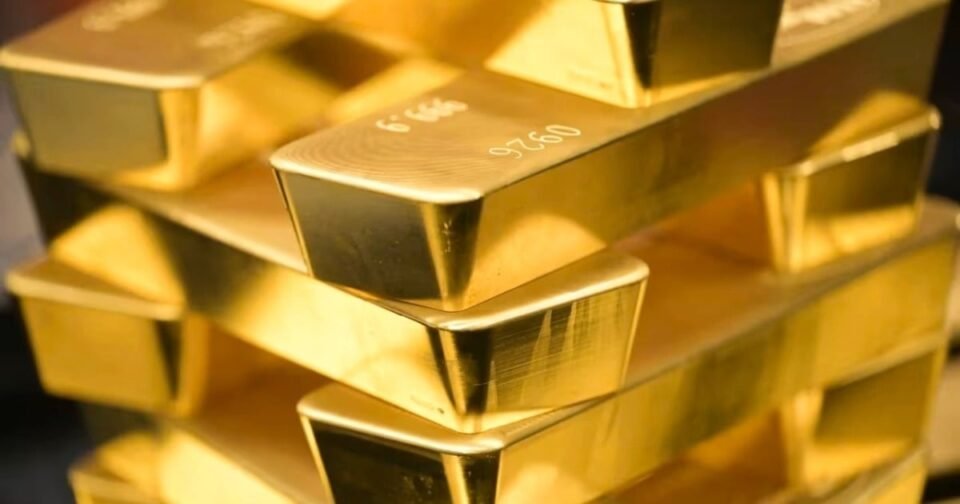
The gold market traded cautiously around the $4,000/ounce mark ahead of key interest rate decisions by the Fed (Photo: Barrons).
The acceleration scenario was unexpectedly disrupted by a sudden variable.
According to GoldSilver, Gerald Celente, founder of the Trends Research Institute with 48 years of analytical experience, has officially withdrawn his target of $6,000 per ounce this year. Instead, he has lowered his forecast to around $4,500 per ounce.
Explaining this setback, Celente said that geopolitical tensions in the Middle East have disrupted the usual pattern of price movements. The sudden outbreak of conflict has drawn capital and investor attention away from the scenario of sustained gold price increases driven by rising inflation.
“No one can predict the future,” Celente shared on The GoldSilver Show. The expert argued that too many factors are outside the realm of computational models, and unexpected events have overshadowed the impact of inflation on gold prices for months.
However, the fundamental support for precious metals has not disappeared. As inflation erodes the purchasing power of fiat currency, gold continues to hold its role as a store of value. Celente cites a Financial Times article from mid-October that the precious metal could very well set new record highs by 2028.
Interest rate pressure and concerns about “retrograde inflation”
Besides geopolitical factors, the complex macroeconomic landscape is also putting significant headwinds on the upward trend of precious metals. Celente introduced the concept of “dragflation” to distinguish it from normal stagflation. According to him, this is a state where the economy is declining but the prices of essential consumer goods such as housing, vehicles, and food continue to rise.
In response, central banks maintain high interest rates. However, this very high cost of borrowing continues to stifle growth and directly puts pressure on gold prices.
According to GoldPrice, the spot gold price at 7:30 AM on October 27th recovered slightly by 0.34%, reaching $4,012 per ounce after having fallen to a 3-month low of $3,975 per ounce. The cooling of crude oil prices has somewhat eased short-term inflation concerns and stimulated bargain-hunting demand.
Bob Haberkorn, senior market strategist at StoneX, commented on Business Recorder: “Trading will be relatively quiet and gold prices will fluctuate around the $4,000/ounce mark until the Federal Reserve announces its decision, allowing the market to see what message the agency sends.”
Although investors expect the Fed to pause interest rate hikes this week, the CME FedWatch tool shows that the probability of the market forecasting the Fed continuing to raise interest rates in December remains very high, at 82%. High interest rates increase the opportunity cost of holding a non-recurring asset like gold.
Investor behavior: Day trading or accumulating?
Another noteworthy aspect mentioned by Mr. Celente is the concentration of power in the financial markets. He cited the case of JPMorgan, which in 2020 approved a $920 million settlement with the U.S. Commodity Futures Trading Commission (CFTC) and the U.S. Department of Justice for placing fraudulent orders to mislead the precious metals market. This demonstrates that short-term price fluctuations are sometimes dominated by a small group of large financial institutions.
In the face of unpredictable fluctuations, the advice of this 48-year experienced expert to individual investors is remarkably simple: “Buy gold and hold it.” Having started buying gold when the price was just $167 per ounce, Celente maintains a habit of steadily accumulating it through cycles instead of trying to predict market peaks or troughs.
On a global level, despite some countries selling gold to address their public debt burdens, major economies like China are steadily accumulating the precious metal to gradually reduce their dependence on external financial systems.
Sharing a cautious view, analysts at OCBC Bank believe that the market should now focus more on the implications of fiscal policy, tariffs, and the level of uncertainty from the US midterm elections, as these are the variables that will determine the next direction of the USD, bond yields, and world gold prices.