
Executive summary
India is the world’s sixth-largest petrochemical producer and the third largest in Asia, yet the country remains heavily reliant on imports to meet demand. It imports around 45% of its chemical and intermediate requirements, including major polymers and petrochemical intermediates.
To reduce this reliance, the government aims to increase India’s petrochemical intensity index (PII) — the percentage of crude oil a refinery converts into chemical feedstocks — from its current 5% to 15–20% and expand capacity from 29.62 million metric tonnes per annum (MMTPA) to 46MMTPA by 2030. This expansion is expected to be supported by around INR4.32 lakh crore (USD45 billion) in investments by public-sector companies such as the Indian Oil Corporation Limited (IOCL), Hindustan Petroleum Corporation Limited (HPCL), Bharat Petroleum Corporation Limited (BPCL), Gas Authority of India Limited (GAIL), and Oil and Natural Gas Corporation (ONGC).
This strategy, however, requires fossil feedstocks. Around 93% of India’s petrochemicals are produced from crude oil, and the country imports around 88% of its crude requirements. This creates risks for the country’s trade balance and energy security, while also increasing its exposure to global fossil-fuel price volatility.
IOCL, established in 1964 to strengthen India’s energy security through oil refining, petroleum supply, and pipeline infrastructure, is a state-owned enterprise in which the Government of India directly holds 51.50% of the company, while total public ownership is about 71%, rising to 77% when Life Insurance Corporation of India’s (LIC) stake is included. Operating through 11 wholly owned subsidiaries and 30 joint ventures, IOCL spans refining, oil and gas, petrochemicals, pipelines, ports, power, and emerging areas such as green hydrogen, biofuels, and battery technologies. Its refining capacity is expected to increase from 70.3MMTPA in 2024 to 107.4MMTPA by 2030.
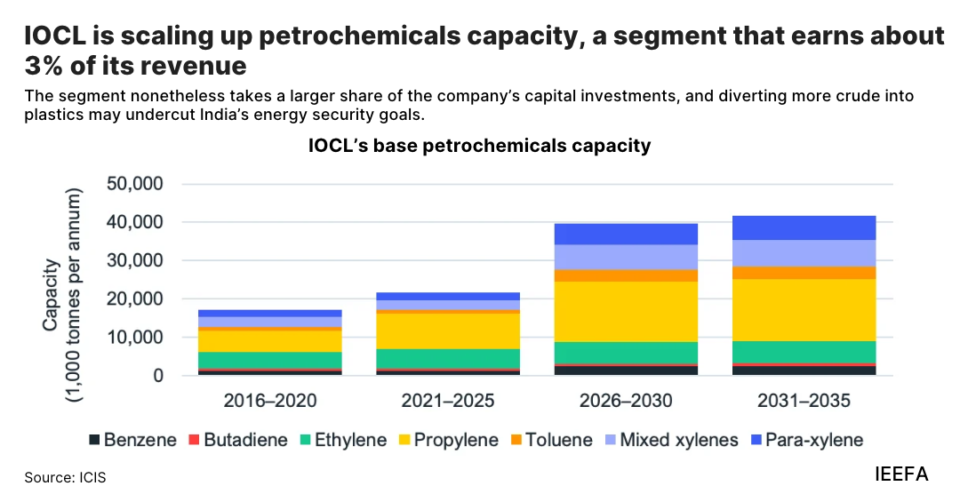
IOCL has significantly expanded into petrochemicals since 2004-2005 and is now India’s second-largest petrochemical producer, after Reliance Industries Limited (RIL), with a PII of 6.1%. It aims to raise this to 15% by tripling petrochemical capacity from 4.3MMTPA to 13.2MMTPA by 2030. Its portfolio spans basic petrochemicals and monomers, intermediates and polymers, alongside its refined-product business. The company is pursuing significant petrochemical expansion across base petrochemicals, intermediates, and polymers to strengthen integration and reduce dependence on transportation fuels. However, this strategy also increases IOCL’s exposure to global oversupply, slower demand growth, and margin pressure.
IOCL’s petrochemical business is built primarily on olefins — propylene and ethylene — which together make up 69% of its installed capacity for all base petrochemicals. As of 2025, the company held 28.84% of India’s propylene capacity and 12.46% of its ethylene capacity, with major capacity additions planned through 2028. IOCL’s investments at its Paradip and Panipat refineries aim to further expand its propylene- and ethylene-based polymer chains (polypropylene [PP] and polyethylene) alongside its para-xylene–purified terephthalic acid (PTA) chain for polyester production.
However, global capacity for these two feedstocks is growing faster than demand. This is already visible in a maturing polyethylene market and persistent oversupply in both polyethylene and monoethylene glycol (MEG), along with rising international competition. Together, these pressures could push down prices and reduce IOCL refineries’ utilisation. Feedstocks such as propylene, benzene, and butadiene are better positioned, since demand for automotive, engineering plastics, and speciality chemicals is rising. However, IOCL’s expansion is heavily weighted towards olefins, keeping it exposed to global overcapacity and weaker profit margins.
In petrochemical intermediates, IOCL produces ethylene oxide, ethylene glycol, and PTA, with PTA accounting for the largest share of its production. Ethylene glycol demand is forecast to grow 4–6% annually, driven by polyester, polyethylene terephthalate (PET) packaging, and industrial use, but rapid capacity additions, especially in China, are outpacing that demand growth, creating oversupply and squeezing margins. Margin pressure in ethylene glycol flows back to ethylene oxide, since about 75% of ethylene oxide goes into ethylene glycol.
Demand for PTA should continue to grow, particularly in India and other developing Asian countries, but heavy new capacity additions are likely to keep margins under pressure industry wide. IOCL is set to grow its own PTA capacity to approximately 3.4 times its 2021 level once the Paradip project is commissioned, strengthening its integration into polyester production. However, this also increases its exposure to an increasingly oversupplied and competitive market.
IOCL’s polymer strategy focuses on PP, high-density polyethylene (HDPE), and linear low-density polyethylene (LLDPE) production, with expansion predominantly focused on PP through 2035. Although India remains a growing polymer market, moderate demand growth is expected, particularly for polyethylene. The compound annual growth rate (CAGR) for HDPE is projected to decline from 7.70% to 3.99%, while the CAGR for LLDPE is expected to fall from 5.57% to 4.24%. PP will remain relatively stronger at around 7.0% compared with the earlier 5.93%. Infrastructure, construction, packaging, and industrial applications will support demand, but market maturity, sustainability regulations, and slower urbanisation and industrialisation could limit growth.
Overall, IOCL’s petrochemical expansion offers greater integration with downstream markets, but returns will depend heavily on capacity utilisation, feedstock economics and product spreads. The key risks to IOCL’s core petrochemical bets are global oversupply, moderating demand growth, volatile feedstock costs, import competition, and sustained pressure on margins.
IOCL remains primarily a refining and petroleum-marketing company, with petrochemicals contributing only around 3% of revenue. Although the company’s petrochemical revenue rose from about INR15,700 crore (USD1.64 billion) in financial year (FY) 2019-2020 to nearly INR28,000 crore (USD2.92 billion) in FY2024-2025, profitability deteriorated sharply as the segment swung from a profit of about INR2,008 crore (USD209 million) in FY2019-2020 to a loss of INR440 crore (USD46 million) in FY2024-2025, despite record sales volumes. Weak downstream demand; global oversupply from the US, China, and West Asia; pressure on PP, ethylene, and propylene margins; and relatively firm crude and naphtha prices have resulted in a tight profit gap between raw material costs used to make plastic and the final selling price of that plastic. As a result, higher production volumes have not translated into stronger earnings, raising questions about the segment’s ability to generate dependable returns.
Despite weak profitability, IOCL continues to commit a substantial share of its capital to petrochemicals. Around 24% of its INR1.04 lakh crore (USD10.86 billion) in major ongoing projects and about 10% of its planned FY2024-2025 capital expenditure are linked to the segment. The proposed INR61,000 crore (USD6.35 billion) Paradip Petrochemical Complex further underscores this commitment. However, this investment is yet to translate into financial efficiency. Asset efficiency in IOCL’s petrochemical segment has weakened markedly since FY2022. Asset turnover dropped by about 47%, from 1.17 in FY2022 to 0.62 in FY2026. Segment assets nearly doubled to INR45,225 crore (USD4.71 billion) by March 2026, while revenue stayed flat at about INR28,100 crore (USD2.93 billion). Overall, petrochemicals currently appear to be a high-capital, high-risk contributor with uncertain earnings, rather than a dependable growth engine. This is particularly significant given the public sector’s about 71% ownership of IOCL (77% including LIC) and the resulting exposure of public capital to continued petrochemical investment.
The larger issue is India’s heavy reliance on imported crude oil, which creates significant vulnerabilities to global price volatility, geopolitical disruptions, inflation, currency pressures, and the trade deficit. Against this backdrop, diverting larger volumes of imported crude into petrochemical production raises a broader question of national interest. Does expanding petrochemical capacity through greater oil consumption and public investment strengthen or weaken India’s energy security?
Rather than pursuing petrochemical growth indiscriminately, India’s policy could focus on rationalising demand and reducing non-essential oil- and plastic-based applications, particularly where viable alternatives exist. This could lower petroleum demand and import exposure while encouraging alternative materials, more sustainable production and consumption models, and better environmental outcomes. Such an approach would align petrochemical policy more closely with energy sovereignty and long-term national interest, rather than treating import substitution alone as the primary objective.
Recommendations
Given the oversupplied market, it would be prudent for IOCL to review its strategy of expanding its petrochemical operations and increasing investments in the sector. The company also needs to revisit its plastic-centric petrochemical strategy. Globally, there is a growing recognition of the need to move away from producing low-value commodity polymers and towards speciality chemicals that have far more niche uses. This could help arrest the indiscriminate production and consumption of non-essential plastics. While revisiting its long-term strategy, IOCL should consider how it could contribute to the country’s energy security by diversifying into alternative and renewable sources of energy.
In the immediate term, IOCL also needs to consider how it will address its Scope 1 emissions, including reconsidering carbon capture, utilisation, and storage (CCUS) as a decarbonisation pathway. Currently, its net-zero strategy relies on renewable energy, green hydrogen, biofuels, and efficiency improvements, that primarily target energy-related Scope 2 emissions, which account for a smaller share of the company’s total emissions.