
Hedge funds’ bet on Bolsonaro’s victory goes awry
Assets plunge after Lula’s win; the real weakens
Brazilian hedge fund managers misread the presidential election results, turning investments that had generated their biggest returns in years into massive losses in just three weeks. The funds had expected right-wing candidate Flavio Bolsonaro to win, but, contrary to their expectations, left-wing President Luiz Inacio Lula da Silva secured a fourth term.
Yonhap News, citing Bloomberg on October 30 (local time), reported that major Brazilian hedge funds suffered heavy losses as selling surged when markets opened on October 26. It was the worst single day for Brazil’s fund industry as a whole in about nine years.

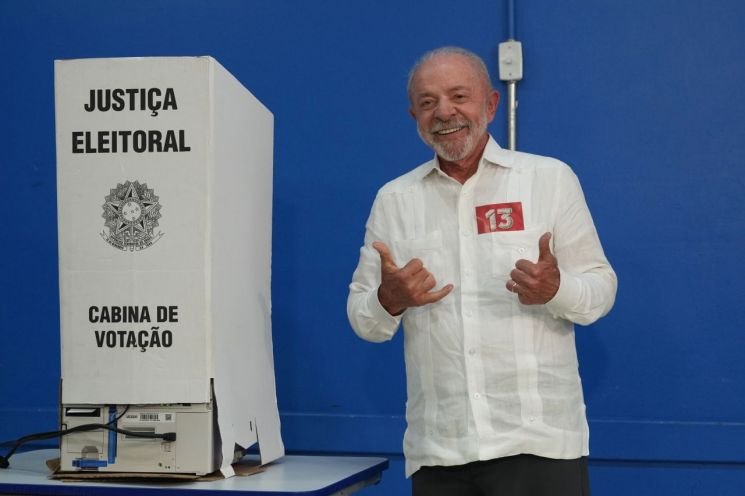
President Luiz Inácio Lula da Silva gives a thumbs-up after the presidential runoff election in São Bernardo do Campo, Brazil, on the 25th (local time). AP-Yonhap News.
Vista Multiestrategia, a fund managed by Rio de Janeiro-based Vista Capital, plunged 24% on October 26 alone. On the same day, Mar Absoluto, a fund managed by Mar Asset Management, fell 15%. Legacy Alpha, a fund managed by Legacy Capital, lost 8%, while a fund at Ace Capital lost about 9%. Encore Asset Management’s equity fund plunged 32% from the previous session.
Mar Asset Management admitted to errors in its investment judgment and apologized in a letter to clients. In the letter, the company said, “We made rigorous preparations, analyses and efforts ahead of an important year for the firm, but we were wrong,” adding, “What has happened has happened.”
The losses were fallout from the market’s mistaken expectations about the election result. Just three weeks earlier, Brazilian hedge fund managers had posted their biggest gains in years. After Senator Flavio Bolsonaro, the eldest son of former President Jair Bolsonaro and the Liberal Party (PL) presidential candidate, unexpectedly finished first in the October 4 first-round election with more votes than expected, financial markets rebounded sharply.
Some hedge funds consequently increased their bullish bets across Brazilian stocks, currencies and interest rates. They expected that a Bolsonaro presidency would reduce Brazil’s huge fiscal deficit and create conditions for cuts to the benchmark interest rate. If that scenario came to pass, government bond and swap rates were expected to fall, while share prices of domestic companies—which had been struggling with high borrowing costs for years—were expected to rise. They also expected the Brazilian real to strengthen on foreign capital inflows.
However, President Lula’s victory in the October 25 runoff, defying most opinion polls and market expectations, brought those investment strategies crashing down.
Asset managers that had made big gains after the first round suffered the biggest losses this time. Joao Braga, a portfolio manager at Encore Asset Management, acknowledged that the fund was “heavily long,” with almost no cash on hand when the selling hit. In other words, most of its assets were positioned to benefit from rising prices.
He added that the positioning was based on opinion polls, the firm’s own calculations using the first-round results, and analyses of voting patterns, and that all of these factors indicated a “very high” probability of a Bolsonaro victory. Ricardo Denadai, founder of hedge fund Ace Capital, also said that his funds suffered significant losses across their equity, currency and interest-rate bets because market moves were larger than after the first round.
A key concern in the market is that the Lula government may prioritize maintaining social welfare spending and policies to stimulate consumption rather than actively reducing the massive fiscal deficit, which exceeds 9% of gross domestic product (GDP). In that case, the government may rely primarily on increasing tax revenue to shore up public finances, raising concerns in the market that high interest rates could persist longer than expected.
Brazilian stock, currency and interest-rate markets have been highly volatile since the election results were announced. The Bovespa, Brazil’s benchmark stock index and equivalent to South Korea’s KOSPI, has fallen about 18% this week alone. The decline has more than erased all the gains recorded after the first-round vote earlier this month. The Brazilian real has fallen more than 8% against the U.S. dollar, making it the world’s worst-performing currency over the same period. Long-term swap rates have also risen by more than 2 percentage points.
The market shock is adding further pressure to Brazil’s fund industry, which was already struggling with outflows. As high interest rates persisted, investors moved into relatively safe assets, leading to continued withdrawals from multimarket funds.
According to data from the Brazilian Fund Association, the hedge fund sector alone recorded net outflows of 9.3 billion reais (about KRW 2.3 trillion) through September this year, making it increasingly likely that the sector will post annual net outflows for a fourth consecutive year.
Hot Picks Today

Arthur Vieira, chief investment officer (CIO) at XP Inc., one of Brazil’s leading hedge funds, warned, “It would be surprising if the fund industry did not deteriorate further over the next year,” adding, “If hedge funds fail to reinvent themselves, they will lose even more of their already weakened influence in the market.”
This content was produced with the assistance of AI translation services.
© The Asia Business Daily. All rights reserved. Unauthorized AI training and use prohibited.