
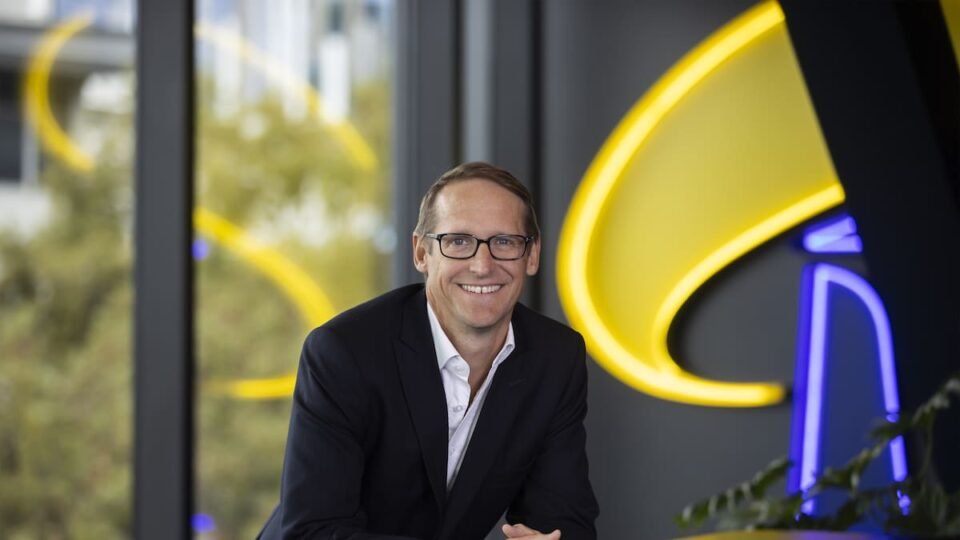
Tower chief executive Paul Johnston.
Paul Johnston is the chief executive of Tower, New Zealand’s only listed insurance company, which employs about 1000 people and has a market capitalisation of around $700 million. Born and raised in Wellington, he spent nearly 20 years in banking, corporate finance, and insurance across Australia,
London, and Japan before returning home five years ago as Tower’s chief financial officer. He lives centrally in Auckland with his wife and their three children.
I was born and raised in Wellington. Both my parents were educators. Dad (Jim) was a university lecturer and professor, and a bit of an entrepreneur, and my mother (Glenys) was a teacher. I’m the oldest of three, with a brother and a sister, Greig and Linda.
I had a fairly standard Kiwi upbringing. We spent lots of holidays on the family farm where Dad grew up in Stratford, Taranaki, which gave me a lifelong interest in building and fixing things. And with both parents being educators, I developed a bit of curiosity and an interest in learning and reading.
I didn’t really have any specific dreams for what I wanted to be. I’ve always built my career around doing interesting things and chasing good opportunities to work with people, take on challenges, and grow.
I played lots of sports, which I really enjoyed. I was a bit of an all-rounder with subjects, and later focused more on maths and sciences, but I really enjoyed English and economics as well. I went to Victoria University of Wellington, where I studied finance and chemistry, and later did a Master’s in Finance at London Business School.

I’ve always thought entrepreneurially. At school, I ran a couple of Young Enterprise Scheme businesses, and at university, a friend and I ran a Christmas tree business. We would work really hard until Christmas selling the trees to corporates, pick them up after New Year’s, and then have the rest of the summer holidays to either enjoy ourselves or get part-time jobs. It was really successful, actually, because we’d earn enough money up to Christmas to pay university fees for the next year. So that taught me the value of working quite hard and thinking about how you can find a point of difference for your customers and go after it really quickly.
I worked for Meridian Energy for about four years in the retail business, and then ended up running the consumer energy business, which looked after all of Meridian’s residential customers.
I also started a business called SwiftPics with a couple of friends, where we built digital photo kiosks. We saw an opportunity in the market with the boom in digital cameras for the digitising of pictures, so we went after that. There were three of us, and we spent about two years battling away with it in the early 2000s. We exported a couple of kiosks to Australia. But the market got swamped by Kodak, which flooded it with kiosks to try to sell more paper, and then it got taken over by online photo-sharing websites like Flickr, and ultimately by Facebook and Instagram and everything else 10, 15 years later.
That’s probably my biggest failure. It was a good business, and it taught me two really interesting things. One was that you’ve always got to focus on what the customers want, when they want it and how they want it. And secondly, particularly in technology, markets move really, really quickly, so you’ve got to move aggressively to keep up.
Then I went abroad. I went to Australia, worked in banking for a year and a bit, then went to London and worked in M&A and corporate finance. I had some pretty interesting experiences through 2008 in London – Nomura was a client when they bought Lehman Brothers. I moved into insurance because I helped AIG restructure in Europe after it fell during the 2008 GFC, and that’s how I ended up at AIG. From there, I worked for Chubb as its CFO for the Far East and Japan.

I’ve always been drawn to insurance because it protects what people love and lets them take risks, backed by insurance. Ultimately, taking risks is what drives economic growth. So for me, insurance has been a really natural home.
We loved Japan. Every weekend we were doing something outdoors – hiking, surfing, skiing. An amazing outdoor lifestyle, which was really surprising, given the picture everybody has of Japan. And then when we needed a weekend off, we’d hang out in downtown Tokyo, which was also pretty phenomenal. We were only there for just over a year.
My wife, Ali, is a Kiwi. We met in New Zealand after university, and she went back to university to do nursing. That’s why we went to Australia for a year, for her to do a graduate programme, then moved to London, where she was a nurse the whole time. We’ve got three children, all born and bred in London; then we moved them to Japan for a little bit, and then back to NZ. Charlotte is our oldest, just finishing her first year of engineering at university, and then we’ve got two teenage boys, Zach and William. They’d obviously never lived here before, but they’d travelled home quite a bit to see grandparents and cousins, and they’re throwing themselves into the NZ lifestyle.
The opportunity came up to be the CFO for Tower, and we felt it was too good to turn down, to go and be the CFO for NZ’s only listed insurance company. I really liked what Tower does: building great insurance products for Kiwis. We put the customer at the heart of what we do and focus on making insurance easy, transparent, and fair through digital, so I thought it was a company well positioned in the market and striving to be ambitious and grow.
We’ve been back in NZ for almost five years now. We actually spent Christmas in a quarantine hotel, the five of us, which was an interesting experience.

It’ll be two years in February since I became CEO, and it is my first CEO job. I’ve done varied and interesting things in my career, and I’ve led large teams, so I think my whole career prepared me for that. Climate change is a challenge, but insurance has lots of challenges, and that’s why we’re there for our customers. I really enjoy that aspect, actually.
We’ve got about 1000 people and a $700m market cap. Last year, we won the Deloitte Top 200 Most Improved Business. This year, we were named Canstar’s Home & Contents Insurer of the Year for the third year running and also picked up its Innovation Award.
I’m not aiming to be the smartest person in the room. I really want to build a room full of smart people who can take ownership. So I like to ask questions, make sure things are set up to succeed, then get out of the way and let people get on with delivering it.
I don’t have an office at Tower. I sit at a high table in the middle of the office, in front of the kitchen, so if I’m not in meetings, people can stop by and grab me about something. Tower was open plan by design, and I chose to be out in the middle so I can understand what people are up to. It’s worked well for me for almost two years, and I understand that people in Tower actually like it and appreciate that approachability.
There’s probably no consistent theme to what annoys me, but a key thing is you’ve got to start with the customer. If we’re getting tied up internally, or not starting with the customer, that can get frustrating.
My biggest success has been being part of the team at Tower over the past few years, where we’ve tripled the share price. We’ve also entered the NZX 50, and in five to 10 years we’ve got ambitions to be at the top of the NZX 50. So maybe I’ll still be CEO of Tower, having continued to build this business and make it an even more meaningful business in the NZ financial services landscape.
Curiosity and learning are key, and arguably even more important now in the age of AI (artificial intelligence). So bring different perspectives together to solve problems, bring people into the room who are smarter than you, and stay curious and keep learning. Being able to work and learn in different markets has been really valuable throughout my career.
We’ve got a couple of examples of AI where we’re making really good progress. In the call centre, it’s giving our agents their next best action when they’re talking to customers on the phone, and so far that’s saved our customers over a million minutes of call time. We’ve also just launched it internally in claims, around triaging claims as they come in.

My day certainly doesn’t start or finish in the office. I generally start at home, read a bit, then cycle in. I spend most of my time in the office actually meeting and talking with people, whether they’re the Tower team or external people. Then I’ll spend my evenings working away on the laptop, whether it’s emails, reading, or learning from things people have sent through.
I considered doing an MBA (Master of Business Administration) after university when I was at Meridian, and someone advised me to read business books instead. So I’ve read a huge number of business books over the years, from Warren Buffett, Benjamin Graham, biographies on businesses like HP, Apple, Microsoft, you name it. I still read a lot, and generally non-fiction.
I love my cycling. I cycled around Fiji last year. We live kind of central, so it’s a 10km ride into the office and back. Most weekends I can be found on the side of the sports ground watching one or more of my children play sport. If it’s cricket season, I’ll be sitting on a deck chair on the side of the cricket field reading work stuff, board reports, or umpiring. I think I’m quite good at compartmentalising what I’m doing, and then being able to move on and put it aside. And exercise is a big thing for me.
I do love a quote from secondary school, from Winston Churchill: “Never, never, never give up.” I also really like the saying, “Look after the process, and the scoreboard will take care of itself,” which was an All Blacks lesson after they lost the World Cup quarter-final to France in Cardiff in 2007.
I really do feel it’s a huge privilege to lead Tower. We’re more than 155 years old in NZ, and we’ve built a great team that’s created great products and technologies for our customers.
The Life of … profiles may be edited for brevity and clarity.
All images supplied.