
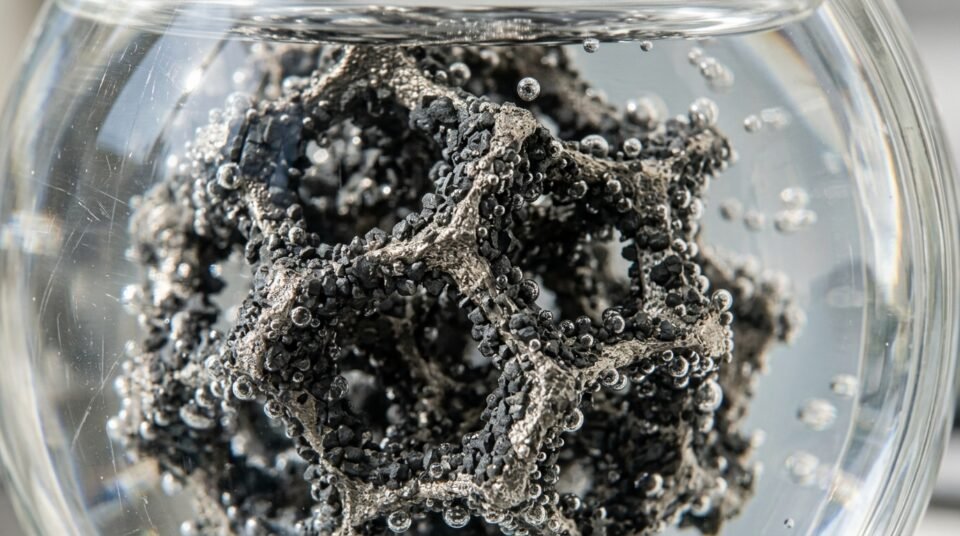
Researchers report a bifunctional water-splitting electrocatalyst that pairs platinum with magnetite at unusually low platinum loadings. In a study published in the journal Ionics, a team led by Lingxin Yu, Lina Han, Yue Shen, Yi Xie, Baolong Li, Ming Wen and Yehua Jiang describes a series of Pt/Fe3O4 catalysts made through a two-step route: first preparing Fe3O4, then depositing platinum nanoparticles by an ethylene-glycol-assisted solvothermal method. The work targets alkaline water splitting, where efficient and low-cost bifunctional electrocatalysts remain a central goal.
The central design question was how much platinum a magnetite support actually needs. The authors systematically varied the Pt loading and tracked how each change affected both the structural characteristics and the electrocatalytic performance of the catalysts. Structural characterization showed that adding platinum did not alter the main crystal structure or the morphology of the Fe3O4 support. X-ray photoelectron spectroscopy, however, revealed changes in the surface electronic environment of Fe3O4 that depended on the Pt loading, a pattern the authors interpret as consistent with possible interfacial electronic interactions between platinum and magnetite. They also note a caveat: nanoscale Pt aggregation at higher loadings cannot be excluded based on the present data.
Among all the samples investigated, the catalyst with a nominal 3 wt% platinum loading, corresponding to an actual Pt loading of 2.09%, delivered the best hydrogen evolution reaction activity and the most favorable overall balance between the hydrogen evolution reaction and the oxygen evolution reaction. In 1 M KOH, this catalyst required overpotentials of 72 mV to reach 10 mA·cm−2 for the HER and 368 mV for the OER. The same material also showed the lowest charge-transfer resistance and the largest electrochemically active surface area among the series, together with excellent long-term stability.
The practical test came in a two-electrode H-type cell, the configuration closest to how a bifunctional catalyst would be used in an electrolyzer. With 3 wt% Pt/Fe3O4 serving as both the cathode and the anode, a cell voltage of 1.76 V was required to achieve a current density of 10 mA·cm−2. The cell continued to operate for 24 hours, with the voltage rising gradually to approximately 1.88 V over that period, a drift the authors report as part of the stability record rather than a failure.
Why would a low loading of platinum on an oxide support outperform heavier loadings? The authors attribute the enhanced performance mainly to four factors: the optimized Pt loading itself, a favorable defect-associated surface oxygen environment, the enlarged electrochemically active surface area, and accelerated interfacial charge transfer. The spectroscopic evidence for Pt-loading-dependent shifts in the surface electronic environment of Fe3O4 supports the idea that the metal and the oxide interact electronically at their interface, while the measured resistance and area values point to faster charge transfer and more accessible active sites at the optimal loading.
The significance of the loading result lies in platinum economics. Platinum is among the most expensive components of any electrolyzer, and reducing its mass fraction while preserving activity directly affects cost. In this study, the best-performing catalyst contained an actual platinum loading of 2.09%, yet it still delivered the strongest HER activity of the series and the best HER–OER balance, allowing the same material to serve on both electrodes of the two-electrode cell.
The study also carries methodological weight for catalyst screening. Because Pt loading did not change the crystal structure or morphology of the support, the performance differences across the series can be tied to loading-dependent electronic and surface effects rather than to wholesale structural changes. At the same time, the authors’ acknowledgment that Pt aggregation at higher loadings cannot be ruled out with the present data marks a boundary on the interpretation, and the spectroscopic changes are described as consistent with interfacial interactions rather than proven as their sole cause.
For the broader field, the authors position the work as a reference for the rational design of high-performance bifunctional electrocatalysts with low Pt loading for alkaline water splitting. The reported numbers, a 72 mV HER overpotential, a 368 mV OER overpotential at 10 mA·cm−2 in 1 M KOH, a 1.76 V two-electrode cell voltage at 10 mA·cm−2, and 24 hours of continuous operation, provide concrete benchmarks against which future low-platinum bifunctional catalysts can be compared.
Subject of Research: Low-loading platinum nanoparticles on magnetite as a bifunctional electrocatalyst for alkaline overall water splitting
Article Title: Low-loading Pt nanoparticles supported on Fe3O4 as a bifunctional electrocatalyst for overall water splitting
Article References: Yu, L., Han, L., Shen, Y., Xie, Y., Li, B., Wen, M., & Jiang, Y. (2026). Low-loading Pt nanoparticles supported on Fe3O4 as a bifunctional electrocatalyst for overall water splitting. Ionics. https://doi.org/10.1007/s11581-026-07624-7
Image Credits: AI Generated
DOI: 10.1007/s11581-026-07624-7
Keywords: electrocatalysis, water splitting, platinum, magnetite, Fe3O4, hydrogen evolution reaction, oxygen evolution reaction, overpotential, alkaline electrolyte, bifunctional catalyst, solvothermal synthesis, electrochemically active surface area