
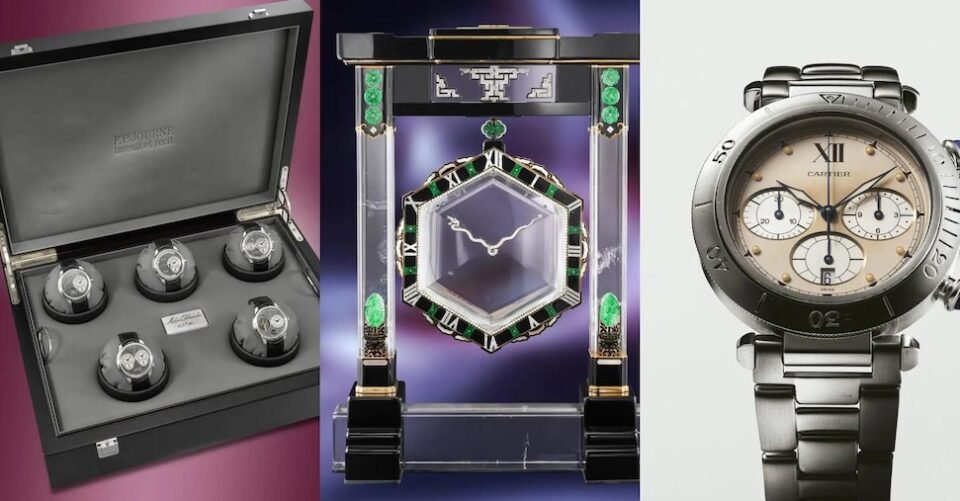
Rolex and Patek Philippe hand over the crown to F.P. Journe
The real surprise – though perhaps not so surprising, given the auctions of recent semesters – is therefore F.P. Journe. At Phillips’ mega auction, the maison’s 13 watches alone fetched $38.8 million: more than a third of the total proceeds. In addition to the top lot, the ‘Régence’, the titanium ‘Chronomètre à Résonance Tokyo Boutique’ fetched $7.5 million (estimate: 400–800 thousand francs), followed by the platinum ‘Vagabondage III’ set with diamonds (6.17 million), the pre-series ‘Chronomètre à Résonance’ no. 022/99R (6.02 million) and the ‘Tourbillon Souverain’ with a brass movement (2.55 million). At Sotheby’s, F.P. Journe also exceeded the one-million mark with a rose gold ‘Résonance’ (circa 2002), selling for 1.25 million. The diamond-set ‘Octa Divine’, the aluminium ‘Centigraphe Sport’ and the rose gold ‘Centigraphe Souverain’, on the other hand, sold for between 437,000 and 577,000 dollars.
Never without a Patek Philippe
Among the great historic watchmakers, Patek Philippe remains the benchmark. At Phillips, the steel split-seconds chronograph, ref. 1436 – one of only two known examples with an original steel case and dial – fetched $7.64 million, a world record for any split-seconds chronograph. The unrivalled classic, the 1941 Ref. 1518 (the first mass-produced wrist chronograph with a perpetual calendar), in its yellow gold version, fetched $1.36 million at Phillips and $1.32 million at Christie’s. It is worth noting that, in this case, steel is more valuable than gold: the world’s most expensive Patek Philippe is a steel 1518 (it is a proven fact that only four examples in this metal exist worldwide). At Sotheby’s, the same complications as the 1518 (chronograph, perpetual calendar, moon phases) were found in the first yellow gold example of ref. 3970 from 1986 (‘The first 3970’), which sold for 2.05 million francs (a record for the reference and the second most expensive lot of the auction).
Rolex, Cartier and others: rarity, preservation, provenance
For Rolex, rarity and condition are the key factors determining the price. At Phillips, the famous yellow gold Ref. 6062 ‘Stelline’, recently discovered and originally purchased in Japan, fetched $2.85 million, whilst the Cosmograph Daytona Ref. 6241 John Player Special sold for $2.32 million. The first part of the Pucci Papaleo Collection, featured in this catalogue (15 chronographs for $4.6 million), saw the square Rolex Ref. 3830, signed by the Milanese retailer Verga, triumph with a bid of $1.55 million; this is the record for a non-Oyster Rolex chronograph.
Cartier has taken centre stage with its Art Deco ‘Portico Mystery Clock’ No. 4 from 1924, one of only six ‘Portico’ clocks ever made, and the only one with a hexagonal rock crystal dial: at Phillips, it fetched $5.87 million, a record for any timepiece from the maison. At Sotheby’s, all 16 vintage Cartier pieces found a buyer, mostly above the upper estimate. Among non-wristwatches, also noteworthy is the 1914 rose gold pocket watch by A. Lange & Söhne, which changed hands at Sotheby’s for $749,000.
Independent and tenacious
The most striking trend of the season, however, was the rise of independent watchmaking. At Christie’s, all the independent watches in the catalogue – including seven one-off pieces – sold at or above the upper estimate. At Sotheby’s, the category was represented by over 20 brands – more than ever before at a Geneva auction. The prices achieved confirm the strength of the bidding. At Phillips, Philippe Dufour’s platinum ‘Simplicity’ – one of the earliest examples – fetched $2.4 million; Kari Voutilainen’s tantalum ‘Vingt-8 Inversé’, a one-off piece, fetched 1.86 million (a record for the model), whilst Roger Smith’s two-tone ‘Series 1’ sold for around 1.12 million. The ‘Opus One Tourbillon’, created by Harry Winston in collaboration with Journe, fetched $1.7 million – a record for the entire Opus series – whilst Sylvain Pinaud’s ‘Origine No. 2’ exceeded its highest estimate by more than five times, reaching approximately $744,000.