


ClearToken, the digital financial market infrastructure provider, has received regulatory approval to operate a digital securities depository (DSD) in the Bank of England’s digital securities sandbox and the firm has also applied to become a regulated central counterparty for clearing.
In 2021 ClearToken was set up to build a digital asset clearing house. Ben Santos-Stephens, chief executive of ClearToken Group, told Markets Media: “When we started, we realised there was not enough cash in the world to settle atomically, so risk management and clearing are still required.”
He used the analogy of the advent of AdSense from Google in 2003. Prior to AdSense newspapers would sell $100,000 blocks of advertising and collect the payment.
“AdSense allowed people to buy one dollar or one cent’s worth of advertising, and business models changed beyond recognition because automation brought the cost down,” Santos-Stephens added.
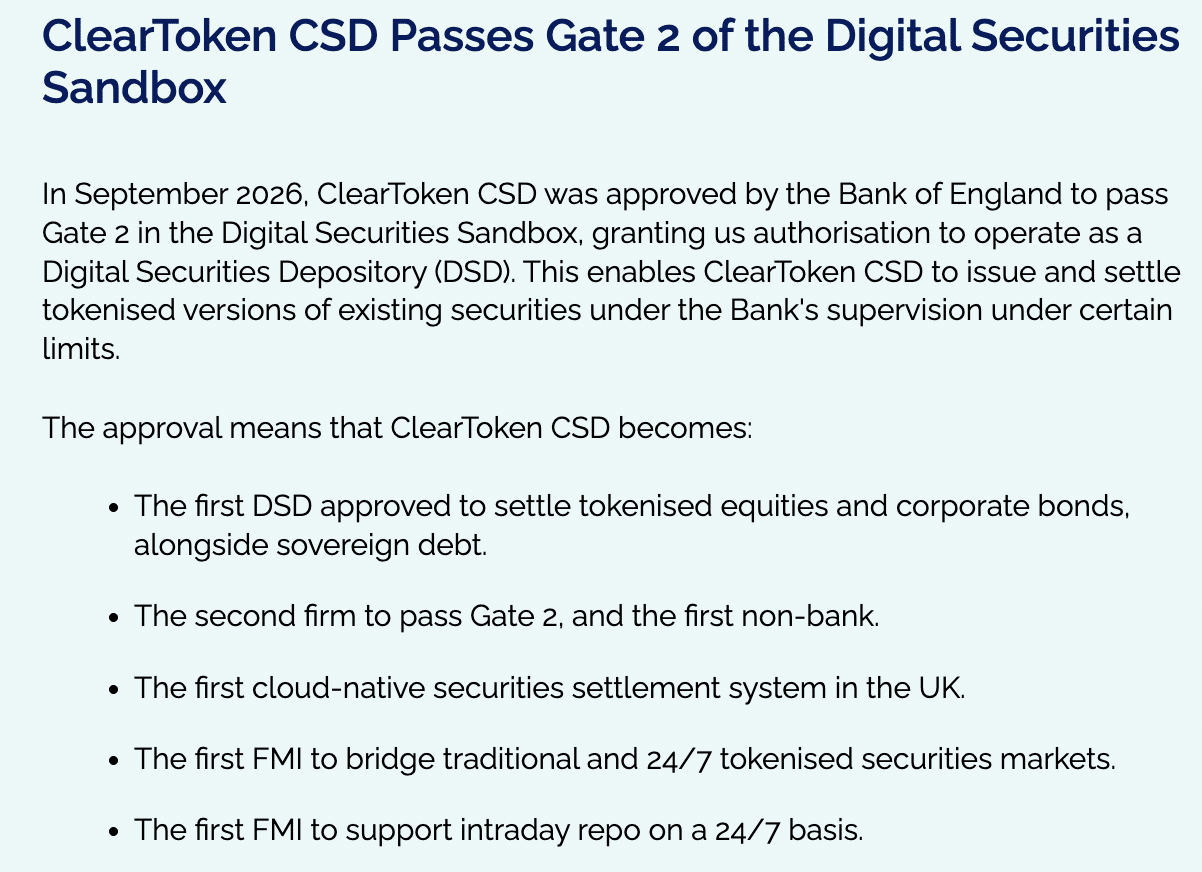
On 22 September 2026 ClearToken announced that the Bank of England approved ClearToken CSD Limited to operate a digital securities depository in the U.K central bank’s sandbox.
ClearToken CSD’s model ensures fungibility between digital and traditional securities by using the same ISINs, which are used to identify securities, to ensure that liquidity is not fragmented and that users’ rights are always preserved. This allows institutions to hold an asset, such as an a security, commodity or a money market fund unit, in a single legal form carrying an ISIN that settles 24/7 and books directly into their existing collateral and treasury systems workflows.
Source: ClearToken
The U.K. had only one central securities depository (CSD), CREST, which has been around for 30 years and has technology that does not operate 24/7, said Santos-Stephens.
In contrast, ClearToken’s digital securities depository will bring the future benefits of 24/7 operations, tokenization, instant and fractional settlement. For example, if the constituents of a fund can be settled fractionally, the fund units can be created and redeemed at any time of day, which opens up new opportunities.
“Our settlement under English law is designed to be irrevocable and unconditional, and assets will be guaranteed to transfer in the event of a bankruptcy,” he added. “Tokens on a blockchain are pieces of information but do not equate to a legal record in a CSD.”
Santos-Stephens said the focus of the DSD is very much on settlement, rather than acquiring assets under custody. He added: “We are not here to compete with custodians but to service very short-term funding.”
On 8 October 2026 ClearToken announced a partnership with Consensys, the protocols and institutional infrastructure company, to help banks move tokenized assets and cash to always-on infrastructure without compromising on control. ClearToken is designed to bring settlement finality and Consensys brings cryptographic finality, the technical certainty that a transaction recorded onchain cannot be altered.

David Cunningham, Consensys
Consensys compliantly connects banks, brokers and asset managers across blockchain networks and financial market infrastructures in a safe, private and compliant manner. ClearToken will draw on Consensys for scalable, resilient tokenization infrastructure, and for the wallets and client reach to bring tokenized assets to institutional clients and partners.
David Cunningham, president of Consensys, said in a statement: “ClearToken is building a regulated route to clearing and settlement on a 24/7/365 basis, subject to clearing authorisation by the Bank of England. Together, this enables our clients to operate around the clock, opening up new business opportunities and reducing risk.”
Clearing
On 14 September 2026 ClearToken said it had formally applied to the Bank of England under the UK EMIR regulation for authorisation to become a central counterparty. The CT Clear service will cover digital and tokenized assets, enabling netting across spot and futures products on a 24/7 basis, starting with fiat currencies, cryptoassets and stablecoins.
If authorised, ClearToken would be only the fourth CCP permitted in the UK, alongside LCH, ICE Clear Europe and LME Clear, and the first since 2014, according to ClearToken. It would be the first globally established CCP to horizontally clear markets that trade continuously.

Ben Santos-Stephens, ClearToken
Santos-Stephens said the application has taken many years of work. He added: “UK EMIR has a very strict timeline of a maximum of six months between a complete application and a decision.”
He described CT Clear as different from a traditional CCP as it will be 24/7, in the cloud and the first one in the UK to accept digital assets, which is a benefit of UK law because the UK recognised digital property at the end of last year.
CT Clear will also be the first future-proofed cloud native clearing infrastructure in the UK, the first clearing service which operates 24/7 and will be cross product netted from the first day according to Santos-Stephens.
The DSD together with the clearer, once approved, will allow ClearToken to settle perpetual futures and repos, forwards, and NDFs (non-deliverable forwards) with expiries of up to seven days. Santos-Stephens said it has been very hard to fund trades between one and seven days because of the operational costs, and ClearToken will cut that expense.
“The DSD will allow clients to mobilise collateral and the CCP will provide risk management, which increases capital efficiency for clients 24/7,” added Santos-Stephens.
The UK CCP application is part of a broader strategy to seek authorisation as a derivatives clearing organisation (DCO) with the U.S. Commodity Futures Trading Commission, as well as recognition in the European Union and Abu Dhabi Global Market.
Regulated perimeter
ClearToken is building a single post-trade service for tokenized assets across three regulated entities, bringing fragmented offerings into one integrated, neutral service for clients covering settlement of the securities leg, movement of cash, and clearing of financing trades and derivatives.
In 2025 ClearToken Depository Limited was approved as an authorised payment institution regulated by the Financial Conduct Authority and a registered cryptoasset firm, settling fiat, stablecoins and cryptoassets.
“One of the regulatory challenges was that cryptoassets could not be put in a CSD, so we needed an FCA-registered entity,” added Santos-Stephens.
Once the CCP is authorised, a digital asset will be able to be issued, settled, financed and paid for, all within a fully regulated perimeter.
Santos-Stephens said the missing piece in tokenization was never asset issuance, but that the market infrastructure for settlement, collateral mobility, and payments. He argued that ClearToken is uniquely positioned with the cash leg and DSD already authorised.
By the end of 2027 Santos-Stephens hopes the firm will be clearing for its first venues, and people will start to see some of the things that are possible. He added: “There are going to be products and businesses built out of this that don’t exist today.”
He believes all the promise around tokenization will come true.
“In the same way as there was hyperbole around smartphones and the internet, it took a long time until someone delivered the technology in a format that worked,” said Santos-Stephens. “The internet only really took off with the smartphone and we are going to see something similar.”

NEWSLETTER SIGN UP
And receive exclusive articles on securities markets