

In this edition, we look at where the smart money is going apart from the AI trade; the AI hangover in the Hong Kong stock market; and how some private fund managers in India are seeking public capital.
Stolid, but solid
Institutional investors DealStreetAsia spoke to over the past year have highlighted abundant opportunities in more traditional infrastructure segments, beyond the headline-grabbing data centres and the AI trade, particularly in emerging markets in Asia.
Much of this is driven by the fundamentals of sheer economic growth in the region, including the movement of physical goods, as well as the yawning gaps in development and upgrading needs of existing facilities that persist. Importantly, investors are eyeing assets that deliver stable, resilient cash flows. And, as more capital flows into the region, the liquidity profile of those assets should improve.
Recent estimates by the Asian Development Bank (ADB) point to significant gaps in infrastructure. This is exacerbated by supply chain disruptions, amid the broader drive towards the electrification of transport and logistics.
ADB’s report this month highlighted that Southeast Asia alone needs $7.1 trillion in infrastructure investment through to 2040; the bulk of this would go to energy and transport facilities.
Roads remain the largest transport investment need at nearly $2 trillion, while railways and airports are among the fastest-growing requirements. “Integrated transport networks and cross-border connectivity will help reduce logistics costs and strengthen Southeast Asia’s competitiveness in global markets,” the report said.
Indeed, activity across infrastructure verticals has been robust.
In logistics, for instance, deals include A.P. Moller Capital’s investment in the Philippines’ AC Logistics; the acquisition of logistics and cold storage platform Cella in Indonesia by I Squared Capital; and most recently, the $500-million acquisition by Europe’s CTP NV of South-East Asia Logistics Partners in Vietnam from Ares Management Corporation.
In India, one of the country’s biggest deals was Adani Enterprises’ airport unit raising about $1 billion from investors including BlackRock and Temasek.
Elsewhere, EQT, through EQT Infrastructure VI, is acquiring Australia’s Cleanaway Waste Management; real asset owner and manager ESR is acquiring Singapore-headquartered clean energy platform Aquila Clean Energy; while Singapore-based solar company Verdant Energy has secured financing from PIDG and responsAbility.
Some of the biggest global funds are targeting assets in key markets across Asia.
Perhaps one indication of broader investor interest, including in logistics and industrial assets, would be the response to a potential initial public offering by Temasek-owned real estate firm Mapletree Investments.
Mapletree Investments’ portfolio spans industrial and logistics real estate globally, as well as commercial property and data centres.
To be sure, there has been much market talk about the listing since the news, including how it comes after a reportedly failed merger with another Temasek unit; and how the business could be split into a fee-generating listed entity and an asset-holding company. Some observers wonder if it is meant to be a boost to the Singapore stock market; still others have noted that the IPO process could also serve as price discovery for a future business combination.
Still, with Anthropic’s IPO around the corner, investors are likely still locked into the AI trade, whatever chip maker Nvidia’s troubles and warnings over runaway artificial intelligence may portend.
Hong Kong’s $48.4b IPO party just hit a wall
Hong Kong has been riding high as a premier location for public listings, raking in proceeds of $48.4 billion in the first nine months of 2026. That is the highest Jan-Sept haul since records began in 1980, LSEG Data & Analytics data shows.
A wave of mostly mainland Chinese issuers across the AI and robotics value chain is lined up to tap the city’s deep pool of international liquidity, contributing to a record pipeline of 635 active IPO applications as of October 30.
But one in four IPO plans in 2026 has failed to cross the finish line, the highest abandonment rate since the 2008 financial crisis, Bloomberg data from November 4 shows.
In October, robotics maker Changzhou Microintelligence, fintech provider Shenzhen Forms Syntron Information, state-owned aquatic tourism operator Jiangsu Slender West Lake Culture and Tourism, and SE Asian container yard operator EKH Limited shelved their listings, despite completing public offering procedures, citing “prevailing market conditions.”
Nothing says “weak investor appetite” quite like a company doing all the paperwork and then abruptly backing away from the table. After a two-year IPO fundraising boom, companies are coming to market expecting peak-bull valuations, only to find investors suddenly clinging to their wallets.
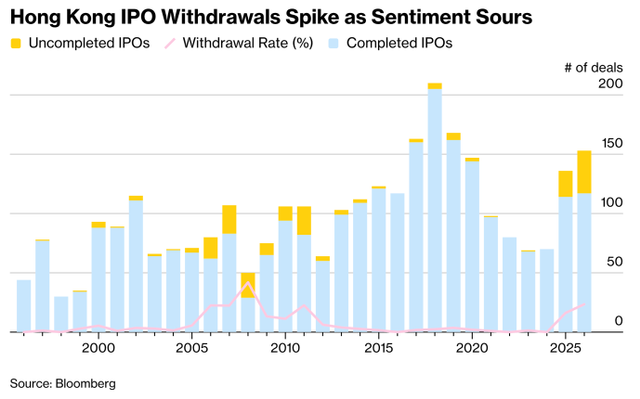
Last-minute withdrawals after order books close have also dampened retail interest, with retail IPO subscription inquiries reportedly dropping by some 50% over the past two months.
The reason could be a brutal secondary market reality check.
More than 60% of Q3 new listings in HK fell below their offering prices as of September 30. Out of nine mega-IPOs exceeding $1 billion in the first nine months, six crashed below their issue prices.
As a striking example, shares in Temasek– and Qatar Investment Authority-backed energy-drink maker Eastroc Beverage have plummeted nearly 60% from issue price since its debut in early February.
Cornerstone investors – the institutional capital that typically receives guaranteed IPO allocations in exchange for holding shares for six months – are demanding deep discounts or walking away from deals entirely.
Even the listings that proceeded recently showed signs of strain: In the city’s 10th billion-dollar IPO of the year, JPMorgan– and Alibaba-backed Suzhou Dongshan Precision Manufacturing, the world’s second-largest supplier of flexible printed circuit boards used in smartphones, downsized its October listing to less than half of what it had targeted.
It is not just cautious investors slamming the brakes. Regulatory screws are tightening from both sides, adding bureaucratic frost to an already slowing market.
On October 13, the Securities and Futures Commission unveiled one of Hong Kong’s most sweeping crackdowns in history on alleged “IPO-rigging syndicates,” warning banks against arrangements that artificially inflate listing demand and outlining red flags when it comes to share sales.
Meanwhile, regulatory clearance from the China Securities Regulatory Commission remains a key hurdle. As of November 4, at least 14 mainland Chinese companies, including 12 existing A-share issuers such as Unisplendour, Three Squirrels and Zhejiang Zhongjian Technology, ditched Hong Kong share sale plans early – the most in at least a decade.
Further, the securities regulator is reportedly tightening scrutiny of spinoff listings to discourage publicly traded parents from carving out crown-jewel units. GoerTek and Yantai Dongcheng Pharmaceutical shelved spinoff listing plans in HK, while pipeline deals like Baidu’s chip unit Kunlunxin await clearance.
Yet HK’s IPO market isn’t suffering in isolation. Globally, geopolitical uncertainty, rising tech financing costs, and the Democrats’ victory in the US midterm elections are forcing the same AI and tech darlings that fueled the IPO boom to face uncomfortable questions about whether their valuations were built on real earnings or fairy dust.
US overconcentration, soaring borrowing costs, and a sector-wide valuation pullback hammered AI infrastructure plays. Nvidia-backed Firmus Technologies abandoned a $43.7-billion IPO in Australia. Blackstone-backed AirTrunk postponed a $1.5 billion REIT listing in Singapore. SoftBank-backed SB Energy and Fidelity-backed Oura both delayed their Nasdaq listings.
While industry participants and auditing firms like Deloitte maintain a full-year IPO fundraising target of $61.2 billion for Hong Kong, the verdict for the remaining 2026 is clear: Whether in Hong Kong or on Wall Street, the era of blank-check enthusiasm for anything stamped “AI” or “tech” is over. Institutional buyers are enforcing stricter valuation discipline – and until pricing gets realistic, the listing reality will remain grim.
When the PE fund manager becomes the investment
With just over a month left in the year, an interesting development is taking shape in India’s private equity and venture capital industry. Investment firms that sought their returns from publicly listing their portfolios are now turning to the stock market themselves.
For retail investors, it opens up a different path into alternatives. Instead of committing large sums to private blind pool funds, they can buy shares in the companies that manage those funds on the open market.
For the managers, a listing brings greater visibility, a public valuation and the ability to offer shares to employees. But it also puts their governance and financial performance under greater public scrutiny.
EAAA India Alternatives is the latest to have made its stock market debut after completing a Rs 1,200 crore IPO. The issue, which was entirely an offer for sale (OFS) by its promoter entity, was subscribed 5.25 times. Its shares opened at a small premium to the issue price of Rs 1,665.
Earlier in August, Gaja Capital became the first pure-play alternative asset manager in India to list. Its Rs 550 crore IPO was subscribed more than 31 times, and the stock made a strong debut.
To be sure, this has been done elsewhere as part of the industry’s natural progression: Blackstone listed in 2007, followed by KKR in 2010, Apollo in 2011, and Ares in 2014.
However, a fund manager is not the same as the companies it backs.
Take EAAA for instance. It manages funds across real assets and private credit. Its business depends on raising money from investors, deploying it, earning management fees, and generating returns that can translate into performance-linked income.
This makes its earnings different from those of a conventional business. Management fees can provide a steady income stream, but performance fees depend on how investments perform and when exits happen. A large AUM number also does not necessarily mean all that money is deployed or generating fees.
This is where retail investors will need to look beyond headline AUM and growth projections, and assess the quality of fee-paying assets, the ability to raise new funds, investment performance and the consistency of earnings.
The question is whether public valuations can keep pace with the longer investment cycles and uneven returns that are part of the private markets business. And the real test will be whether these businesses can deliver consistent growth and returns to shareholders, not just their fund investors.
Top PE Developments
Deals
Germany’s Messer Group has emerged as the frontrunner to acquire CVC Capital Partners’ stake in Indonesia’s Samator Indo Gas.
A consortium led by China’s listed Tianjin Jiuri New Materials will acquire Dutch IGM Resins from pan-European PE firm Astorg for about $278.6 million.
Fundraising
IFC could invest up to $90 million in Navis Capital Partners’ ninth buyout fund.
Ardian has raised some 1 billion euros for a dedicated semiconductor PE platform targeting investments in Europe, North America and Asia.
Abu Dhabi Investment Authority is reportedly seeking $7.5 billion in bank financing to fund its private equity, infrastructure, and real estate investments, amid efforts to diversify its portfolio.
Tieups
Manulife Investment Management and UBS’s Unified Global Alternatives business have partnered to develop a customised Japan PE programme.
Carlyle is partnering with SEI Investments to launch a private market fund targeting wealth investors that will span diverse strategies.