
 |
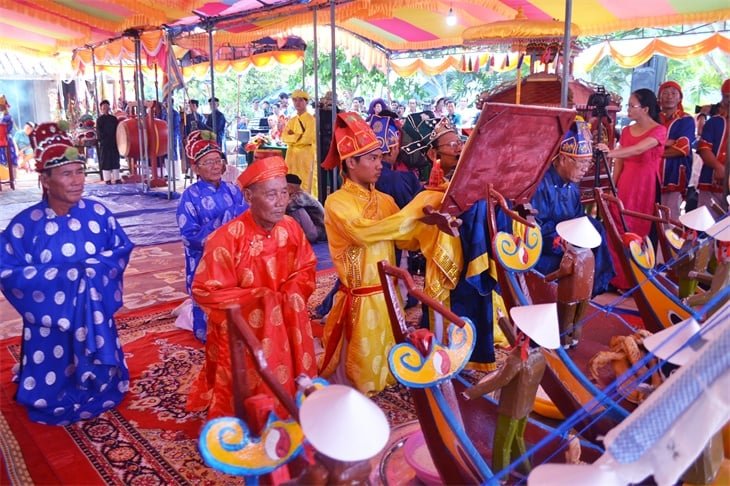
| The ceremony honoring the soldiers of Hoang Sa, paying tribute to the merits of the ancestors who opened up the land and the soldiers of Hoang Sa and Bac Hai, is one of the cultural highlights of the Ly Son Special Economic Zone (Photo: Huu Danh). |
Making a significant contribution to economic efficiency.
Resolution No. 20-NQ/TW dated July 28, 2026, of the 14th Central Committee of the Communist Party of Vietnam on building and developing Vietnam into a strong maritime nation opens up a new vision for the sea: not only as a space for resources, economy, or national defense and security, but also as a space for the survival, culture, and development of the nation. Within this vision, building a rich maritime culture, preserving and promoting the heritage of islands and seas, and improving the lives of coastal communities are of particular significance.
A beautiful beach might attract tourists once, but it’s the story of the land, its people, its cuisine , its festivals, its memories, and its identity that truly makes them stay longer, spend more, and want to return. Therefore, building upon its rich marine cultural resources, Khanh Hoa is gradually developing tourism in depth, viewing marine culture as a soft infrastructure guiding planning, product development, and spatial organization. One approach that could create a breakthrough in preserving and promoting the value of marine culture in conjunction with tourism development is the creation of a digital “Khanh Hoa Marine Culture Map”; preserving “living cultural spaces”—where heritage is formed, preserved, transmitted, and continues to be present in community life. The formation of Khánh Hòa’s coastal cultural corridors, such as the “Memories of the Coastal Village” route and the “Grape Aroma – Salt Flavor – Pottery Colors” route, has led to Khánh Hòa welcoming approximately 12 million visitors in the first six months of 2026, an increase of over 40% compared to the same period; international visitors reached over 4.6 million, and tourism revenue was estimated at around 42,500 billion VND.
Meanwhile, in the Ly Son Special Economic Zone (Quang Ngai province), closely associated with the Sa Huynh culture with a history of approximately 3,000 years, it bears the strong imprint of the nation’s maritime sovereignty with typical relics such as: Am Linh Temple, the tombs of Hoang Sa soldiers, and the Khao Le The Linh Hoang Sa ceremony – unique cultural heritage reflecting the tradition of protecting maritime sovereignty through many generations. Religious structures and folk festivals such as Hang Pagoda, the Tu Linh boat racing festival, and Tan Mausoleum dedicated to the Whale God have contributed to creating a distinct maritime cultural identity. With its system of relics possessing special cultural, historical, and architectural value, it has become a destination attracting many tourists to visit and experience. By 2030, Ly Son is expected to welcome approximately 400,000 tourists, including 10,000 international visitors; total tourism revenue is expected to reach about 900 billion VND; and the tourism and service sector will contribute about 60% of the special economic zone’s GRDP.
However, sharing from a local perspective, Mr. Le Quoc Viet, Vice Chairman of the Da Nang Tourism Association, said that most coastal villages still lack truly unique models to attract tourists for extended stays. Many places only focus on exploiting the landscape or short-term experiences, while community-based tourism products based on cultural experiences lack depth and linkages, and the people have not yet truly benefited stably from tourism activities. Many southern coastal areas are often affected by monsoons and prolonged rough seas. Therefore, relying solely on swimming or relaxation will make it difficult to achieve stable year-round development.
Meanwhile, Mr. Pham Anh Viet, Director of the Man Thai – Tho Quang Community Tourism Cooperative, believes that the biggest challenge currently is preserving the culture and spirit of the fishing village amidst the rapid urbanization of the coastal region. He argues that the key to community tourism is ensuring that local people remain involved in all tourism activities, rather than being excluded from the development process. When local residents participate in providing services, sharing stories of maritime culture, and preserving the traditional way of life of the fishing village, the destination can create its own unique identity.
To ensure the sustainability of maritime culture, it is necessary to expand products associated with traditional crafts, lagoon-river-bay ecosystems, marine sports , and cultural experiences, creating a chain of services that operate year-round, Mr. Le Quoc Viet emphasized.
Building a distinctive and competitive brand.
|
The future competitive landscape of coastal tourism will depend more on the ability to create distinctive experiences, linked to local identity and the sustainability of the destination. Local communities must become an integral part of the destination. When people participate in preserving the environment and culture and benefit from tourism, coastal villages can develop brands that are strong enough to compete sustainably. Mr. Nguyen Trung Khanh, Director General of the Vietnam National Tourism Administration. |
If properly developed, based on the local culture, natural ecosystem, and genuine community participation, coastal localities will not only expand their tourism products but also have the opportunity to form a marine and island tourism space with depth and unique identity within the national tourism development strategy.
To address practical shortcomings, an expert suggests a comprehensive inventory, identification, and digitization of Vietnam’s marine cultural resources, encompassing cultural landscapes, folk knowledge, traditional crafts, festivals, and community memories and history. A digital map of Vietnam’s marine culture could be developed, connecting it with data on heritage, tourism, the environment, and marine spatial planning. This would serve both conservation and support research, education , product creation, and tourism promotion. Furthermore, a regional marine cultural-tourism value chain and corridor should be established. This approach would also allow localities to complement each other’s strengths, extend the length of stay, and expand the market for cultural and creative products related to the sea.
Simultaneously, a clear benefit-sharing mechanism needs to be established, creating conditions for multiple stakeholders to participate. A portion of revenue from heritage exploitation and cultural tourism should be reinvested in conservation, the environment, cultural institutions, and community livelihoods; while encouraging businesses, cultural funds, social organizations, creative communities, and public-private partnerships to develop marine cultural products.
Maritime culture only truly comes alive when it is continuously created, enriched, and transmitted by today’s community through methods that are compelling to contemporary society, this expert asserted.
Source: https://thoibaonganhang.vn/xem-trong-tai-nguyen-mem-cua-kinh-te-bien-186317.html