
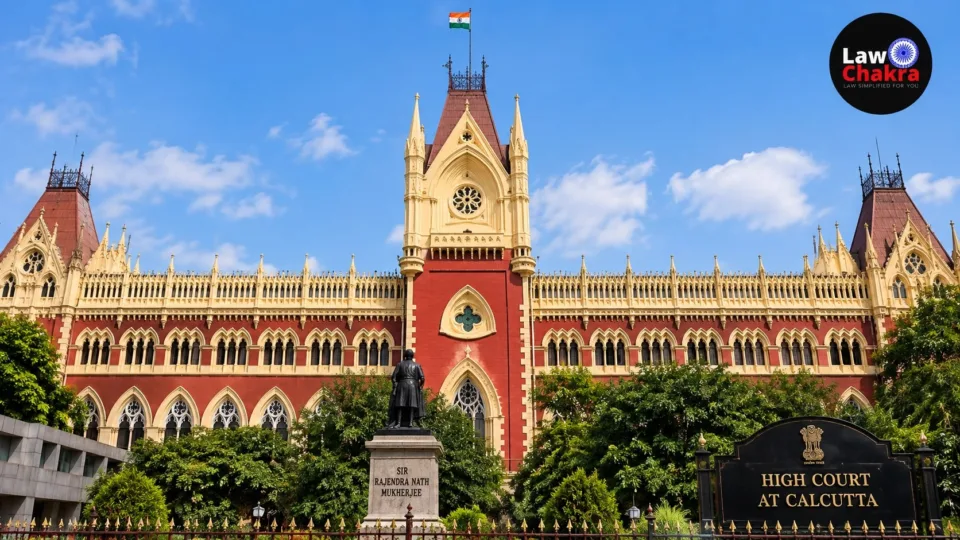
A Bench that first asked how a writ could let people “barge into private property” has still allowed Chhath Puja on private property at a riverbank estate in Bally, Howrah, capping the gathering at 3,500 devotees under strict police supervision.

Kolkata: The Calcutta High Court on Friday, November 13, 2026, allowed devotees to offer Chhath Puja prayers on private property belonging to the Shib Krishna Debutter estate at Rashbari ghat on the bank of the Ganga in Bally, Howrah, subject to a cap of 3,500 devotees and close monitoring by the police and volunteers [Kanchan Dubey and Others v. The State of West Bengal and Others].
The directions came from a Division Bench of Chief Justice Ravindra Vithalrao Ghuge and Justice Om Narayan Rai, in a public interest litigation filed by a group of women.
Conditions set for the worship
Weighing the competing concerns, the Bench attached the following conditions:
- No more than 3,500 devotees may worship at the property, with numbers tracked through metal detectors and CCTV cameras monitored by the police.
- No temporary structures other than changing rooms may be put up on the riverbank.
- Loud music and DJ processions are barred.
- No vehicles may enter or exit beyond a specified point.
Names and phone numbers of several volunteers from among the worshippers were also recorded by the Court. They have been made responsible for managing and restraining the crowd and for preventing any untoward incident, in coordination with the police.
Why the women approached the Court
The petitioners wanted to celebrate Chhath Puja for a few thousand devotees on the estate’s riverbank property. They said the High Court had, on several occasions over the years, allowed their community to perform its rituals there.
Their counsel told the Court that the rituals would be completed within 19 hours. He placed on record a list of ghats in the locality and submitted that every ghat other than the one on the estate was in such poor condition that a crowd of devotees there would inevitably lead to casualties.
A reluctant start from the Bench
At the outset the Bench was unwilling to permit a gathering on private land. It floated another route: the State Government could acquire the property, pay compensation to the estate and then allow devotees the right of worship. During the hearing, the Court orally asked:
“How can we pass a writ of mandamus allowing people to barge into private property?”
The State’s assurance and the estate’s objection
Additional Advocate General Billwadal Bhattacharyya, for the State, assured the Court that the Government would take appropriate steps to monitor the crowd. He asked that devotees be given a final chance to worship at the site this year, as policies to regulate such worship were already being framed.
Counsel for the Shib Krishna Debutter estate strongly opposed the request. The pathway to the riverbank, he submitted, was extremely narrow and the embankments were more than a century old, so a stampede was a real risk.
Ritual claim, property right and safety
Festival seasons often force courts to reconcile two claims: a community’s right to practise its rituals and an owner’s right to control access to private property. The Bench’s own question on whether a writ of mandamus can let people enter private land shows that such relief is not automatic, and its suggestion of acquisition with compensation points to the lawful route if public worship at the site is to continue in future years.
For this year, though, public safety was the deciding factor. With the other ghats said to be unsafe and the estate warning of a stampede on a narrow path, the Bench chose a capped, closely monitored gathering backed by the State’s assurance and named volunteers, while the State says rules to regulate such worship are being framed.
Case Title: Kanchan Dubey and Others v. The State of West Bengal and Others
Bench: Chief Justice Ravindra Vithalrao Ghuge and Justice Om Narayan Rai, Calcutta High Court
Date of Order: November 13, 2026
For the State: Additional Advocate General Billwadal Bhattacharyya