
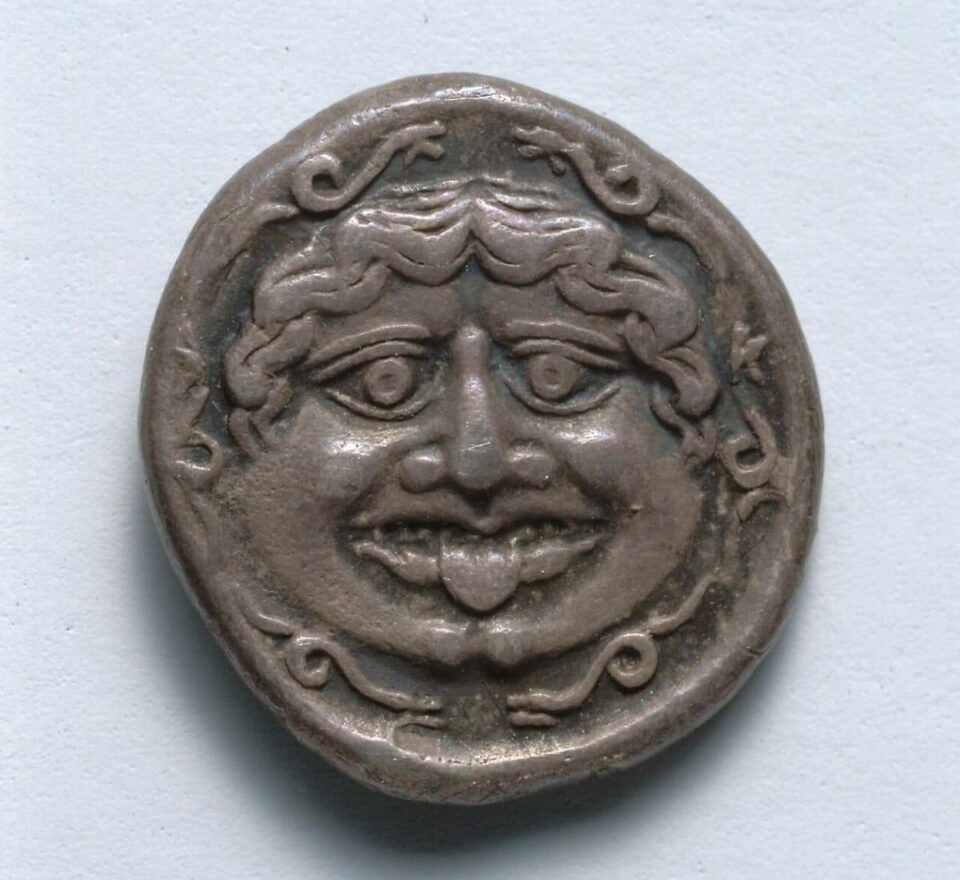

Ancient Greek burial hoards discovered in Romania have revealed rare silver coins bearing images of Gorgons, mythical creatures from Greek mythology. A new study examines two collections of coins dating to the fifth century BC, offering fresh evidence of ancient trade connections and burial customs along the western Black Sea coast.
The coins were found at ancient Tomis, a Greek settlement in what is now Constanța, Romania. The collections contain eight silver coins from the Greek city of Parion and four from the Persian Achaemenid Empire. The research, led by Gabriel Mircea Talmațchi of the Museum of National History and Archaeology in Constanța, examines how these coins reached Tomis and why ancient communities placed them in graves.
The findings also shed light on the commercial networks linking ancient Greek colonies in the Black Sea with settlements across the Mediterranean and Asia Minor.
Ancient Greek coins feature images of Gorgons
Eight of the silver coins originated in Parion (Greek: Πάριον), an ancient Greek city in present-day northwestern Turkey. The city served as an important trading center connecting the Black Sea region with the wider Greek world. The coins, known as drachmas, feature the face of a Gorgon, a frightening creature from Greek mythology. Each image shows a Gorgon with an open mouth, a protruding tongue, and hair resembling snakes. The opposite side carries a square impression with an irregular pattern.
In ancient Greece, the image of Medusa and other Gorgons often served as a protective symbol believed to ward off evil. The coins weigh approximately 3.1 to 3.3 grams each. Several show considerable wear, suggesting they circulated before being placed in graves.
Researchers date this type of coin to around 500 BC, although scholars have proposed different dates for some examples. Their presence at Tomis provides evidence that coins from Parion traveled farther north than previously recognized, extending the known reach of the city’s monetary connections.
Rare Persian silver coins found in burial hoard
The second collection contains four silver coins known as “sigloi,” issued by the Persian Achaemenid Empire. These coins depict a Persian king or heroic figure holding a spear and bow. The figure wears traditional Persian clothing and appears in a running or kneeling position. The coins likely originated at the royal mint in Sardis, in present-day Turkey, between approximately 480 and 420 BC.
Rare silver coins bearing frightening Gorgon faces have been identified in ancient Greek burial hoards in Romania.
Dating back 2,500 years, the coins reveal clues about ancient trade networks and burial rituals along the Black Sea. pic.twitter.com/lp3vjIq6zb
— Tom Marvolo Riddle (@tom_riddle2025) November 11, 2026
According to the study, Persian silver coins of this type are particularly rare in the western Black Sea region. Only one other similar specimen had previously been documented at Tomis. The discovery also reflects the wider movement of silver coins through ancient trade and military networks.
Talmațchi suggests the coins may have settled with merchants, mercenaries, or military activity. Another possibility involves objects acquired during conflicts between Persian and Scythian forces. However, their exact route to Tomis remains uncertain.
Ancient burial rituals reveal the importance of coins
The coins came to light during construction work between 1959 and 1961, when authorities demolished Constanța’s old railway station and developed nearby residential buildings. The work disturbed an ancient Greek burial ground. Many artifacts, including coins, pottery and jewelry, entered private collections before archaeologists could properly document them. This loss of archaeological context makes it difficult to establish precisely how the coins were arranged inside the graves.
Nevertheless, the study suggests the burial deposits may date to the second half of the fifth century BC. Coins held religious importance in ancient Greek funeral customs. Some were placed in graves as offerings associated with the journey to the afterlife. One practice involved the “obol of Charon,” a coin intended as payment to the mythical ferryman who carried the dead into the underworld.
The researcher also suggests that the silver deposits may have belonged to prosperous families, possibly involved in trade. Although their original discovery lacked proper archaeological documentation, the coins provide valuable evidence of Tomis’ early economic connections and the burial traditions of its Greek inhabitants.