
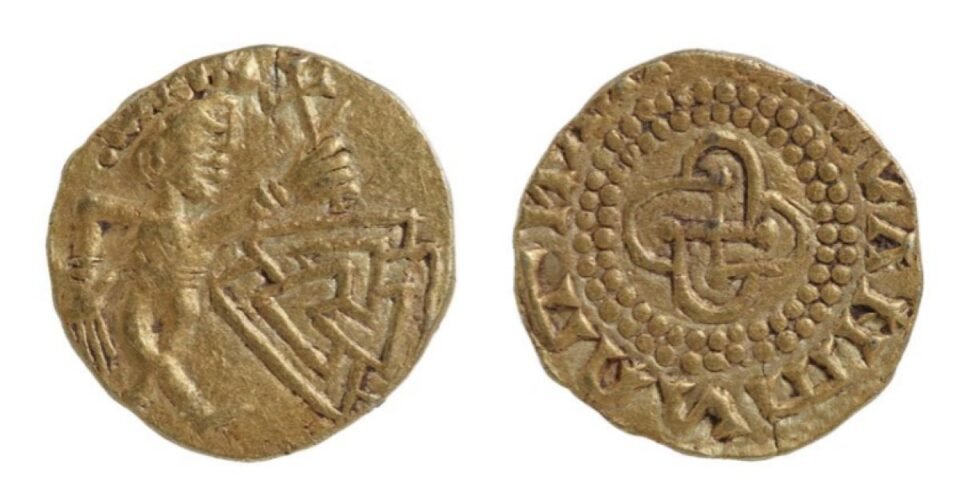
The object was found at an undisclosed location and reported the Norfolk coroner to adjudicate whether it be declared treasure.
But at a remarkable hearing, a disagreement saw one expert suggest it could be a potentially unique discovery while two others questioned if it was even genuine.

The unusual proceedings attracted a packed courtroom at Norfolk County Hall, where metal detectorist Ray Jenkins was joined by friends and family to hear the fate of his discovery.
Even staff at County Hall had filled the public gallery, drawn by a fascinating archaeological mystery which was about to expose a fundamental disagreement between experts.
On one side was Dr Adrian Marsden, a specialist in historic coins, who insisted the gold coin, known as a thrymsa, was genuine.

On the other were Dr John Naylor, National Finds Adviser for the Portable Antiquities Scheme at the Ashmolean Museum, University of Oxford, and Dr Wendy Scott, a curator at Norwich Castle Museum, who both challenged its authenticity.
Dr Marsden attended the hearing in person alongside the finder, while Dr Naylor and Dr Scott gave their evidence by live video link.
At the centre of the dispute was a coin believed to date from around AD 625, the period of the famous Sutton Hoo burial, but featuring designs which experts said were unlike those ordinarily associated with the period.

For Dr Marsden, that was precisely what made the discovery so exciting.
He argued that experts needed to recognise the significance of the Norfolk findspot, drawing comparisons with Rendlesham in Suffolk, an important Anglo-Saxon royal settlement.
His frustration centred on what he regarded as a circular argument: that an object potentially representing the first known example of its type was being doubted precisely because no other examples existed.
If every previously unknown object was dismissed because it differed from established examples, his argument suggested, how could archaeology ever recognise something genuinely new?

But the two opposing experts raised detailed concerns about the coin’s imagery, questioning whether its artistic features were consistent with the period in which it was supposedly made.
The court heard that some symbols appeared more closely associated with Scandinavian art from the ninth or tenth centuries – potentially several hundred years later than the coin’s proposed date.
The vast majority of comparable artistic evidence came from Sweden and Denmark, with similar designs also appearing on Danish coins.
For Dr Naylor and Dr Scott, the apparent chronological mismatch raised serious questions about whether the coin could be authentic.
Particular attention was paid to the depiction of a human figure holding a cross.

The court heard that figures of this type were generally shown wearing longer tunics, whereas the figure on the Norfolk coin appeared to have bent, exposed legs.
The way the figure held the cross also came under scrutiny.
Rather than simply touching it, as was more commonly seen in comparable imagery, the figure appeared to be grasping it tightly.
Even the positioning of the fingers became the subject of expert examination, with questions raised about their shape, their apparent extension behind the cross and the relationship between the hand and the religious symbol.
The reverse of the coin also presented difficulties.
However, the court heard that some elements supported its possible authenticity, including letter forms which were not dissimilar to those found on comparable early medieval coins.
The competing interpretations left the court confronting an intriguing archaeological dilemma.
Were the unusual details evidence that the coin could not have been made in the seventh century, or were they the very characteristics which made it an extraordinary discovery?

For Dr Marsden, the archaeological importance of the site was central to that question.
He maintained that the findspot had the potential to produce exceptional material, and that the absence of an exact parallel should not automatically count against authenticity.
But Dr Naylor and Dr Scott remained unconvinced, pointing to features they considered inconsistent with established examples of early Anglo-Saxon coinage.
There is no doubt that the find itself is genuine. The dispute is whether it dates back as far as suggested or was a later replica or fake.
The disagreement transformed what might otherwise have been a routine treasure inquest into a detailed debate about the limits of archaeological knowledge.
Treasure inquests generally consider the age, composition and circumstances of discovery of objects to establish whether they meet the legal definition of treasure.
But in this case, before the coroner could reach a determination, she had to weigh conflicting evidence about whether the object was genuinely an early medieval coin at all.
The hearing, held before Area Coroner Johanna Thompson, came following changes to treasure legislation which broadened the definition to include certain objects of exceptional historical, archaeological or cultural significance.
After hearing the evidence, Ms Thompson declined to make an immediate ruling.
Acknowledging the amount of material presented, she said she would need time to carefully consider the competing arguments before reaching a conclusion.
“Obviously there is a lot of material to be considered,” she said.
“I’m not going to make a final determination today. I am going to have to carefully consider the evidence submitted today to make a clear conclusion which I will give in writing.
“I do not want to rush this.”
The coroner described the object as potentially exceptional and stressed the importance of reaching a considered decision, particularly in light of changes to treasure legislation.
Her written determination will establish the legal status of the disputed discovery.
For Mr Jenkins, who sat in the courtroom surrounded by friends and family, the wait for an answer continues.
And for the experts, the fundamental disagreement remains unresolved.
Is the Norfolk coin an extraordinary piece of Anglo-Saxon history? Or a fake.