
A Korean research team has developed a water electrolysis catalyst that achieves hydrogen production performance comparable to a commercial platinum catalyst while using only one-quarter as much precious metal. The study, led by Professor Jinwoo Lee from the Korea Advanced Institute of Science and Technology (KAIST), introduces a novel “atom-layer neighbor” structure that groups three or four ruthenium atoms in a single atomic layer. This design allows the atoms to work cooperatively in the reaction, addressing a key limitation in conventional catalysts where isolated atoms or large clusters fail to maximize efficiency. The findings, published in Nature Communications, suggest a pathway to lowering the cost of green hydrogen production by reducing the reliance on expensive precious metals.
The motivation for this research stems from the economic and environmental challenges of producing green hydrogen. Water electrolysis uses electricity to split water into hydrogen and oxygen, a process that generates low-carbon hydrogen when powered by renewable energy sources such as solar and wind. However, the catalysts required for the hydrogen-producing reaction typically rely on precious metals, which are costly and scarce. This creates a significant barrier to scaling up green hydrogen production, necessitating technologies that can maintain high performance while drastically reducing the amount of precious metal used.
In conventional precious metal nanoparticle catalysts, many atoms are clustered together in large particles. A major inefficiency in this arrangement is that atoms buried inside the particles are largely unable to participate in the chemical reaction. Consequently, only a fraction of the precious metal is actively utilized, leading to wasted material and higher costs. To address this, researchers have previously explored single-atom catalysts, where individual metal atoms are dispersed across a support material. While this approach maximizes surface exposure, the isolated arrangement of single atoms can limit performance in reactions that require several atoms to work together simultaneously.
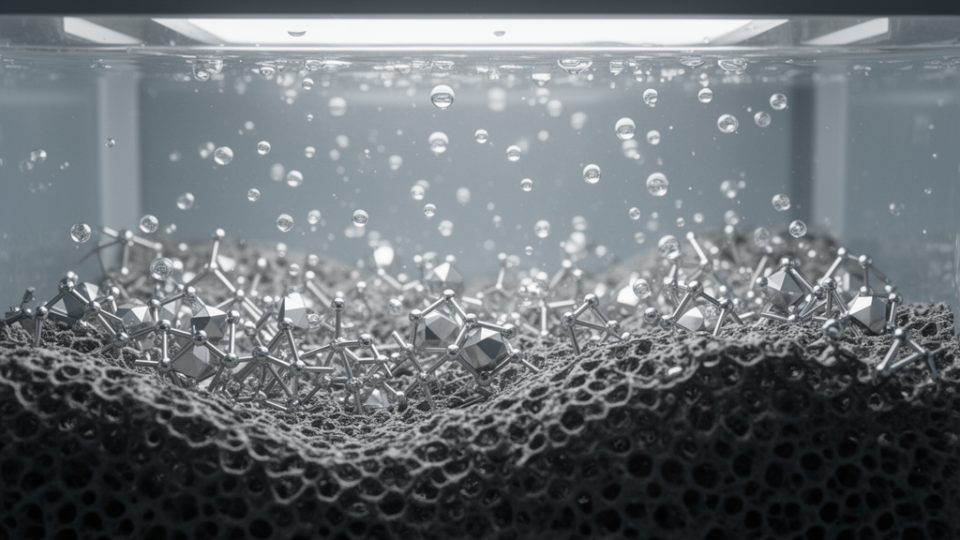
The KAIST team sought to bridge the gap between these two approaches by maximizing the use of each atom while enabling neighboring atoms to cooperate. They created “atom-layer neighbors,” which are small groups of ruthenium atoms arranged in a layer just one atom thick. This specific structure keeps the atoms close enough to facilitate cooperative interactions in the reaction without forming the large, inefficient particles seen in conventional catalysts. By maintaining this precise arrangement, the team aimed to ensure that every ruthenium atom contributes effectively to the catalytic process.
Maintaining the atom-layer neighbor structure requires a robust support material that holds the ruthenium atoms in place during synthesis and operation. During the initial stage of catalyst synthesis, the researchers used molecular interactions to prevent the atoms from aggregating into large particles. In subsequent heat treatment, strong metal-support interactions anchored the atoms to a tungsten carbide (WCₓ) support. The team also varied the number of atoms in each group to identify the most effective structure for hydrogen production, ultimately finding that groups of three or four atoms provided optimal performance.
Furthermore, the researchers optimized the local environment surrounding the active atoms to enhance reaction efficiency. They observed that hydroxyl species (OH) on the support surface strengthened the hydrogen-bond network among water molecules. This strengthening facilitated faster proton transfer, which is a critical step in the hydrogen production reaction. By controlling both the arrangement of the catalytically active ruthenium atoms and the interactions among surrounding water molecules, the team enabled the reaction to proceed more efficiently than in conventional systems.
The performance of the new catalyst was tested in an anion-exchange membrane water electrolyzer (AEMWE) cell. The catalyst achieved a current density of 9.82 amperes per square centimeter (A/cm²) at 2.0 volts (V) and 80°C. Current density measures the current flowing per unit of electrode area and serves as a key indicator of the rate of hydrogen production over that area. The results showed that the ruthenium-based catalyst delivered performance comparable to that of a commercial platinum catalyst, despite using 75% less precious metal.
In terms of catalytic activity per unit mass of precious metal, the new catalyst was approximately four times more efficient than the platinum catalyst used for comparison. This significant improvement in mass activity highlights the effectiveness of the atom-layer neighbor structure in utilizing the available metal atoms. The ability to achieve comparable performance with a fraction of the precious metal content has important implications for the economic viability of green hydrogen production, as it reduces the material costs associated with catalyst manufacturing.
The team also evaluated the durability of the catalyst during extended operation to ensure its practical viability. In a 500-hour continuous operation test, the performance loss of the ruthenium catalyst was about half that of the platinum catalyst used for comparison. This result demonstrates that the catalyst can maintain high performance and stability over extended operating times, which is crucial for industrial applications. The combination of high activity and improved durability suggests that the atom-layer neighbor structure offers a robust solution for long-term hydrogen production.
The research was conducted in collaboration with Professor Hyungjun Kim from the Department of Chemistry at KAIST, Professor Jang Yong Lee from Konkuk University, Dr. Joonhee Moon from the Korea Basic Science Institute (KBSI), and Dr. Sungjun Kim from the Korea Research Institute of Chemical Technology (KRICT). Research Professor Seongbeen Kim, along with researchers Hyunwoo Jun and Jihye Park of KAIST, and Dr. Sungjun Kim of KRICT, contributed as co-first authors of the study.
Professor Seongbeen Kim noted that the study brought small groups of precious metal atoms together and optimized the surrounding environment for water reactions, enabling efficient and sustained hydrogen production with a small amount of precious metal. He expressed hope that the findings will help reduce precious metal use in hydrogen production equipment and guide efforts to improve other catalysts.
The findings were published online in Nature Communications on September 22, 2026, in Volume 17, Article No. 11021. The paper, titled “Stabilizing ruthenium atom layer neighbors through molecular and metal support interactions for water electrolyzers,” provides a detailed account of the synthesis, characterization, and performance evaluation of the new catalyst. The research was supported by grants from the National Research Foundation of Korea (NRF) funded by the Ministry of Science and ICT (MSIT) and by the Basic Science Research Program of the Korea Basic Science Institute (KBSI). These findings could help reduce precious metal use in hydrogen production equipment and lower catalyst replacement and maintenance costs, potentially lowering the overall cost of green hydrogen production if validated at larger scales.
Subject of Research: Development of a ruthenium atom-layer neighbor catalyst for efficient and cost-effective green hydrogen production via water electrolysis.
Article Title: KAIST develops ruthenium catalyst that matches platinum in hydrogen production using one-quarter as much precious metal
Article References: KAIST develops ruthenium catalyst that matches platinum in hydrogen production using one-quarter as much precious metal. Original publication (Bibliographic details unavailable.)
Image Credits: AI Generated
DOI: Not provided
Keywords: ruthenium catalyst, green hydrogen, water electrolysis, atom-layer neighbor, precious metal reduction, KAIST research, platinum comparison, hydrogen production, tungsten carbide support, anion-exchange membrane, catalyst durability, Nature Communications, renewable energy, molecular interactions, proton transfer, cost-effective catalyst, single-atom catalyst, hydrogen bond network, electrolyzer performance, metal-support interaction