
THERE ARE NO RULES FOR BUILDING A SILVER COLLECTION, ONLY ENDLESS OPPORTUNITIES TO DISCOVER REMARKABLE OBJECTS AND THE PEOPLE WHO MADE AND OWNED THEM
By Karen Rigdon | November 17, 2026
What does collecting silver look like in 2026? We have emerged from an extraordinary century of mass silver ownership. For generations, sterling flatware, tea and coffee services, bowls, and trays were expected furnishings of American homes. As entertaining became increasingly informal, those expectations faded. Silver’s precious metal content has always been both its protection and its vulnerability. During years of falling favor, silver remained in the home, moving from dining rooms to closets, bank boxes, and increasingly to the marketplace. More recently, rising intrinsic value has accelerated the disappearance of much of that excess.
Across much of silver’s long history, ownership was selective, and collectors have always prized exceptional design, craftsmanship, authorship, and historical significance. Perhaps the 20th century’s extraordinary period of mass ownership may prove to have been the anomaly.
Today, collecting directions seem almost limitless, exciting! There is no prescribed period, style, or form that defines a collection. We can follow established traditions or explore areas that have received little scholarly attention. Perhaps the most interesting question is no longer what silver we are expected to own, but what objects inspire us to look more closely.
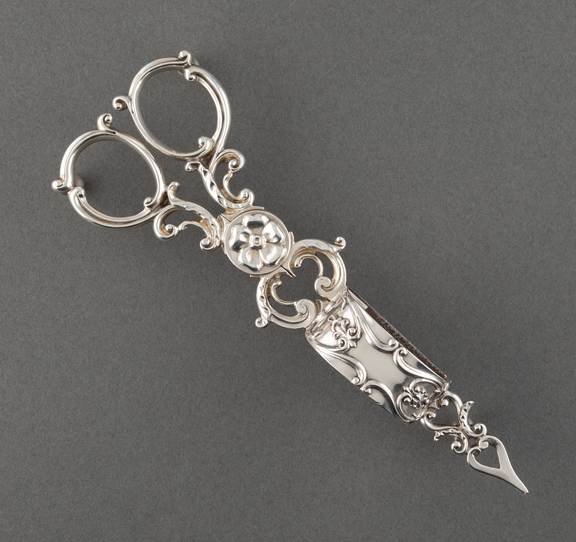
A Paul Storr silver candle snuff and wick trimmer, London, 1827. Available in Heritage’s November 18 Fine Silver & Objects of Vertu Signature® Auction.
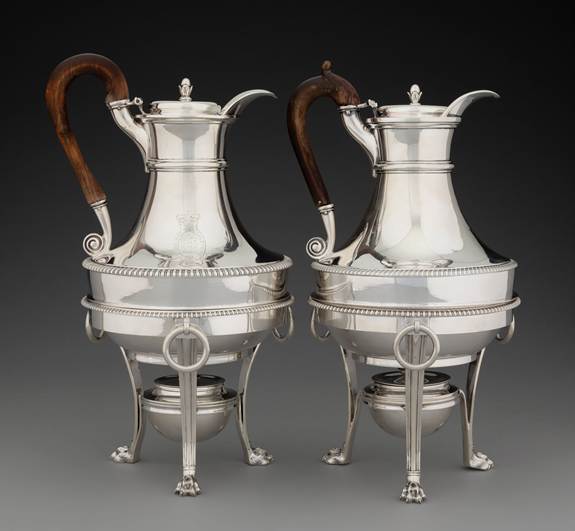
Two Paul Storr silver hot-water ewers on stands, London, 1802-1806. Available in Heritage’s November 18 Fine Silver & Objects of Vertu Signature® Auction.
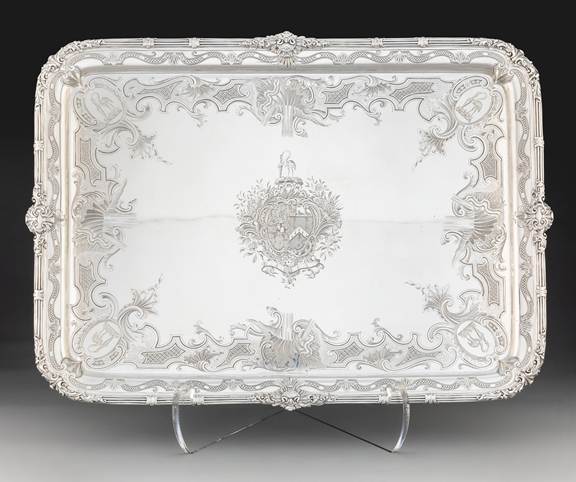
A Paul Storr silver serving tray, London, 1815. Sold for $32,500 in a November 2025 Heritage auction.
Follow a Maker — or Follow an Idea
Perhaps you are drawn to a particular silversmith or period. The celebrated English silversmith Paul Storr offers a wonderful starting point.
A small silver candle snuff and wick trimmer of 1827 invites us into the daily rituals of a prosperous Georgian household, when maintaining candlelight required specialized tools and considerable attention. A pair of elegant Paul Storr neoclassical hot-water ewers on stands, made between 1802 and 1806, offers another perspective on the sophisticated dining culture and artistic tastes of the period. Consider also a magnificent Storr serving tray of 1815, with elaborate engraved ornament and a central armorial achievement. Its heraldry preserves a record of the family for whom it was made.
One collector could look at the work of a single craftsman, another might become fascinated with the evolution of domestic lighting or the influence of neoclassicism on silver design, and another might pursue the identities, lineage, and alliances reflected in its engraved arms. A collection can follow a maker, a period, a form — or simply an idea that captures the imagination.
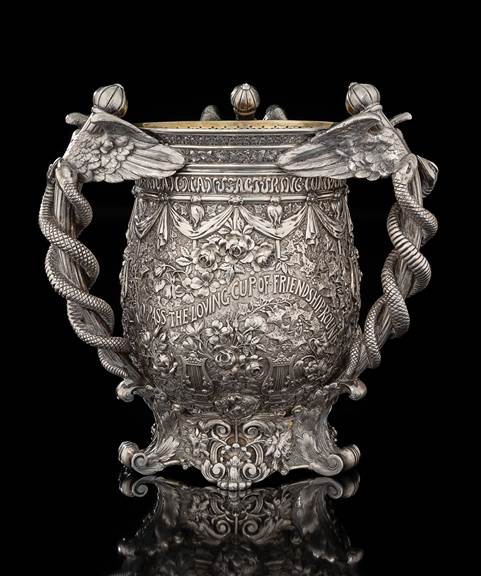
A Tiffany & Co. chased repoussé partial gilt silver three-handle presentation cup, New York, 1898. Sold for $37,500 in a May 2026 Heritage auction.
Holding a Moment in Time
Sometimes it is not the maker who first captures our imagination, but the person for whom an object was created or the occasion it commemorates.
Presentation silver offers the pleasure of holding a specific moment in history. An inscription can provide a name, a date, an event — a place to begin an investigation. Consider Tiffany & Co.’s magnificent three-handled presentation cup of 1898, created for David Nevins Jr. Its richly chased and repoussé decoration reflects the artistic ambition and exuberance of Gilded Age American silver. But beyond its design, the cup preserves the memory of a particular individual and occasion. Who was Nevins? Why was the cup presented? What did the event mean to those involved? Questions such as these can lead a collector into the social, political, and economic history of an era.
Armorial silver and presentation silver offer related but distinct opportunities. The engraved arms on a family tray may preserve identity and lineage; a presentation inscription records an occasion, an achievement, or an expression of gratitude. In both cases, silver becomes something more than an object of beauty. It becomes a historical document, inviting us to reconstruct the lives and circumstances of the people who owned it.
A Taste for Discovery
What does collecting silver look like in 2026? Let’s consider a few scenarios, starting with the 19th-century American table.
That period generated an extraordinary variety of specialized silver serving pieces, and the resulting collecting opportunities are endless. For example, as the transportation networks expanded, commercial ice became readily available. Fresh foods traveled greater distances, and imported delicacies reached a widening audience. Silversmiths responded with an astonishing assortment of imaginative implements.
There seemed to be a specialized utensil for nearly every dish on the table. Some were whimsical creations produced in small numbers, while others belonged to extensive flatware services. Macaroni servers, cake saws, nut scoops, sardine forks, ice scoops — the list is almost endless.
The plethora of new forms presented their own challenges to hostesses and guests, who scrambled to keep pace with the latest fashions in dining. With a specialized implement for every dish, the elaborate table became a test of social confidence. One can only imagine the embarrassment of selecting the wrong utensil — and the fear that such a breach of etiquette might be remembered long after the dinner itself. Heaven forbid a guest should reach for the ice cream hatchet to serve the roast beef!
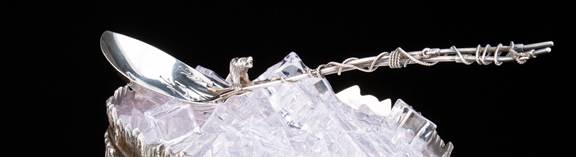
A detail view of a Gorham Mfg. Co. barrel-form silver ice bucket with spoon, Providence, Rhode Island, 1872. Sold for $23,750 in a May 2021 Heritage auction.
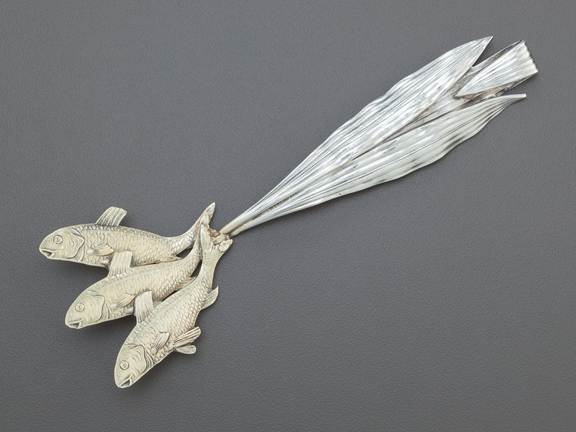
A Shiebler silver and silver gilt figural sardine fork, New York, circa 1880. Sold for $1,125 in a November 2013 Heritage auction.
These objects offer more than amusing glimpses of dining etiquette. Consider Gorham’s extraordinary 1872 scoop, transformed into an Arctic fantasy complete with a harpoon entwined with rope and a diminutive polar bear, that leads us toward the history of ice harvesting and distribution. Or George W. Shiebler’s circa 1880 sardine fork with three realistically modeled fish, which introduces the growing popularity of preserved foods and international trade. In Gorham’s Narragansett pattern, shells, seaweed, and marine life become integral to the serving pieces themselves, inviting an exploration of naturalism and the artistic imagination of 19th-century American silversmiths.
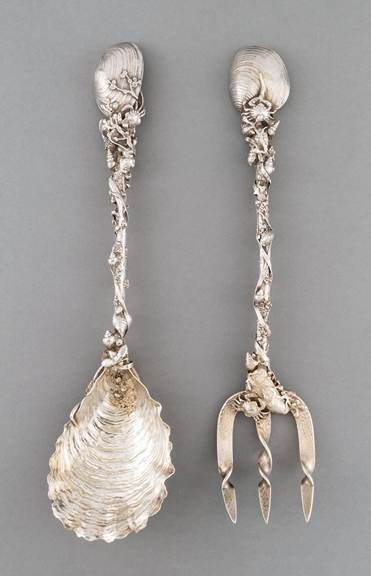
A two-piece Gorham ‘Narragansett’ pattern silver salad serving set, Providence, Rhode Island, designed 1878. Sold for $30,000 in an April 2018 Heritage auction.
Today, these objects need not be collected as part of complete flatware services. Each offers an independent opportunity to explore design, foodways, and social history.
And perhaps that’s another pleasure of collecting silver in 2026: We can admire the ingenuity of the 19th-century table without having to survive its etiquette.
Beyond the Manufacturer’s Mark: Studio Silver
We have a wealth of scholarship on early American silver, a growing understanding of 19th-century production, and an expanding appreciation of 20th-century design. Yet the American studio silversmiths of the postwar era offer considerable territory for exploration.
The great American silver manufacturers are familiar names, and scholarship has increasingly brought attention to the designers behind their 20th-century creations. But beyond industrial design lies a less familiar world of studio silversmiths, artists, and craftspeople whose work deserves closer examination.
John Prip offers a bridge between these worlds. In 1948, the fourth-generation silversmith, who trained in Denmark under master silversmith Evald Nielsen, began teaching at the School for American Craftsmen, which found its permanent home within the Rochester Institute of Technology in 1950. There Prip influenced another generation of metalsmiths and joined fellow metalsmith Ronald Hayes Pearson and other craftspeople in establishing Shop One, a cooperative devoted to exhibiting and selling handmade work.
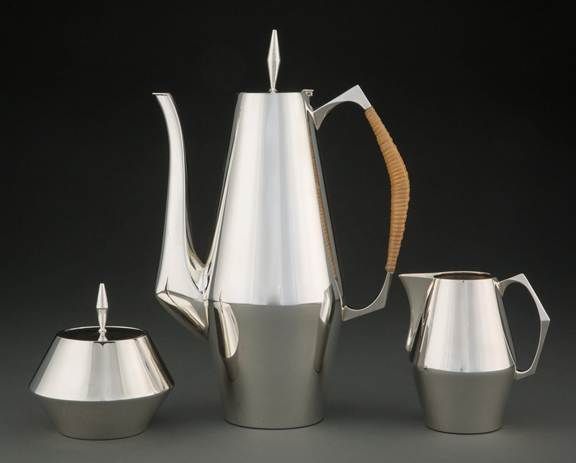
A three-piece Reed & Barton ‘Diamond’ pattern silver coffee set, Taunton, Massachusetts, 1957-1958. Sold for $1,250 in a November 2021 Heritage auction.
In 1957, Prip joined Reed & Barton as designer-craftsman in residence, bringing his Scandinavian training and studio experience to industrial production. His striking Diamond pattern coffee service complemented flatware originally designed by Gio Ponti.
Prip’s career illustrates the connections between independent studio practice and industrial production. Beyond his well-documented achievements lies a broader community of studio silversmiths whose work and relationships remain comparatively little explored.
For collectors, this opens another direction. Look beyond the manufacturer’s mark to discover the individuals, ideas, and artistic ambitions behind the objects. Some makers have long been known; others remain difficult to identify. There is still much to learn about 20th-century American silver — and considerable pleasure in making those discoveries.
Everything Goes
Collecting silver in 2026 need not follow a prescribed path. You might pursue a celebrated maker, explore a particular historical period, investigate a forgotten form, or acquire individual objects that simply fascinate you.
You might begin with a single serving piece and find yourself immersed in the history of 19th-century dining. A presentation cup might lead you toward the life of an individual whose name would otherwise be forgotten. A modern coffee service might introduce a designer whose contributions are only beginning to be understood.
The possibilities are endless.
I haven’t introduced these objects because I believe they are financial investments. They may prove to be, but that isn’t why we collect. I’ve introduced them because they offer places to begin. Follow an established path or venture into neglected territory. Make discoveries. Build knowledge alongside your collection. Allow the objects themselves to lead you toward questions you had never thought to ask.
Perhaps the most exciting collection is not the one someone has already told you how to build, but the one whose story is still waiting to be discovered.
