
Routine surveillance of fundamental metabolic nutrients such as glucose and cholesterol represents a cornerstone in managing cardiovascular risks and metabolic disorders, spurring continuous demand for portable, rapid, and cost-effective analytical protocols. Traditional clinical assays and laboratory methodologies frequently rely on enzymatic cascade architectures where glucose oxidase or cholesterol oxidase converts target substrates into hydrogen peroxide, followed by horseradish peroxidase catalysis to oxidize chromogenic reporters into visually distinct colored products. However, conventional enzyme systems suffer from intrinsic limitations, as natural proteinaceous catalysts exhibit limited long-term stability and constrained catalytic efficiency during low-energy-barrier processes like peroxide decomposition. To overcome these constraints, researchers led by Junlin Liu, Shaowei Chen, and colleagues developed a synthetic nanozyme platform comprising ruthenium-doped platinum-iron-nickel-copper-tungsten high-entropy alloy nanoparticles anchored onto multi-walled carbon nanotubes. This nanostructured material acts as an exceptionally robust signal transducer, providing superior peroxidase-like catalytic performance that enables sensitive, dual-mode fluorescence and smartphone-assisted visual quantification of both metabolites across diverse dietary items and clinical serum specimens.
The engineering of effective metal-based nanozymes has historically faced mechanistic trade-offs governed by Hammett linear scaling relationships, where single-metal or low-order alloy catalysts struggle to balance substrate activation and product desorption simultaneously. Platinum possesses an advantageous electronic configuration that yields notable peroxidase-like activity, yet monometallic platinum surfaces often bind reactive oxygen intermediates too tenaciously or fail to optimize the cooperative elementary steps of hydrogen peroxide adsorption, cleavage, and radical desorption. By contrast, high-entropy alloys incorporate five or more metallic elements within near-equiatomic solid-solution crystal lattices, harnessing the characteristic cocktail effect and multi-element synergy to overcome conventional scaling restrictions. High-entropy lattices introduce pronounced internal lattice distortion due to atomic size discrepancies, which simultaneously exposes dense active sites and tunes the electronic d-band center. Anchoring these multi-element metallic clusters onto conductive carbon nanotube networks further facilitates electron delocalization, suppresses elemental phase segregation, and provides an extended surface area that enhances both interfacial electron transfer and structural longevity during catalytic redox transformations.
Fabrication of the ruthenium-doped platinum-iron-nickel-copper-tungsten high-entropy alloy nanocomposite was accomplished through an organic-phase wet-chemistry protocol utilizing acetylacetonate precursors. Specifically, platinum(II), iron(III), nickel(II), copper(II), and ruthenium(III) acetylacetonate salts were combined with tungsten hexacarbonyl, multi-walled carbon nanotubes, and glucose within an oleylamine solvent matrix containing 1-hexadecyltrimethylammonium chloride. Following thorough mechanical grinding, the reaction mixture was heated to 220 degrees Celsius for two hours under continuous magnetic agitation. The resulting solid precipitates were isolated via centrifugation, washed iteratively with an ethanol and cyclohexane solvent mixture, and purified through ultrasonic dispersion in ethanol containing 0.5 moles per liter of acetic acid at 25 degrees Celsius, followed by warming at 45 degrees Celsius to remove residual organic capping ligands. Thorough structural characterization using bright-field and dark-field transmission electron microscopy revealed that the synthesized metallic nanoparticles possessed an average diameter of approximately 15 nanometers, uniformly distributed across the intertwined carbon nanotube scaffolding without apparent aggregation.
High-resolution electron microscopy, diffraction, and spectroscopic techniques corroborated the successful formation of a homogeneous face-centered cubic solid solution among the constituent elements. High-resolution transmission electron micrographs revealed clear crystalline lattice fringes with interplanar d-spacings of 0.215 and 0.182 nanometers, matching the (111) and (200) crystallographic facets of face-centered cubic high-entropy alloys, alongside matching Fast Fourier Transform patterns. Energy-dispersive X-ray spectroscopy under high-angle annular dark-field scanning transmission electron microscopy demonstrated uniform spatial distribution of ruthenium, platinum, iron, nickel, copper, and tungsten throughout each individual nanoparticle framework. Powder X-ray diffraction patterns displayed characteristic reflections at Bragg angles of 41.14, 47.80, 70.14, and 84.86 degrees, closely matching standard copper-platinum reference profiles. Furthermore, comprehensive X-ray photoelectron spectroscopy confirmed nearly equiatomic metal stoichiometry and revealed mixed valence states, including zero-valent and divalent iron, zero-valent and divalent nickel, zero-valent and monovalent copper, trivalent ruthenium, zero-valent and divalent platinum, and pentavalent and hexavalent tungsten species, which cooperatively optimize active-site charge transfer.
A critical challenge in developing colorimetric diagnostic transducers is achieving high peroxidase-like efficiency while rigorously suppressing undesirable intrinsic oxidase-like activity that generates background coloration in the absence of target analytes. Comparative screening across eight distinct alloy formulations confirmed that platinum serves as the core catalytic engine, as eliminating or halving platinum loading precipitously degraded catalytic output. Doping with moderate levels of ruthenium elevated peroxidase performance while markedly suppressing baseline oxidase activity; however, excessive ruthenium loading compromised efficacy through unfavorable d-band shifts and surface segregation that disrupted active platinum and iron centers. Tungsten proved indispensable for fine-tuning the electronic structure, whereas supplemental additions of cobalt or palladium provided no catalytic enhancement. Kinetic investigations based on steady-state Michaelis-Menten modeling revealed exceptionally low Michaelis constant values of 0.043 millimoles per liter for the chromogenic reporter o-phenylenediamine and 0.094 millimoles per liter for hydrogen peroxide, reflecting superior substrate affinity compared to conventional nanozymatic systems, bolstered by pi-pi interactions with the carbon nanotube framework.
Electron paramagnetic resonance spectroscopy elucidated the operative radical generation pathways driving the rapid oxidation of colorless o-phenylenediamine into yellow 2,3-diaminophenazine. Using 5,5-dimethyl-1-pyrroline N-oxide and 2,2,6,6-tetramethyl-4-piperidone as selective spin-trapping agents, researchers identified a distinctive four-line quartet with a 1:2:2:1 intensity ratio and a g-factor of 2.0059, unambiguously verifying the generation of hydroxyl radicals from hydrogen peroxide decomposition. In addition, characteristic electron spin resonance signals confirmed the simultaneous formation of singlet oxygen triplets and superoxide anion radical adducts, demonstrating that the high-entropy catalytic interface drives multi-pathway reactive oxygen generation. Systematic evaluation of reaction parameters indicated that the highest fluorescence response efficiency occurred at 25 degrees Celsius over a 30-minute incubation period utilizing 30 micrograms per milliliter of both nanozyme and chromogen. Operating at pH 7.2 retained near-peak catalytic turnover while ensuring complete physiological compatibility with the upstream natural enzymes glucose oxidase and cholesterol oxidase, which function optimally under neutral conditions.
When evaluated as an analytical transducer, the optimized nanozyme suspension generated a linear fluorometric response to hydrogen peroxide across the concentration span of 1 to 50 micromoles per liter, exhibiting a linear determination coefficient of 0.9958 and a limit of detection reaching 67.45 nanomoles per liter. Integrating the nanozyme with upstream natural oxidases established a coupled cascade detection mechanism: enzymatic oxidation of glucose or cholesterol generates stoichiometric quantities of hydrogen peroxide, which directly triggers the catalytic conversion of o-phenylenediamine into 2,3-diaminophenazine. Under optimized assay conditions, fluorescence emission at 570 nanometers followed strict linear relationships from 0.5 to 400 micrograms per milliliter for both metabolites. The corresponding limits of detection were calculated at 94.73 nanograms per milliliter for cholesterol and 88.70 nanograms per milliliter for glucose. Selectivity trials demonstrated that potential matrix interferents, including sucrose, urea, glycine, calcium chloride, and sodium chloride, produced negligible signal deviations even when introduced at tenfold concentration excesses, while the reconstituted catalyst maintained over 95 percent of its initial operational activity after five weeks of storage.
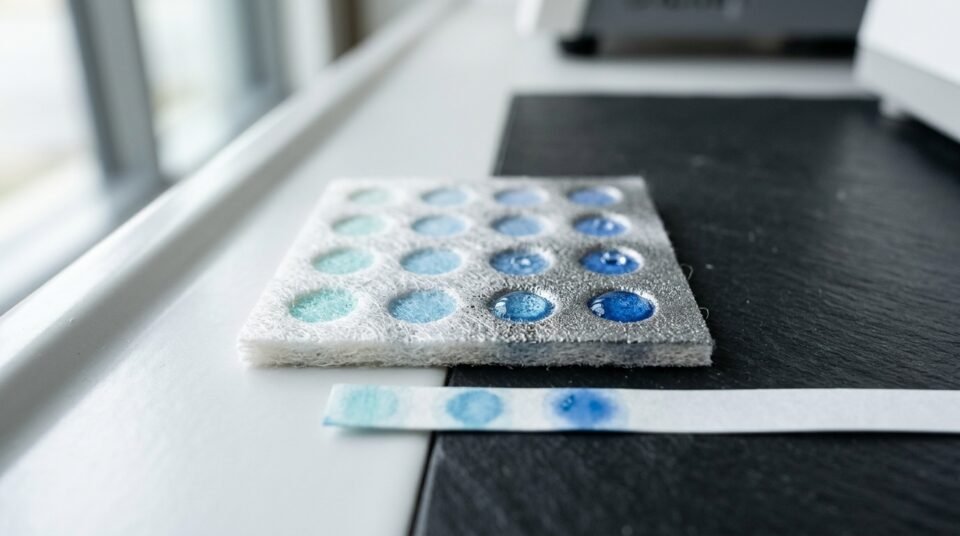
To transition the laboratory assay into a practical point-of-care analytical device, the investigators established a portable smartphone-assisted colorimetric inspection platform. The visual workflow utilized standard 96-well microtiter plates positioned inside a customized dark box equipped with mechanical positioning slots and a regulated 12-volt light-emitting diode strip to eliminate unpredictable ambient lighting fluctuations. Digital photographs were captured with a Xiaomi 9 SE smartphone operating under manual camera settings with fixed sensitivity at ISO 200, shutter speed at 1/100 second, and color temperature balanced to 5500 Kelvin. Using a mobile color-picking tool, red, green, and blue channel intensity values were extracted across uniform 30-pixel central regions within each well. The computed ratio of the combined red and green channels over the blue channel increased monotonically with analyte concentration, demonstrating robust linear quantification ranges of 1 to 50 micromoles per liter for peroxide, 1 to 400 micrograms per milliliter for cholesterol, and 0.5 to 400 micrograms per milliliter for glucose, accompanied by limits of detection of 474.75 nanomoles per liter, 606.03 nanograms per milliliter, and 535.81 nanograms per milliliter, respectively.
Practical utility was rigorously assessed by assaying actual commercial food products and human clinical serum samples, benchmarking experimental readouts against standard high-performance liquid chromatography-mass spectrometry and certified hospital clinical laboratory methods. Food processing protocols incorporated complete ethanolic potassium hydroxide saponification followed by n-hexane extraction for lipid-dense matrices such as cooked egg yolk and commercial cow milk, alongside homogenization and filtration for diverse fruits including kiwi, orange, watermelon, pineapple, grape, and strawberry. Across all culinary matrices, quantitative measurements obtained via fluorescence spectroscopy and smartphone-based colorimetry showed outstanding agreement with chromatography benchmarks, yielding Pearson correlation coefficients exceeding 0.993 for both cholesterol and glucose. Similarly, clinical analysis of serum specimens from healthy volunteers and diagnosed hypercholesterolemia or hyperglycemia patients confirmed high diagnostic fidelity, with statistical correlation coefficients exceeding 0.992 against automated hospital analyzers, confirming that endogenous proteins, lipids, and minor hemolysis did not distort analytical accuracy.
Despite its remarkable analytical sensitivity, repeatability within a five percent relative standard deviation, and operational portability, the authors noted specific engineering limitations inherent to smartphone-based imaging. All digital calibration curves in the current investigation were established using a single camera sensor hardware model, meaning that inter-device discrepancies in complementary metal-oxide-semiconductor sensor fabrication, spectral responsiveness, and proprietary internal image-processing software across differing mobile brands could affect color quantification. To ensure universal cross-platform reliability in decentralized healthcare settings or field-based food inspections, incorporating physical standardized color calibration cards into the visual field is recommended to eliminate hardware deviations dynamically. In conclusion, the ruthenium-doped platinum-iron-nickel-copper-tungsten high-entropy alloy nanozyme demonstrates how rational multi-element catalyst design can bypass conventional catalytic scaling barriers, presenting an exceptionally stable, highly sensitive signal transduction platform that bridges sophisticated materials chemistry with practical, on-site biochemical diagnostics.
Subject of Research: Point-of-care visual detection of cholesterol and glucose using high-entropy alloy nanozymes
Article Title: High-entropy alloy nanozymes as a robust signal generator for point-of-care visual detection of metabolites
Article References: Liu, J., Qi, M., Wang, L., Cai, B., Cui, T., Zhang, G., Kang, X., Liu, D., Zhang, Y., Qin, Y., & Chen, S. (2026). High-entropy alloy nanozymes as a robust signal generator for point-of-care visual detection of metabolites. Advanced Sensor and Energy Materials, 5(3), Article 100207. https://doi.org/10.1016/j.asems.2026.100207
Image Credits: AI Generated
DOI: 10.1016/j.asems.2026.100207
Keywords: High-Entropy Alloy, Nanozymes, Peroxidase-Like Activity, Point-of-Care Testing, Colorimetric Detection, Glucose Monitoring, Cholesterol Detection, Carbon Nanotubes, Enzyme Cascade, Smartphone Biosensing, Reactive Oxygen Species, Michaelis-Menten Kinetics, Food Quality Analysis, Clinical Serum Assay, Electron Paramagnetic Resonance, X-ray Photoelectron Spectroscopy