
-
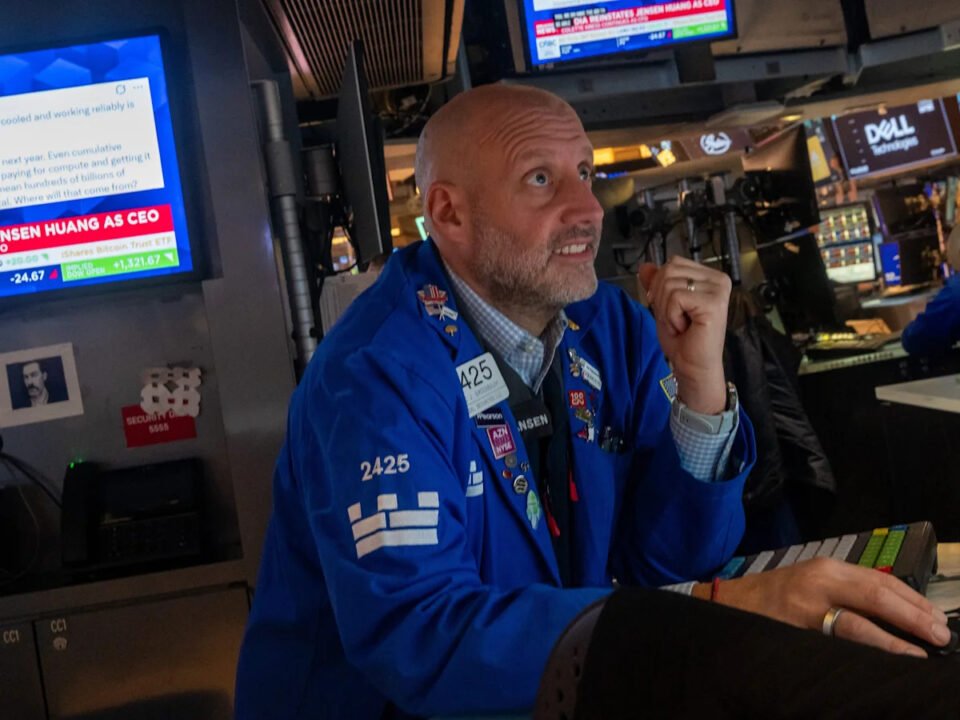
Hedge funds are cutting risk as market volatility rattles investors, Goldman Sachs says.
-
Meanwhile, ETFs and mutual funds drew $150 billion in inflows over the past month despite the sell-off.
-
Hedge funds may wait for stocks to recover before buying again, potentially fueling a rally.
Hedge funds have been cutting their exposure to stocks amid market volatility, while longer-term investors remain heavily invested, according to Goldman Sachs.
“I think there’s a lot of uncertainty and also fragile sentiment being expressed by our hedge fund clients,” Vincent Lin, the co-head of prime insights and analytics at Goldman Sachs, said in the bank’s “The Markets” podcast published Wednesday.
Goldman’s hedge fund clients cut exposure for five weeks before increasing ETF shorts by 19 percentage points last week, the third-largest weekly increase in a decade, Lin said.
By contrast, ETFs and mutual funds attracted a combined $150 billion in inflows over the preceding month, even as stocks declined, Lin said.
Lin described a divide between “fast money,” including hedge funds and momentum-driven traders, whose positioning is near historical lows, and “slow money,” such as retirement accounts and mutual funds, whose stock exposure remains relatively elevated.
The divergence comes amid renewed volatility in global markets as investors reassess AI valuations and the outlook for US interest rates.
Asian stocks rebounded Thursday after Wall Street recovered most of its steep intraday losses Wednesday. South Korea’s Kospi and Japan’s Nikkei 225 closed up 0.3% and 1%, respectively, while Taiwan’s Taiex ended 3% higher.
Lin said disappointing performance was the biggest factor behind hedge funds’ reluctance to take on more risk. Goldman’s hedge fund clients that bet on both rising and falling stocks saw their gains for the year shrink from about 17% at midyear to 7% as of Monday.
“Typically, when you are not making money, your risk appetite, in terms of deploying more capital has been reduced,” he said.
Lin also pointed to growing uncertainty surrounding AI investment returns.
“From a fundamental perspective, the AI narratives have clearly gotten more challenging. And I think most of the sentiment or conversation we’re having is that the best of the AI infrastructure returns is probably behind us,” he said.
With the year drawing to a close, Lin said hedge fund managers were more focused on preserving capital than chasing a rally.
But a market recovery could draw buyers back. Lin said fundamental hedge fund managers wanted to see prices stabilize, while Goldman’s models pointed to more buying from momentum-driven strategies if stocks steadied or rose.
“So, I think buyers live higher is what I would describe it,” he said.
If you enjoyed this story, be sure to follow Business Insider on Yahoo.