
Words by Devanshi Mody
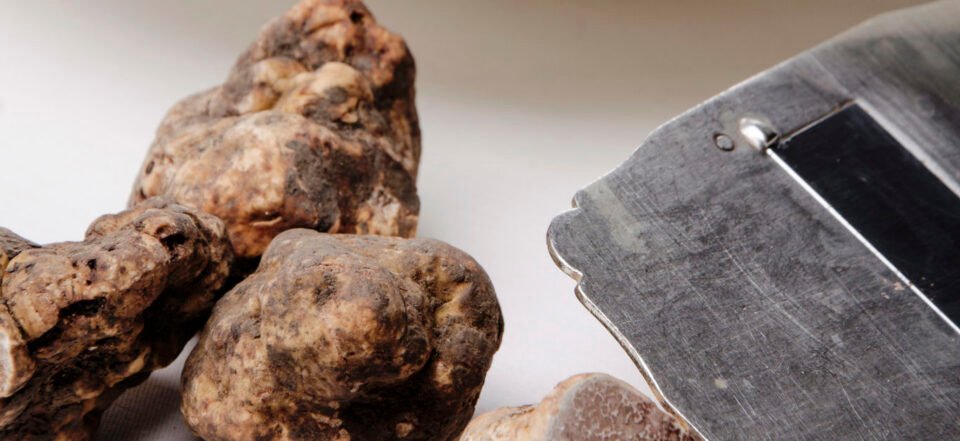
White gold, as the Alba white truffle is gastronomically called, is worth its weight in gold. What makes for its legendary notoriety? Associated with Imperial Rome, the Medici, the Vatican and today with international celebrities, this winter truffle is the ultimate luxury food. For it is the rarest food known to mankind: the uncultivable Alba truffle grows only around November to January in extremely rare conditions, and only in Piedmont.
The distinctive flavour and unique scent, which hold connoisseurs spellbound, generate annual frenzy over the white truffle season. So much so that this fancy fungus has turned Piedmont from one of Italy’s poorest parts to a luxury holiday haven as The Langhe, a UNESCO-protected region, has upgraded itself with top-notch hotels, gastronomic restaurants and world-renowned wineries. Certainly, Piedmontese wines seem to have eclipsed Tuscan wines.
However, as forests make way for luxury hotels and vineyards, the very truffle which lures tourists, is threatened, so I discover over a fortnight in The Langhe around the famous White Truffle Auction. The auction I have attended several times but, for the first time, I go on a truffle hunt during my sojourn at Casa di Langa, and it is here I learn about the darker side of the white truffle.
I am tarrying over one of The Langhe’s finest breakfasts (the hotel dispenses a superb Grana Padano to be tried with fabulous homemade breads) when I receive a sharp call. Other guests on the truffle hunt have assembled in the lobby. Why am I not on time? Eh, well, I thought the hotel operated on Standard Italian Time… I dash up outdoor steps overlooking the valley, glowing in brilliant autumnal colours, to the hotel lobby presiding over the incline. An American and Qatari couple await me patiently. This is the first time I am seeing Arabs in The Langhe and Casa di Langa is aswarm with Asians. The Queen of Truffles is now luring travellers from faraway exotic shores.

There was a time when I had the Langhe all to myself over the white truffle season. There was also a time when white truffle hunts entailed traipsing around cold wet sloping forests at unseemly hours. A truffle hunt at 10.30am is a considerably more civilised, but a decidedly touristy approach that rather shears the hunt of its authenticity. However, our eloquent, animated guide, a young lady, keeps us engrossed and, indeed, entertained with her witticisms.
As we fetch her dog from her car she asks what we think the muzzle she clasps over the fluffy white dog’s mouth is for. To protect the white truffle from being devoured by the fat little pup who has demonstrated a fine palate and excessive penchant for the precious white truffle (she won’t brook black truffles)? No, to protect the dog from poisoned baits! The hunt for white truffles is now like the hunt for gold. Thus, trained truffle hunting dogs are being slain to eliminate competition by the truffle mafia! Yes, there is one! They not only smash cars of competitors, but vandalise their homes too. Our guide narrates dramatic first-hand experiences.
As we judder down the cliff into the forest, the dog bounds merrily on and within minutes starts digging with zeal. After excavating a mound of earth she exposes a pale patch enshrouded by mud- a white truffle! The white truffle’s sharp garlicky aroma strikes us hard. The immediate discovery provokes a guest to enquire if the truffle wasn’t ‘planted’. The guide looks affronted. Truffle hunts are a costly excursion and guests remonstrate wildly if they don’t find a white truffle quite like guests on a safari if they don’t see a lion. Thus, hunters have taken to planting truffles just as safari guides decoy lions and leopards. The puppy fetches seven black truffles and a solitary white truffle attesting to the rarity of the latter and their scandalous prices this season.
Notwithstanding, international tourists are shelling lunatic amounts for white truffle dégustations at Michelin-starred restaurants and the hot new entry Cannavacciuolo Le Cathedrali at the sexy Le Cathedrali Relais by LAQUA Collection has become an overnight sensation. But naturally, three-Michelin-starred celebrity chef Cannavacciuolo lends his name and supremely groomed team to the restaurant.

In smart contemporary interiors, an excruciatingly refined white truffle menu unfurls, paired expertly with the slickest wines sourced from a cellar with over 2,000 labels. The crisp, cool sparkling wine aperitif is served with varietal breads, each more dextrously crafted than the other. The extravaganza culminates in a dessert staggered deliciously over four parts. After this most exalted of epicurean exercises all subsequent dining experiences in The Langhe can only be a notch lower.
Come Friday, The Langhe is sold out. After six frenzied hours there is divine grace by way of a last-minute cancellation at heritage Corte Gondina Boutique Hotel in La Morra. A bed and breakfast, they dispatch us for supper to a local family-owned restaurant that serves truffle-flecked regional specialities paired with organic wines. Back at Corte Gondina we wake to the fragrance of fresh-baked breads and cakes presented at a gourmet breakfast in a quaintly delightful room overlooking the gardens of the erstwhile townhouse. Corte Gondina is sold out for Saturday night. The gracious owner expends hours calling every possible hotel for availability, but to no avail. She finally drops us off in Alba saying we would have better luck in town.
Divine intervention sends our way the very marvellous Saverio Taliano, manager of the celebrated Villa Beccaris. He can’t leave two ladies stranded and descends from his far-flung villa to effect a heroic rescue mission. He hasn’t a room to offer us, but he has the plumpest address book in the region and knows everyone who is anyone. Magically, he wheedles out the last room going at a chokka hotel in Alba.
Charm incarnate, the soft-spoken Saverio with an endearing smile and the biggest heart whisks us up to Villa Beccaris to which the rich and famous drive in their Ferraris and Lamborghinis for car shows. We must be hungry and cold and he must treat us to fine wines and canapés in the enchanting vintage bar of the 18th Cent hill-perched villa with a vibrant history which Saverio relates over exquisite Barolo. We are, after all, in the famous Barolo wine region and Saverio has us discover Cannubi, a rich red by Marchesi di Barolo, paired with fine artisanal Occelli cheeses, amongst the hotel’s exclusive offerings. The evening in wonderful company stretches on.
Next morning when Saverio comes personally to escort us to Castello di Grinzane Cavour for the white truffle Auction he reveals that when he got home his wife was utterly furious with him: she had orchestrated a surprise party on the eve of his birthday but he got home so late that most of the guests had supped and left without even wishing the birthday boy! We feel devastated but Saverio kindly assuages us as he arranges for us to be picked up after the truffle auction and transferred to the magnificent Villa Beccaris for the night.

After the cultural parade in the gardens of the hilltop medieval Castello di Grinzane Cavour we process in for the charity auction where the prize truffle weighing just over a kilo goes for a whopping 100,000 Euros acquired by a business magnate bidding live from Hong Kong. After the auction, VIPs are treated to a gala in the castle and us lesser mortals to a wonderful four-course wine-paired white truffle lunch at a picturesquely-set local trattoria.
Then for the epic drive to Villa Beccaris where Saverio bestows upon us nothing other than the majestic presidential suite with all the trappings of luxury swirled in heirloom aura. Grand portraits watch you tread on vintage carpets and lounge on a period divan as a crackling fire warms you on the journey back in time. Up-to-speed in the bathrooms are luxury Etro toiletries, of course. You can’t have enough white truffles and fine wine Saverio has decreed as he swings us a table for a white truffle dégustation on a packed Sunday night at Michelin-starred Massimo Camia. Here’s a gastronomic restaurant that attracts everyone from elders clad in traditional suits, gowns and hats to trendy youngsters who come for youthful creations.
After a hurried breakfast in Villa Beccaris’s glass-encased greenhouse-like grand breakfast room that peers haughtily over a valley aswoon in gold and auburn caped trees, Saverio whizzes us for a wine tasting at the historic Marchesi di Barolo, Piedmont’s oldest winery with royal lineage, which retains original artefacts from the regal epoch. This is one Piedmontese winery one MUST visit. A historic tour and a tale of chivalry told with vim and vigour and not a little wit make it an unmissable treat.
The privileged get to lunch at the winery’s elegant restaurant with Madam Anna Abbona, the supremely engaging owner of the family-run enterprise, who reveals that people dismissed her as insane when she opened a restaurant overlooking the vineyards in the winery where a crafted wine tasting demonstrates how different terroirs generate nuanced wines. Over a dialogue about wine and terroir you muse that if terrain can influence grapes so much, all the more so the ultra sensitive white truffle.

From Villa Beccaris, Saverio drives us to Relais San Maurizio, a gloriously gardened 1690 monastery turned into Piedmont’s most famous hotel. Our minuscule monk-cell room makes us feel like monks, but we eat and drink better than them at subterranean Michelin-starred restaurant Guido da Costilioli. The restaurant, inherited by two brothers, Ugo and Andrea Alciati, whose mother Lidia cooked whilst their father Guido became its name and face, has enjoyed undiminished patronage over its 60-year history. Family-friend Monica Magnini flits like a fairy over the vast dining room filled with eclectic contemporary art pairing wines from the terrific cellar with a white truffle dégustation which imparts suave to traditional recipes.
Monica coos: “Tagliatelle, loads of butter and white truffle. Mmmmm… What could be more delicious?” If only the white truffle could be as copious as the butter…. Monica is impressed I have been invited to visit Gaja where wine enthusiasts usually pay 400 Euros for a winery visit with wine tasting.
Gaja, the winery in Barbaresco, whose maverick wine-making catapulted Piedmontese wines onto the world map, has shifted to a splendid heritage villa since I lasted visited. The villa is historic, the interiors are contemporary, but the winery’s origins are from 1859 and the contrast captures the contrary inclinations of Angelo Gaja whose audacious decisions deliberately defied convention and bewildered, if not scorned, the region’s pundits.
The most complex wine tasting I have ever experienced includes a 20-year-old sauvignon blanc which tastes like ripe passion fruit if not Persian saffron tea and a mystifying 1995 Barbaresco the colour and texture of tar- this is when the usually demure, dainty Barbaresco turns dowager!

Over a tasting that shatters preconceptions Gaia Gaja, Angelo’s daughter, traces some of her father’s idiosyncrasies to her grandmother rural wisdom. Gaia elucidates: “We carry out many operations in the cellar and in the vineyard according to the lunar phase. For example, we prune the vines during the waning moon because in this phase the vines tend to develop more slowly; the shoots grow back more slowly but stronger. Just as it was my grandmother’s custom to cut her hair only during the waning moon, so that it would grow back more slowly but stronger.”
If Angelo’s ‘luxury’ wines are amongst the most scarily priced in Italy, Gaia understands that too much luxury is self-destructive. A good harvest, she explains, is when vines endure harsh conditions enough to survive and yield the finest grapes. “It’s like if you are in an AC room with a stocked fridge at hand and have to make no efforts. Then you just get lazy. Vines are exactly the same.”
Angelo Gaia in his 80s, trim, dynamic, physically and mentally spry, is ever active and innovative. When I meet the man himself (he has made the cover of top international magazines) he is simple, curious. He speaks about climate change, toys with planting vines in The Himalayas, a refuge at least for the near future against the ravages of climate change. Gaia avers that her father’s ideas never fail to shock, if not stagger, and if he knows everyone is doing something, even if it is the right thing, he will do the opposite, “That’s just his nature.” Moreover, he will proceed to prove that his way is the right way!
Well, if you can get a vintage sauvignon blanc to taste like Persian saffron tea and fresh passion fruit, then it seems like you can do no wrong!

But not everyone thinks so. Carlo Nizzo, owner of Vigno di Fagnano 1709 Eco Relais, avers of the dangers of expanding vineyards which will eventuate deforestation. He questions the ethics of top wineries which he feels are more a masterpiece of marketing than spectacular wine-making and advocates a more conscientious approach to expanding Piedmont’s luxury travel industry. Veering away from cliches, he dares to direct me to restaurants he feels actually merit acclaim rather than because Michelin has deigned to confer a star on them.
One such restaurant is Il Cascinalenuovo where chef Walter Ferretto has enjoyed Michelin stars for years but more excitingly he has been invoked to present white truffle menus and great red wines of Piedmont for Arabian royals at Maldives’ famed Cheval Blanc. His brother Roberto pairs wines at their restaurant in Alba whilst Walter manages the kitchen, fusing tradition with innovation which comes via a young new apprentice Gabriele Bianco who concocts a white truffle pizza-like amuse bouche and even splashes white truffle on dessert. This is one restaurant where they don’t arrive with a machine to clinically calculate the weight of every wisp of truffle served. And you wouldn’t guess that the white truffle is endangered.
That there could be an eventual conflict between Piedmont’s white truffle and wine industry, as some believe, doesn’t trouble Roberto Ferretto who sends me to another historic winery, Braida, whose flamboyant owner Rafaella Braida over a dinner party at her arty home reassures how white truffles and the finest wine from their winery can coexist.
The last time I visited the iconic Marchesi di Gresy, owned by the Gresy family since 1797, someone rocked up in a Porsche to pick me up, so I am a tad disappointed with the Mercedes dispatched for me this time. I didn’t know then that Alberto di Gresy was the aristocratic owner. He is now too busy managing his cars, amongst other matters, in Milan so his manager and namesake takes us through an absorbing wine tasting at the estate elucidating how Bourgogne-style parcellaires are being implemented at their vineyards, once farmland which were converted with intuition and ingenuity into vineyards producing some of Piedmont’s finest wine by Alberto di Gresy, the ‘real’ one, not the ‘fake’ Alberto, as the manager Alberto jocularly refers to himself.

Converting your own farms into vineyards is one thing, but there is growing clamour in Piedmont about forests being converted into vineyards and its ecological implications. That climate change and deforestation have rendered the truffle even rarer and more precious is impressed over a white truffle dégustation at The Four Seasons Hotel Milano which serves white truffle not from Piedmont, but from Tuscany, at their fine dining restaurant Zelo. Whilst the chef pleads ‘quality’ concerns, the price is surely the concern.
The Alba white truffle has many masqueraders and only a connoisseur can sniff out the difference. But if the entire room doesn’t smell of truffle, it’s clearly a fake and faking truffles is big business.
As I stay at some of the Langhe’s best hotels, dine at some of the finest Michelin-starred restaurants and visit the most prestigious wineries, the paradox of the Alba white truffle endangered by the very luxury travel industry it generated has me wondering if the ‘Queen of Truffles’ will even survive until I visit Piedmont next.