
Hydrogen energy has the advantages of being clean, low-carbon, and efficient, making it as one of the most promising sustainable energy sources [1]. Electrocatalytic water splitting is a classic way for obtaining hydrogen energy, which can be decomposed into two key reactions that include oxygen evolution reaction (OER) and hydrogen evolution reaction (HER) [2], [3]. The anodic OER has slow kinetics and low energy efficiency due to it being a complex four-electron transfer process, leading to a high overpotential and a low kinetics for water splitting [4], [5]. At present, the commercial OER electrocatalysts have been focused on the noble-group metal oxides, such as ruthenium dioxide (RuO2), however, the high cost and single catalytic performance (that is ineffective against HER) have severely limited their large-scale commercial applications [6], [7], [8]. HER has the superiorities of simple mechanism and fast kinetics, but the benchmark electrocatalysts are also noble-group metals, such as platinum/carbon (Pt/C) [9], [10], [11]. Therefore, searching for new substitutes is a significant and meaningful endeavor.
The rare-earth metal group has been focused in the catalytic field because of their rich electronic energy levels and special 4 f electronic structures [12], [13]. Except for the above advantages, praseodymium (Pr) from the rare-earth metal family is also an abundant metal [14], [15]. Therefore, Pr and S were constructed to form Pr oxysulfide (Pr10S14O) in this work. However, due to limited active sites, the Ru was doped into Pr10S14O. As a commercial OER electrocatalyst metal, doping of Ru in the substrate of catalyst provides a certain guarantee for the electrocatalytic performance [16], [17], [18], [19], [20]. For instance, Wen et al. reported that the Ru-CeO2 aerogel shows good HER performances through formation of the interfacial Ru-O-Ce bridge [21]. However, how to control the doping of Ru into the substrate to obtain more excellent electrocatalytic performances is still a challenging topic [22], [23], [24].
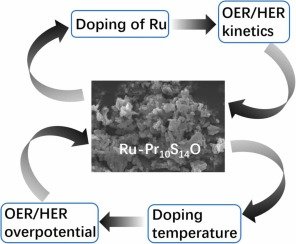
In this work, we first studied the Ru doped Pr10S14O, exploring the influences of doping temperature and doping content of Ru on OER and HER performances. Herein, we analyzed the different doping temperatures (50 °C, 60°C, and 70°C) and doping contents of Ru (10 %, 20 %, and 30 %) via fabricating nine electrocatalysts by conducting the orthogonal experiment. We found that the doping content of Ru mainly affects the kinetics of OER and HER, while the doping temperature of Ru mainly affects the overpotentials of OER and HER. Overall, the 30 %Ru-Pr10S14O-70 exhibits the best performances with the OER potential of 1.50 V at 10 mA cm−2 and 1.61 V at 80 mA cm−2, and a low HER overpotential of 44 mV at 10 mA cm−2. Besides, the 30 %Ru-Pr10S14O-70 still shows the low Tafel slope, demonstrating that it has fast reaction kinetics. Therefore, we have figured out the rule of Ru doping in the Pr10S14O to obtain satisfactory performances, which provides significant guidance for the design of electrocatalysts for water splitting in producing hydrogen in the future.