
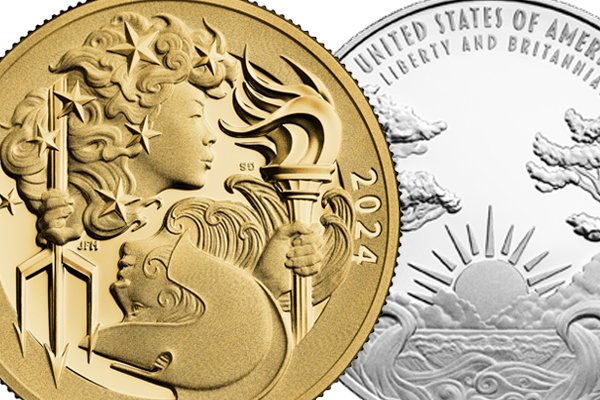
The chief engravers depict the two portraits in profile, resembling faces on a playing card. One is right side up while the other is upside down – until it’s rotated. “Coins are art that you hold in your hand. This one not only demands that you hold it in your hand, but to fully enjoy it, you need to rotate it,” explains Joe.
The symbols identify each figure. Liberty carries a torch and is adorned with stars. Joe says of Liberty, “Her hair is wild, and the stars are freely floating around her head.” Her features reflect the many different ethnicities that make up America so that everyone can see themselves in her image. The torch represents enlightenment and was a symbol used in historic designs such as Augustus Saint-Gaudens’ 1907 $20 gold coin.
Britannia wields a trident and wears a Corinthian helmet. The Corinthian helmet represents her origins as a figure on Roman coins. The Romans often depicted the province of Britannia as a woman. The trident reflects Britain’s maritime power in the 17th and 18th centuries when she first made her appearance on British coins.
To create this design, Joe and Gordon thought about what Liberty and Britannia meant to them. Then they traded drawings back and forth to envision a complementary treatment of both figures.
With the help of stakeholders from both mints, the ideas were narrowed down for the chief engravers to develop further. Committees in both countries reviewed the two final designs choices: Liberty and Britannia portraits arranged like a playing card or full figures standing next to each other. They chose the playing card option to recommend for final approval by the Secretary of the Treasury in the U.S. and King Charles III in the U.K.
The U.S. Mint will use this design on the obverse of a gold coin and a silver medal paired with a reverse design by Joe. The Royal Mint will use the design as the reverse on a variety of gold and silver coins with the king on the obverse.