
Kathmandu. In a mountainous country like Nepal, tunnels are the only viable alternative to make road transport easier, faster, and safer. By cutting through mountains instead of navigating winding roads, both travel time and fuel consumption are significantly reduced.
Nepal’s first modern Nagdhunga Tunnel is currently in the final stages of preparation for operation, with testing scheduled for this month. With this, Nepal is officially entering the tunnel era.
However, the Nepali economy cannot support building tunnels everywhere just because the need is felt. Out of nearly a dozen and a half (mainly 16) tunnel projects studied so far, only 4 or 5 appear to be cost-effective and constructible in the immediate future.
- The Mountain of Costs and the Test of Feasibility
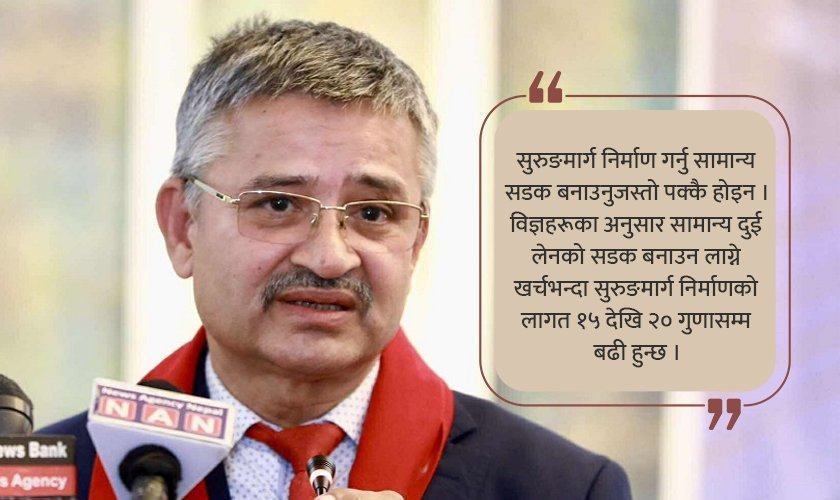
Building a tunnel is certainly not like building a standard road. According to experts, the cost of building a tunnel is 15 to 20 times higher than that of a standard two-lane road. For example, if it costs 100 million rupees to build 1 kilometer of a standard road, it costs 3 to 4 billion rupees to build a tunnel of the same length.
Given such massive investment, a trade-off analysis of costs and returns is essential. Tunnels cannot be built based on emotion without a scientific calculation of how much time and fuel will be saved relative to the investment.
This is why tunnel construction involves various stages of study. First, a pre-feasibility study is conducted. If this yields positive signs, it moves to a feasibility study, followed by a detailed feasibility study, and finally, the detailed engineering phase. Since the detailed study phase involves everything from soil testing to design, it incurs significant costs. Therefore, projects that do not appear economically viable are halted at the pre-feasibility stage.
- Only 4-5 Out of 16 Studied Projects Are Return-Oriented
About 16 tunnel projects have been studied in Nepal so far, but not all are ready for immediate construction. Generally, any infrastructure project is considered unfeasible if it does not yield a return of 10 to 11 percent. For instance, to shorten the 14-kilometer steep road at Daunne, a 6-kilometer tunnel would be required, but it would cost approximately 18 to 20 billion rupees, which far outweighs the savings in time and fuel. However, alternatives for Daunne are still being explored.
Currently, only 4-5 tunnel projects, such as the Thankot-Chitlang, the Tokha-Chhahare route to shorten the path to Nuwakot, and the Malekhu-Phisling route, are at a level where they can be taken forward for further study and construction. Additionally, the tunnels being built on the Kathmandu-Nijgadh Expressway are highly feasible because they will reduce the travel time between the Terai and Kathmandu to 1 hour, and passengers are willing to pay tolls. Most other projects have been put on hold as they are not currently economically viable based on pre-feasibility studies.
- Technology Transfer: Now Nepalis Can Build Them
Nepal’s reliance on foreign contractors for tunnel construction is slowly coming to an end. Significant technology transfer has occurred during the construction of the Nagdhunga Tunnel. Not only Department of Roads engineers but also private sector Nepali engineers and operators have gained experience working on this project. Nepali construction entrepreneurs have learned skills by working as subcontractors.
Just as the Japanese learned from the British and the Koreans from the Americans, Nepal has learned from the Nagdhunga project, and the direct benefits will be visible in the coming days. Nepali contractors and engineers will be able to work on new tunnel contracts. This will save the high fees paid to foreigners, and experts estimate that the current cost, which is 20 times higher than standard roads, could be reduced to 12 to 15 times.
- Multidimensional Benefits of Tunnels
The main benefit of tunnels is the massive saving of time and fuel. Furthermore, in a country like Nepal, which is at high risk of landslides, tunnels are considered extremely safe. No matter how well-built the walls on external roads are, there is always a risk of landslides blocking the path, but there is no such risk inside a tunnel. Additionally, earthquakes have little impact on tunnels.
Long-term maintenance costs for tunnels also decrease. While it currently costs 200-220 million rupees annually to operate the single Nagdhunga Tunnel, once 8-10 tunnels are built in the future, all can be monitored from a single ‘control center’. Just as one shepherd is needed to herd one cow, and the same shepherd can manage 30 cows, operating costs will decrease significantly as the number of tunnels increases.
- Nagdhunga Toll Tax: Expensive or Cheap?
Recently, the toll tax set for the Nagdhunga Tunnel has been debated in Parliament, with claims that it is expensive. However, experts do not agree. According to them, the calculation does not account for the monetary value of the time saved by passengers. The fee is based only on fuel savings and reduced wear and tear on vehicle parts. Furthermore, only 60-70 percent of those savings have been set as the fee, not 100 percent.
Moreover, the fee has been significantly reduced for vehicles leaving Kathmandu. As this is Nepal’s first such practice, the government has kept the operation under its own control. If passengers hesitate to use the tunnel due to the fee, the government has made flexible provisions to review and reduce the fee within 1-2 years.
Overall, tunnels are an important foundation for Nepal’s prosperity. However, it would be wise for the Nepali economy to proceed by building tunnels only in limited and necessary locations based on economic returns, traffic pressure, and technical feasibility, rather than on a whim.
(Sharma is a former Secretary at the Ministry of Physical Infrastructure and Transport.)