
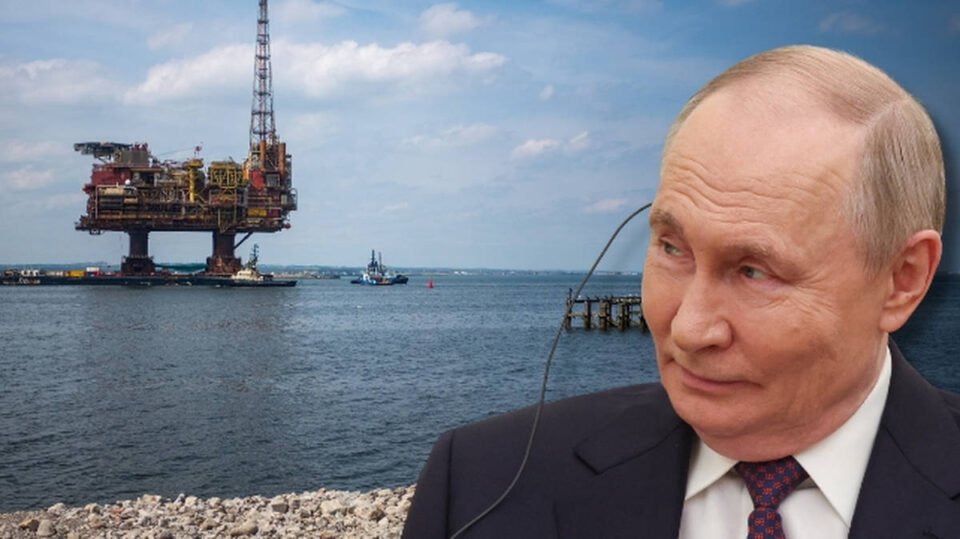
Dan Marks, a research fellow with defence think tank the Royal United Services Institute (RUSI), has been briefing North Sea energy companies on a form of warfare utilising mass-produced “cheap drones”.
Ukraine, which has a small navy and air force, has used drones in the sky and the sea to destroy a Russian destroyer, an oil rig and an LNG tanker.
Mr Marks has warned that conflicts, which previously would have been contained regionally, are spilling over into the wider continent due to drone warfare.
“You have many more targets, you can have many more economic targets – it’s much cheaper to hit them,” he told LBC. “And because of the number of drones you can send, you can overwhelm air defences and things like that.
“Ukraine is very aggressively targeting Russia’s energy sector. And this has implications for the global oil and gas industry because it’s revealing the weakest spots, like where you can have maximum impact, what type of attacks have the most impact. It’s not only Russia and Ukraine that learn from that. It could be non-state actors, it could be terrorists.”
Earlier this month, Defence Secretary John Healey sent a direct warning to President Putin after it emerged Russian submarines had been surveilling British undersea cables and pipelines.
Mr Marks is warning that any such attacks on the UK could be “hard to prove”.
“With a war like Ukraine and the Middle East, these drones are just in mass production. That means that the controls on where they’re going, who has access to them, is it fully controlled? It’s less than it would be in peacetime.
“It’s possible that they start to crop up in other conflicts in other parts of the world, and it also makes that slightly more deniable. You can say ‘Well, it may be a Russian drone, but it must have come out of storage, it must have been stolen, or taken by organised crime.’”
However, the RUSI fellow argues that any potential attack would likely aim to destroy energy infrastructure:
“It’s an obvious place to target – everybody needs energy. The UK has very high energy prices, and we’re quite exposed to imports. We have quite robust infrastructure, actually. It’s quite hard to cause blackouts and things like that, but you can have an effect at a relatively low cost.
“There’s distribution lines, local transformers, national substations, big generating plants, small plants, offshore infrastructure. So there’s a big surface for attacks and lots of things that need to be defended.”
Police Scotland has confirmed it’s monitoring ‘emerging threats’ in the North Sea.
Superintendent Simon Reid told LBC: “We see a greater awareness of the ability and the capability of others to use different technologies to potentially affect the sector.
“We’ve got very extensive experience working with the sector around a huge range of issues we reflect on. The community in the North Sea is up to 10,000 people at any given time. That’s essentially a small town and we see a policing response to any routine events within that sector.”
Supt. Reid stressed the importance of energy producers reporting any relevant information on these ‘emerging threats’.
“Sharing that information in terms of what’s happened, where it’s happened. We feed that into a number of national structures critically to understand what’s occurred, to understand why it might have occurred, where it may have come from and to enable us to jointly respond.”
The Energy Operations Manager of Offshore Energies UK is urging companies in the North Sea to invest in security and resilience as conflicts overseas continue.
“We cannot let complacency seep into our operations, but also we’ve got to make sure that we evolve,” Mark Wilson told LBC. “The situation around us is evolving on a geo-political scale, so we’ve got to evolve with it as well – and at pace.”