
Today, BlackRock published its Fall 2026 Hedge Fund Outlook. The report, which features a foreword from Mike Pyle, Deputy Head of BlackRock’s Portfolio Management Group, explores how rising dispersion, an evolving investment toolkit, and the search for differentiated returns are reshaping the opportunity set for hedge funds heading into 2027.
Key takeaways from the report include:
- Hedge funds are moving close to the core of portfolios: Stock-bond correlations are less stable and long-duration government bonds no longer provide the ballast investors expected, so market-neutral strategies now play a bigger diversification role.
- Volatility can be used as a portfolio tool: Extreme weekly market moves have been far more frequent than a normal distribution implies, and volatility markets can help investors hedge risk and generate returns.
- Dispersion is creating opportunities for systematic strategies: Shifting fundamentals and market leadership are increasing differentiation across companies, creating opportunities for systematic investors while underscoring the need for diverse signals and controls for crowding.
- Global macro-opportunities are expanding: Rising debt supply and diverging inflation, monetary policy and growth across regions are creating opportunities across markets.
- Corporate activity is creating event-driven opportunities: Global M&A volume reached about $2.7 trillion in the first half of 2026, near historic highs.
BlackRock is one of the top 10 hedge fund managers with $120 billion in client assets (in hedge fund strategies; total AUM is ~$15 trillion).
Foreword
It’s become increasingly clear that the economic and market environment of the 2020s has made hedge fund strategies more additive in portfolios. In the 2010s, underlying weakness in demand led to a very particular market regime: one in which low inflation, low interest rates and low correlations made achieving portfolio diversification relatively straightforward, while low volatility and dispersion left a narrower alpha opportunity set for active managers. This was a challenging environment for hedge funds. Today’s world looks different. Supply constraints, geopolitical fragmentation and a succession of shocks, now including the historic AI buildout, have created bottlenecks across labor, energy and materials. The result has been more frequent inflation shocks, increasingly stretched government fiscal positions and greater pressure on monetary policy frameworks.
For investors, these shifts have mattered. Stock-bond correlations have become less stable, while volatility and dispersion have risen. With persistent supply constraints keeping inflation elevated and uncertain, long-duration government bonds are no longer providing the ballast investors had come to expect — increasing the diversification value of market-neutral strategies such as hedge funds. Greater market volatility and dispersion have also expanded the opportunity set for long-short investors seeking alpha.
This year has reinforced these themes. Although the Middle East energy shock has perhaps proved less severe than some experts had feared, it offered a clear example of a negative supply shock at work, raising inflation risks and creating meaningful differentiation across countries and sectors. Adding to these pressures, intensifying competition for capital has created another supply bottleneck — that for capital itself. With heavy government borrowing competing with the enormous capital requirements of the AI buildout, a higher cost of capital is favoring strong balance sheets while putting greater pressure on leveraged borrowers.
AI itself is also reshaping markets, not as a single trade but as an increasingly important source of dispersion. Beneath resilient headline indices, performance has diverged sharply across the AI value chain. Beyond its impact on markets, AI is transforming how we invest, expanding the breadth and accelerating the pace of ideas we can generate, test and act upon.
These forces run through the pages that follow and inform three themes that help explain why we believe hedge funds belong closer to the core of portfolios today: dispersion, innovation and differentiation.
Dispersion is rising as the common macro backdrop of the pre-pandemic era gives way to diverging policy paths and market outcomes. Low inflation and highly accommodative monetary policy were once shared features across most major economies. Today, sticky inflation, diverging monetary policy, mounting fiscal pressures and geopolitical fragmentation are producing greater variation across countries and asset classes. Tom Becker (p. 5) examines the growing competition for capital, showing how government and corporate borrowing needs are rising together and why widening differences across countries are expanding the macro opportunity set.
Innovation is expanding the toolkit investors can use to identify and capture these opportunities. AI, alternative data and systematic techniques are changing how investors generate ideas, while derivatives and platform capabilities are broadening how they implement them. Raffaele Savi (p. 7) explains why, as AI transforms how information is processed, investment edge doesn’t disappear but shifts. Following a sharp momentum reversal this year, he argues that the breadth of ideas in a portfolio has become increasingly important because successful ideas are being absorbed ever more quickly into consensus. Rick Rieder and Jacob Caplain (p. 10) show that extreme market moves occur far more often than a normal distribution would suggest, and that volatility markets can help investors hedge risk and generate returns across both turbulent and calmer conditions. Multi-strategy platforms, able to combine these capabilities and reallocate capital as leadership shifts across asset classes, regions and styles, are particularly well positioned to put these tools to work.
Differentiation, meanwhile, is becoming central to the hedge fund value proposition. The role of hedge funds in portfolios increasingly rests on accessing distinct sources of return rather than adding another form of market exposure. That becomes especially valuable when traditional sources of diversification are less dependable. If government bonds do not consistently offset equity drawdowns, market-neutral and other alpha- oriented strategies can provide an alternative source of portfolio ballast. Mark McKenna (p. 13) describes a “corporate change supercycle,” in which returns are driven primarily by the outcomes of individual transactions rather than the direction of broader markets. And as demand for skilled managers grows, competition for capacity is intensifying. Diana Myint and Albert Matriotti (p. 16) explain why some of the most valuable sourcing work takes place before a fund even exists.
Taken together, these themes point to a common conclusion. Today’s environment is not simply broadening the opportunity set for hedge funds but heightening the importance of the diversification they can bring. It is also increasing the premium on manager skill. Reflecting that, as we look toward 2027, investment outcomes need to continue to depend less on the direction of markets and more on security selection, disciplined risk management and genuinely differentiated sources of alpha potential. That is why we believe hedge funds increasingly belong closer to the core of portfolios.
Macro abundance
The global macro backdrop as we head into year-end looks like an intensified version of where we started the year: global growth is strengthening, AI is powering a hefty capital investment boom and inflation across developed markets remains (increasingly) far above central bank targets. Market pricing has shifted throughout 2026 to better reflect this macro landscape, with both rates and earnings expectations moving higher, and we see scope for that repricing to continue into year-end. In this high-intensity macro environment, we also see increasing evidence of higher regional dispersion that can benefit our global investment aperture.
A debt issuance boom is challenging bond markets
Government and corporate debt issuance are simultaneously rising, which is historically anomalous. Typically, a strong economic expansion shrinks government deficits and that creates space for corporations to increase investment without materially increasing aggregate debt supply. However, the post-pandemic expansion has been powered by procyclical fiscal policy and that means that governments are debt financing ever larger outlays, while companies are raising increasing amounts of capital to fund AI infrastructure, M&A and other procyclical investments. The result is a meaningful increase in debt supply that can be seen in the chart below.

Markets ultimately clear at prices that match supply and demand, and the challenge for bond markets in 2026 has been finding enough buyers willing to finance this rising issuance at prevailing yields. We are positioned for this dynamic to continue, particularly since the debt-financed investments are directly supporting economic activity and, on a tactical horizon, adding to already rising inflation pressures. A combination of resilient growth, sticky inflation and abundant bond supply keeps us directionally short bonds. We also continue to seek out relative-value opportunities across global rates, favoring regions with less acute inflation challenges, more austere fiscal policy or more dovish central banks.
Rising IPO supply sends a different investment signal
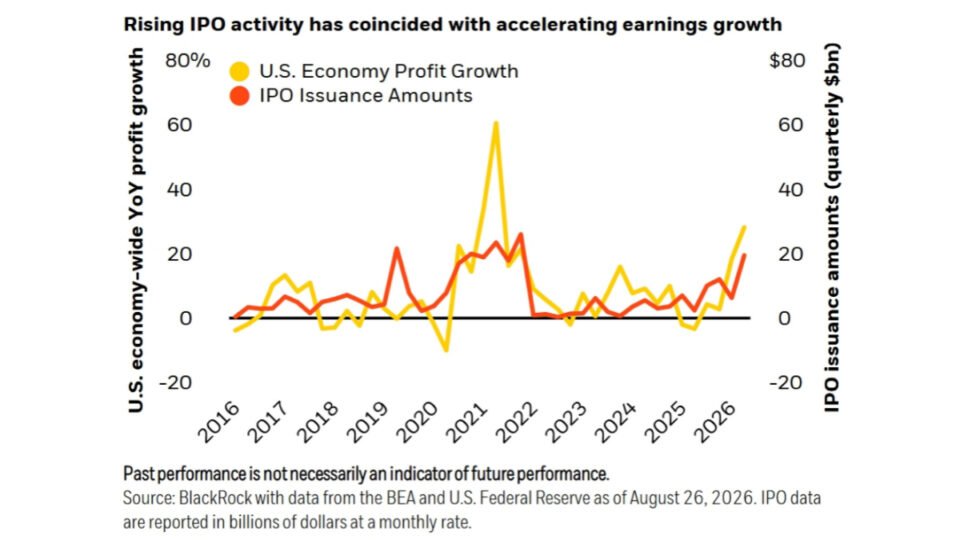
While rising net debt issuance should continue to pressure fixed income markets, the increasing supply of public equities is associated with a different dynamic. The initial public offering (IPO) window has reopened as private stockholders transfer their ownership into public markets. Private companies tend to go public when investment opportunities are plentiful, financial conditions are supportive and corporate fundamentals are strong — all good descriptions of 2026. Rising IPO activity also tends to coincide with an acceleration of economy-wide profit growth, which is supportive of equities and can be seen in the visual to the right. We remain long directional equities on the back of improving top line fundamentals for companies.
Why cross-regional macro investment opportunities are rising
The decade before the pandemic was characterized by unusually synchronized global markets characterized by low inflation, aggressive monetary accommodation and relatively limited fiscal dispersion across countries. The post-pandemic environment has looked very different. The last few years have seen the rise of persistent and sticky inflation, activist fiscal and industrial policies and geopolitical fragmentation. This new macro landscape has unsurprisingly increased the cross-country dispersion of stock and bond markets and also increased the macro investment opportunity set.
Rising dispersion in fundamentals creates more investment opportunities, but dispersion alone does not guarantee alpha. The key question for an investor is whether divergences are already accurately reflected in market prices. Core to our investment philosophy is a belief that, while markets are mostly efficient, behavioral biases and structural barriers create gaps between macro fundamentals and what is priced across equities, bonds and currencies. In our experience, identifying and understanding the various catalysts that create investable mispricings across asset classes and across countries is essential. In a world with so much of so many things all seemingly happening at once, we rely on this process to distill signal from noise to deliver durable, macro alpha to our clients.

Read BlackRock’s Fall 2026 Hedge Fund Outlook here.