
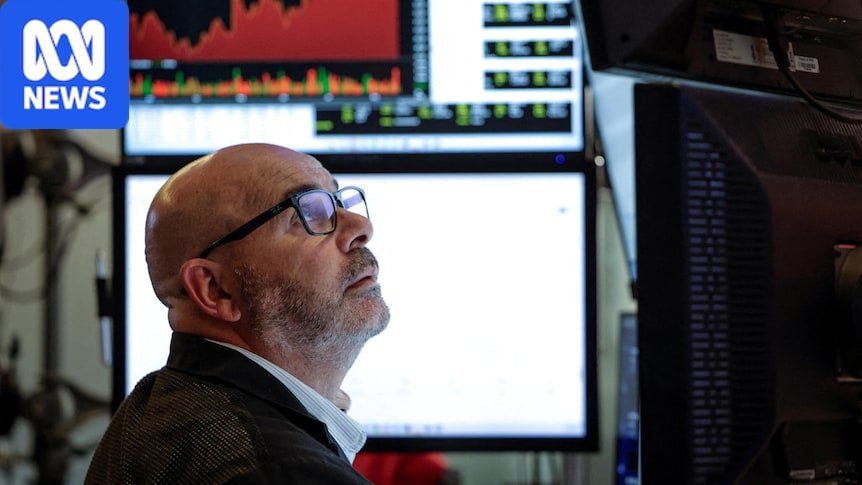
We are witnessing a once-in-a-generation bond market sell-off.
It’s the main event on global financial markets at present, which also means there are implications for millions of Australians.
For the uninitiated, a bond is generally either a corporate or government IOU, and these debt securities can be traded by big investment groups and everyday retail investors.
Generally considered safer than the volatile share market, the bond market provides an economic canary in the coal mine because it can foreshadow financial market stress.
The bond market itself is a vehicle for investors to measure and weigh inflation, as well as broader economic risks.
Politicians can spin a big budget deficit or their reasons for engaging in military conflict, but the bond market provides a clinical assessment of the fallout of such actions for everyday workers.
And the market is screaming economic trouble ahead.
US bond-yields spell debt market ‘freak out’
US government debt or “Treasuries” were sold off sharply last week.
Put simply, investors were dumping these US government securities and those buying were demanding higher returns for their investments.
Bond yields rise when their prices fall. Rising yields mean people are losing faith in the borrower’s capacity to pay.
They can also mean investors are looking for compensation as returns are eroded by inflation.
The US 10-year and 30-year government bond yields are now around two-decade highs — both are close to breaching 2006 and 2007 peaks, with 2004 the highest before that.
The latest bout of selling was thanks to a new bit of US economic data.
The September Flash Composite PMI, or Purchasing Managers’ Index (which points to the health of the US manufacturing sector) surged to 58.4 from 56.0 in August — the highest reading since July 2021 and well above the 55.3 consensus.
There’s been a major correction to bond markets. (Reuters: Susan Vera)
Crucially, the data showed input prices growing at the fastest pace in four years.
That means it’s getting more expensive to make stuff and generally prices are going to rise faster.
This, combined with escalating tensions in the Middle East, rising oil prices and fears of overspend by big tech firms on AI and data centres, meant the debt markets started to freak out.
Germany, Japan dealing with rising yields
Make no mistake, this is a global financial phenomenon.
The world’s biggest economies, and their governments, are grappling with higher interest payments as spending demands surge.
Germany’s finance agency said on Thursday it expects federal borrowing to hit a record €525.5 billion ($US598 billion) in 2026 and to rise further next year, driven largely by rising refinancing needs and growing requirements for special funds.
The yield on Germany’s benchmark 10-year Bund briefly rose above 3.6 per cent this month, its highest level in 17 years.
Loading…
Japan’s 10-year bond yield hit its highest since 1996 on Thursday.
Commentary from the world’s most influential central banks only added fuel to the bond fire.
One of the US Federal Reserve Governors, Michael Barr, said last week “further policy adjustments are likely needed” to return inflation to the two per cent target in a timely way, adding that risks to achieving the inflation goal had increased.
Markets now price approximately a 66 per cent probability of a further 25 basis points (0.25 percentage point) hike at the October US Federal Open Market Committee (FOMC) meeting.
The US Treasury Department in Washington issues bonds. (Reuters: Brian Snyder)
“It is tough to pick the peak [for interest rates],” the CBA’s head of market strategy and rates research Adam Donaldson said.
“Inflation remains under pressure due to the war in Iran and solid economic growth.
“But we do think that US bond yields are somewhere near their peak,”
he said.
Economic veterans cautious about the months ahead
Veteran market commentator Marcus Padley runs a managed fund on behalf of clients.
He remains increasingly cautious about the weeks and months ahead on financial markets.
“SocGen [sic] described the bond market sell-off as a meltdown,” Mr Padley wrote on social media.
“And it’s worryingly global.
Marcus Padley is cautious about what’s next for the bond market. (The Business)
“Australian, UK, German, and European 10-year bond yields are all up.”
“The biggest risk in the global equity market, since US debt hit $40 trillion, has always been a bond market meltdown. Overnight, we have seen what it looks like when it starts.“
Bond levels not seen in two decades
We saw significant central bank and government financial support in the wake of both the global financial crisis and the COVID-19 pandemic.
Since then, however, ultra-low interest rates have fuelled borrowing and spending.
It’s helped generate inflation and it has become incredibly challenging for both governments and central banks to manage.
“You assume that at some point all the powers of the United States will step in to make sure nothing precipitous happens, but it is obviously uncomfortable for equity investors and endorses our current cash stance,”
Marcus Padley said.
If we see a significant financial event like a sovereign government debt default, a hedge fund collapse or a major tech company insolvency, it’s assumed a bailout will be swiftly engineered.
The risk is though that such a rescue will either be ignored by the markets or not eventuate at all.
Shane Oliver says in a worst case scenario bond yields top 6 per cent. (ABC News: Amy Murray)
In any event, the ABC asked AMP’s head of investment strategy what such an event would look like.
“That’s a bit of like ‘how long is a piece of string?'”
“I think worst case would be [a US 10-year-bond yield] around six per cent … and a bit more in Australia, ie back to around late 1990s/early 2000s levels,” Dr Oliver said..
“Hopefully we won’t get there but at this rate it’s possible especially given the worry list for bond investors around high oil prices, high inflation, high public debt levels, rising corporate borrowing, erratic US policy making and rising Japanese bond yields.“
The multi-trillion-dollar question is: how far are bond markets willing to push governments and big corporates to get their financial houses in order?
An Australian bond note. (Supplied: Australian Office of Financial Management)
Because until the inflation threat bearing down on the world economy dissipates, and productivity remains subdued, the bond market will keep pushing the envelope.
It raises the prospect of financial pain for the majority of the Australian population in terms of job losses, higher mortgage interest payments and lower superannuation balances for retirees.
“This would imply multiple rate hikes from here from the Fed and RBA and risk recession and a profit slump which would hit shares,”
Shane OIiver said.
“It’s not my base case but is high risk.”
Loading…