
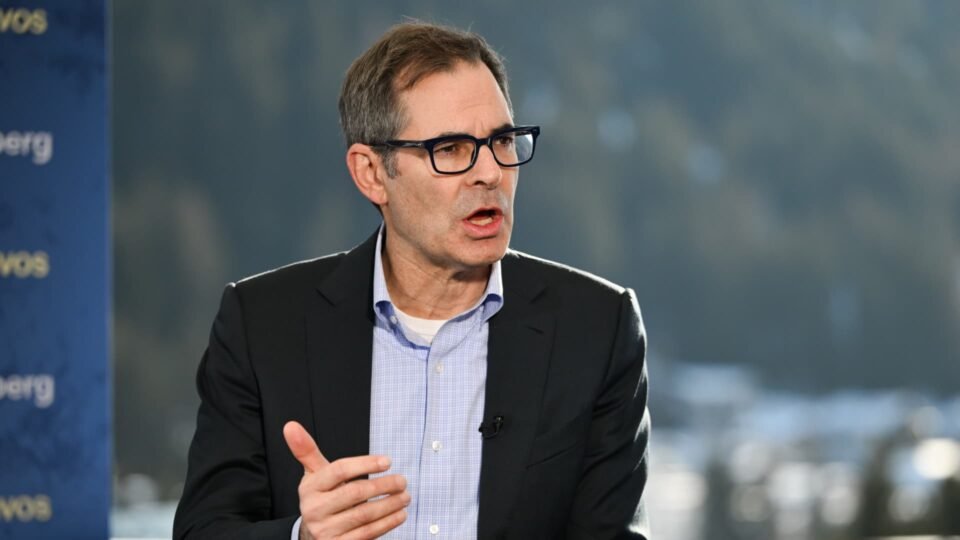
CoreWeave CEO Michael Intrator participates in a Bloomberg Television interview during the World Economic Forum in Davos, Switzerland, on Jan. 20, 2026.
Chris J. Ratcliffe | Bloomberg | Getty Images
AI stocks rallied on Monday, but CoreWeave closed slightly lower as investors remained skittish about its debt. Yields on Oracle debt also remained elevated as credit worries persist across the AI trade.
The tech-heavy Nasdaq Composite gained 1% on Monday. Oracle rose 1% after dropping 9% last week, while Intel climbed 2.4%, Advanced Micro Devices added 1.8% and Micron Technology rose 3%.
CoreWeave, the so-called neocloud company that led the sell-off last week, bounced around, hit a 52-week low and ultimately closed fractionally lower. Meanwhile, its bond yields remained high and its five-year credit default swaps were at distressed levels.
The yield on CoreWeave’s 2032 bond remained elevated
The yield to maturity on its 9.625% bond due in 2032 was at 14.9%, slightly down from its high of over 15% last week. The spread on its five-year credit default swaps stood at roughly 1,082 basis points, nearly 2% lower than Friday.
Coreweave’s 5-year credit default swaps on Oct. 19, 2026
Credit default swaps are contracts where buyers pay for protection in case the borrower can’t repay its debt. A spread above 1,000 basis points is generally a sign of distress.
“The market tends to get worried about companies that have refinance risk when rates are higher, and CoreWeave was a little bit of the poster child,” said John Lloyd, global head of multi-sector and corporate credit at Janus Henderson. His firm’s multi-sector income fund owns CoreWeave 2031 bonds. “They need the debt markets in order to grow, in some form or fashion.”
The concern wasn’t limited to CoreWeave’s bonds. It was also seen in Oracle, which is an investment-grade hyperscaler and considered a bellwether on AI credit. Its five-year CDS spread also moved wider on Monday to 315 basis points, a 311% increase from a year prior.
Oracle’s five-year credit default swaps on Oct. 19, 2026
What’s notable is the dispersion in AI-related high-yield bonds, similar to what is happening in the broader junk market, Goldman Sachs said last week.
Neoclouds and firms with significant frontier lab exposure are largely at the epicenter of the funding cost debate, while AI-adjacent energy and utilities have been more resilient since they have more diversified revenue streams and a relatively defensive earnings profile, Amanda Lynam, Goldman’s chief credit strategist, said in a note. Investment-grade bonds have also seen less severe price action, she added.
“As the pace of issuance has increased, differentiation factors around construction risk, coverage of principal or refinancing risk, and claim to tenant have become increasingly important,” Lynam wrote. “Additional considerations around power availability, permitting, and insurance all advocate for a bottom-up approach to investing in the asset class.”
Economist David Rosenberg, founder and president of Rosenberg Research, called Oracle the “canary in the coal mine.” Oracle, Alphabet, Amazon and Meta have issued more than $228 billion of bonds this year and now account for about 10% of the global investment-grade market, he noted.
Oracle, which has about $132 billion of net debt and a BBB- rating from S&P Credit Ratings, “is the bridge between junk-rated neoclouds and investment-grade hyperscalers,” said Rosenberg, who has a reputation for bearish calls.
“A downgrade to junk would be the clearest sign of contagion.”