

A major push by DTCC could accelerate adoption, but costs and technical hurdles remain.
Tokenization of real-world assets, such as treasury bonds, commodities, or equities, is still in its infancy but is growing rapidly. The value of these tokenized assets globally is roughly $400 billion today, but it could explode to $5.5 trillion by 2030, according to the Citi Institute.
Supporters of on-chain assets received a further boost last week when Depository Trust & Clearing Corporation, or DTCC, announced a new tokenization service, a development especially noteworthy given that the user-owned, industry-operated financial market infrastructure company has more than $100 trillion in assets under custody.
“Yesterday was a huge day for DTCC. We just got $30 trillion on-chain,” CEO Frank La Salla told attendees at the Link: NYC conference on Oct. 29. “I think we will get gradual initial adoption” on the tokenization front. “But ultimately it will begin to accelerate and ramp up.”
The $30 trillion represents the market value of 34 securities eligible for tokenization through DTCC’s new service, not the value of assets already tokenized.
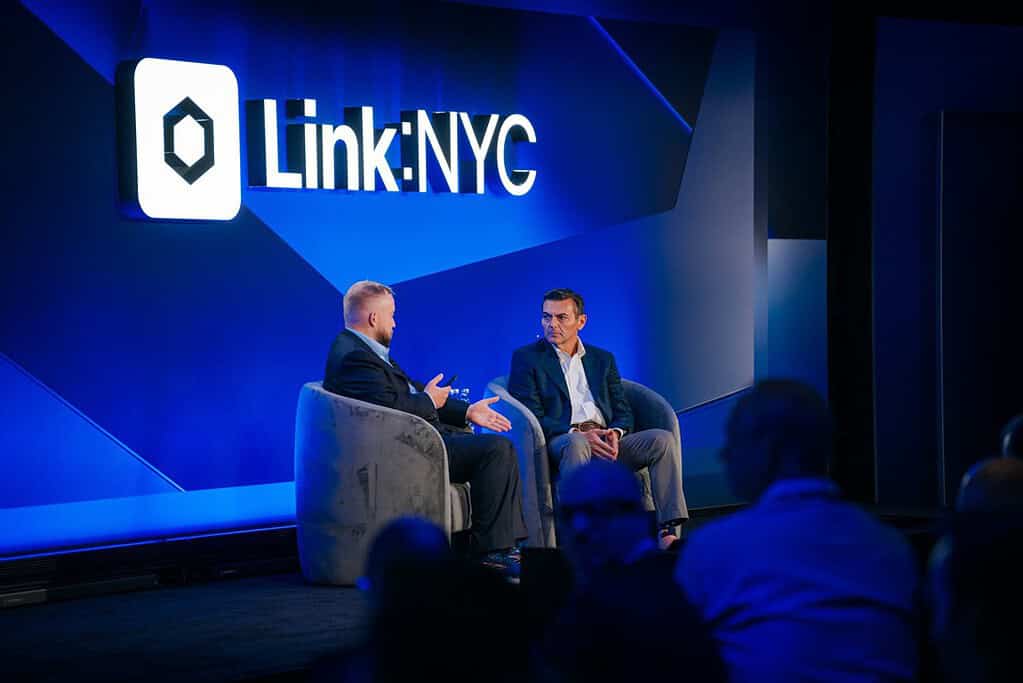
But numbers alone may not tell the whole story. “After you tokenize something, there has to be utility,” said Sergey Nazarov, co-founder and CEO of Chainlink, a digital infrastructure provider, speaking at the conference. The on-chain (i.e., blockchain-based) version of a financial asset must offer advantages over its traditional counterpart.
DTCC CEO Frank La Salla acknowledged these challenges in his comments at the conference. He cited several product areas where tokenization could have an almost immediate impact, given the global need for liquidity and capital: collateral and repo.
“There’s a real demand for dollar liquidity in Asia,” La Salla told a packed house. This demand arises even on weekends, when U.S. markets are closed. “With blockchain technology, you can have collateral on-chain, perfected”—i.e., a legal process that protects one’s ability to take ownership of collateral in the event of default—“and provide that liquidity, totally collateralized, before New York even awakens. That’s very powerful.”
The repo market offers opportunities, too. Securities typically must be pre-positioned before they are available for repo, and that pre-positioning requires additional collateral, La Salla explained. “On the blockchain, you can do that instantaneously the same day. We have had member firms tell us: ‘If you operationalize this, it could save us 20-30% on the balance sheet.’ That is enormous.”
SEC Permissions Secured
DTCC worked with the SEC for 18 to 24 months to secure the “no action letter” needed for its tokenization program, La Salla said. The company insisted that tokenized securities retain the same legal rights as their traditional counterparts. “We felt that was what issuers wanted, and what investors wanted.”
In his view, the tokenized security would be the “digital twin” of the underlying asset. Nazarov, who moderated the panel, said that many tokenized assets carry fewer legal entitlements than off-chain assets, so DTCC’s insistence on this point was a positive adjustment.
Interoperability remains another obstacle. Solving the challenge “will be critical,” La Salla said. Without common technical standards, blockchains such as Ethereum and Solana struggle to communicate.
Mark Nichols, co-president of digital assets at Broadridge, said stock issuers worry that tokenization could change how their shares trade, including price discovery.
More Expensive to Custody?
Custody costs remain a barrier for institutional investors. Holding tokenized assets is currently more expensive than traditional custody. On-chain custody can cost as much as 15 basis points, while traditional assets are often stored for less than 10 bps, as noted by another panel speaker, Sam ten Cate, managing director of digital strategy at State Street Investment Management.
Panelist Matthew Blumenfeld, Global & U.S. Digital Asset Lead at PwC, said trust remained an issue. “Can you trust the parties involved?” Custody differs in Hong Kong from the United States, for instance.
In 2024, Singapore-based DBS Bank launched DBS Token Services, allowing corporate clients to settle multicurrency transactions instantly, around the clock, said Evy Theunis, managing director and head of digital assets in the bank’s Institutional Banking Group. Many corporate clients have taken advantage of the service because they trust DBS to care for their assets responsibly. Elsewhere, she said, many Asian firms still demand 24/7 settlement when transacting with U.S. companies.
The Genius Act, the 2025 U.S. stablecoin law, “really woke up the banking world around tokenization of money,” Theunis said. On Sept. 5, 2026 — a Saturday — DBS settled a cross-border USD payment with U.S.-based Citi via Swift’s Digital Ledger. The transaction was completed in minutes. In the past, that same transaction would have sat in the queue until Monday morning.
Andrew Singer is a contributing writer based in the U.S.