
By Sinéad Carew and Sophie Kiderlin
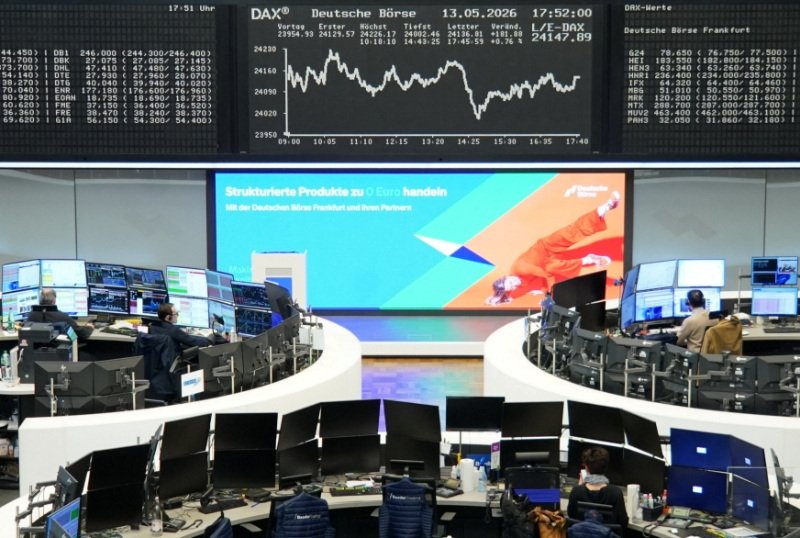
NEW YORK/LONDON, May 15 (Reuters) – Global equity indexes fell on Friday while bond yields soared as investor euphoria over technology stocks gave way to inflation fears and traders raised bets that the Federal Reserve will hike interest rates this year.
U.S. President Donald Trump left China on Friday with no major breakthroughs on trade or tangible help from Beijing to end the Iran war.
And uncertainty over a Middle East peace deal drove oil prices higher, adding to concerns about inflationary pressures after two batches of high inflation readings for April were released earlier this week.
The S&P 500 and the Nasdaq sold off after climbing to closing records on strength in artificial intelligence-related technology stocks in the previous two sessions.
“There’s a realization that the market had gotten way ahead of itself. It wasn’t paying enough attention to what the bond market and economic data was telling it. It was caught up in this momentum AI trade,” said Kenny Polcari, chief market strategist at Slatestone Wealth.
“The market is finally paying attention to what the bond market and the economic data is telling it. Inflation remains sticky and is potentially going to move higher in the months ahead.”
EQUITIES GO INTO REVERSE
On Wall Street the Dow Jones Industrial Average fell 537.29 points, or 1.07%, to 49,526.17, the S&P 500 fell 92.74 points, or 1.24%, to 7,408.50 and the Nasdaq Composite fell 410.08 points, or 1.54%, to 26,225.15.
Still, the S&P 500 logged its seventh straight weekly gain, its longest winning streak since late 2023. But the Nasdaq and the Dow fell on the week, with the Nasdaq snapping a six-week winning streak.
MSCI’s gauge of stocks across the globe fell 17.06 points, or 1.53%, to 1,099.00.
Earlier, the pan-European STOXX 600 index finished down 1.48%. MSCI’s broadest index of Asia-Pacific shares outside Japan fell 2.5% and Japan’s Nikkei slid 1.99% after data showed wholesale inflation accelerated to 4.9% in April, the fastest pace in three years, keeping the Bank of Japan on track to raise rates.
In South Korea the Kospi index fell more than 6% on Friday after a steep run higher in recent months. It is still up 77.8% year to date.
GOVERNMENT BOND YIELDS SPIKE
In government bonds, U.S. Treasury yields climbed to their highest levels in a year as elevated oil prices added to fears that ongoing energy disruptions in the Middle East could add to inflation.
The yield on benchmark U.S. 10-year notes rose 13.8 basis points to 4.597%, from 4.459% late on Thursday while the 30-year bond yield rose 10.9 basis points to 5.122%.