
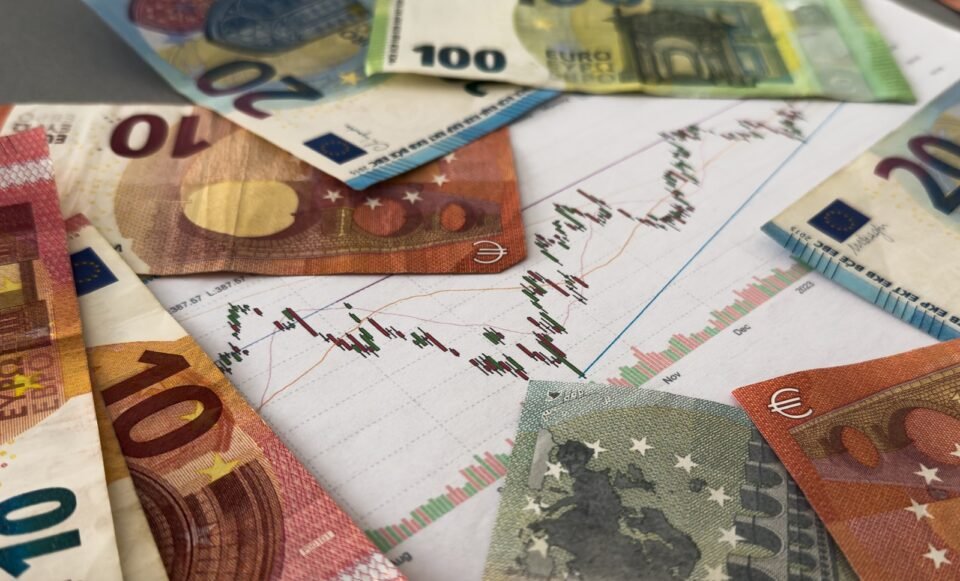
The euro continues to lose value against the US dollar, reaching its lowest level against the American currency in the past 17 months. Selling pressure on the single currency is intensifying amid reports of ongoing fiscal problems in France, combined with pronounced political instability in the eurozone’s second-largest economy.
At the same time, the Romanian leu has reached a new record low, crossing the threshold of 5.35 lei per euro, after President Nicușor Dan presented a fourth consecutive nomination for the position of prime minister. Despite having the highest interest rates in the European Union, at 6.5%, the country’s central bank has been unable to maintain the currency’s value within its preferred range under its managed floating exchange rate policy.
Much like France, Romania is struggling with an exceptionally high budget deficit (exceeding 7–9% of GDP), while the central bank’s reserves are declining following active interventions to defend the value of the leu on international markets.

In September alone, Romania’s foreign exchange reserves fell by 4.8 billion EUR as a result of high government debt servicing costs and a widening current account deficit, further limiting the central bank’s ability to defend the national currency. This has not gone unnoticed by international credit rating agencies, which have downgraded Romania’s sovereign debt rating to the lowest investment-grade level, just one notch above “junk” status, with a negative outlook. The natural consequence is a strong incentive for international capital to leave the country, further worsening the deficit and the depreciation of the currency.
Foreign-currency deposits held by Romanian households increased by 5.2% year-on-year in August 2026, reaching the equivalent of 28.9 billion EUR, according to data from the National Bank of Romania. The latest government bond issuance on the Bucharest Stock Exchange clearly demonstrates a preference for euro-denominated securities, which accounted for as much as 70% of the subscribed volume, while interest in leu-denominated bonds has almost halved compared to the same period last year.

As has become clear, however, switching from the local currency to the euro solves only part of the problem of declining savings value, as the single European currency itself has experienced a significant depreciation, particularly against the US dollar, but also against the British pound and the Swiss franc.
“This creates the effect of choosing the cleanest shirt from a basket of dirty laundry: the euro appears to be a good investment only when compared with the currency of a country facing even greater fiscal problems than the eurozone itself. Between 2023 and 2026, the leu depreciated against the euro by approximately 6–7%, while domestic consumer prices increased by almost 30%, according to official data. In other words, a large part of the inflation-driven loss of purchasing power has not been reflected in the nominal depreciation of the leu against the euro,” says Victor Dima, Treasury Manager at Tavex Romania.

A simple comparison of 10,000 Romanian lei invested in August 2025 and held until August 2026 in three different types of assets – lei, euros, or gold – can demonstrate the difference. With reported inflation of 6.27% over the period, the initial 10,000 lei would have the following values in real terms after one year: 9,410 lei if held in lei, 9,752 lei if converted into euros, and 12,849 lei if invested in gold. This represents real returns of -5.9%, -2.5%, and 28.5%, respectively.
In fact, a growing trend among many central banks is to replace part of their foreign exchange reserves, traditionally held in government securities, with substantial purchases of gold. This trend is gaining increasing momentum. According to the World Gold Council, central banks made net purchases of 1,082, 1,037, 1,045, and 863 tonnes of gold in 2022, 2023, 2024, and 2025, respectively, compared with average annual purchases of approximately 500 tonnes during the preceding decade. Over just four years, this amounts to nearly 4,030 tonnes of additional gold reserves – a quantity exceeding the world’s annual gold mine production.
Unlike gold, long-term interest in traditional reserve currencies appears considerably more restrained. According to the World Gold Council’s 2026 survey, 83% of surveyed central banks expect gold’s share of international reserves to increase over the next five years, while a record 45% plan to increase their own holdings over the next twelve months. At the same time, 74% anticipate a decline in the share of the US dollar, while expectations for the euro point more towards maintaining its current position.
Even more telling is the fact that, by the end of 2025, gold already accounted for 27% of total international reserves by market value, surpassing both US government bonds at 22% and the euro at 15%. Although this was largely driven by the appreciation of the metal, the trend highlights gold’s growing importance as an alternative to government-issued currencies and debt instruments.
It is therefore only natural for individual investors and savers to follow the example of major financial institutions and protect the value of their own assets by holding investments that do not depreciate at the same rate as inflation.