
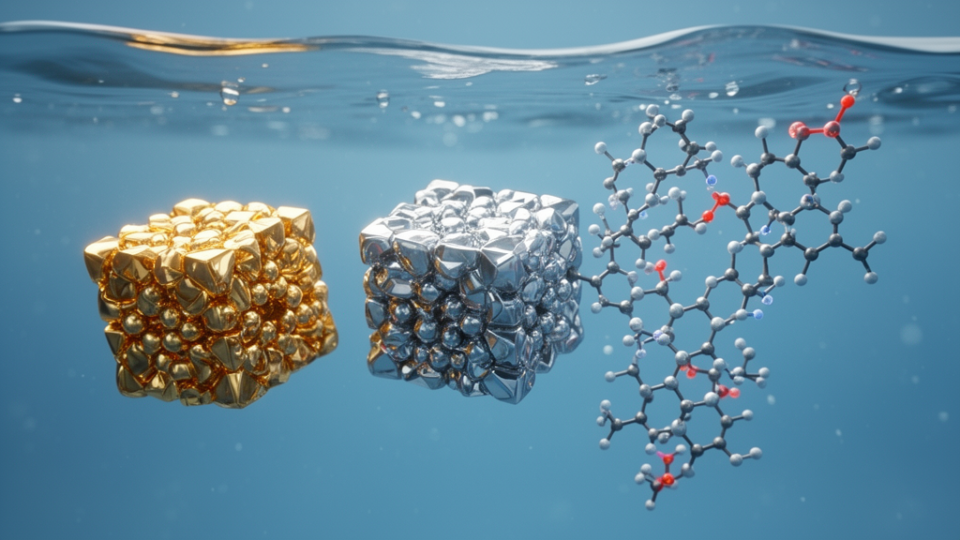
Published in the journal Gold Bulletin, the study provides a comparative analysis of catalytic efficacy under mild reaction conditions, highlighting the potential synergistic effects of combining two distinct metals in a single nanoscale system. The work addresses the growing demand for efficient, green chemical methodologies in the production of complex heterocyclic compounds that are vital for medicinal chemistry and pharmaceutical research.
Spirooxindoles are a class of spirocyclic compounds characterized by a sp3 carbon atom connecting two rings, creating a stereocenter that is highly valued in the design of bioactive molecules. These structures are a subset of isatin derivatives, which contribute significantly to the synthesis of diverse molecular architectures with promising activities in the field of medicine. The unique framework of spiro-fused 2-oxindole rings offers attractive synthetic targets by overcoming the steric strain associated with the spiro carbon atom, making them ideal candidates for the development of new therapeutic agents.
The study utilized multicomponent reactions, a one-pot methodology that employs more than two starting materials to synthesize bioactive compounds. This approach is favored for its atom economic nature, efficiency, and high bond-forming index, which allows for the formation of various non-hydrogen atom bonds in a single synthetic transformation. By combining substituted isatins, malononitrile, and 1,3-dicarbonyl compounds, the researchers aimed to produce a series of diverse spirooxindoles while minimizing the limitations of conventional linear or sequential multistep synthesis.
The catalytic systems investigated were nano-Pd@rGO, consisting of palladium nanoparticles supported on reduced graphene oxide, and nano-Au–Pd@rGO, which incorporated both gold and palladium nanoparticles on the same support. Characterization using energy-dispersive X-ray spectroscopy confirmed the presence of palladium and carbon in the monometallic catalyst, while the bimetallic catalyst showed the presence of palladium, gold, and carbon. Transmission electron microscopy revealed that the palladium nanoparticles were spherical and homogeneously distributed with sizes ranging from 3 to 8 nm, whereas the gold-palladium nanoalloys measured between 4 and 8 nm.
Optimization of the reaction conditions for the monometallic nano-Pd@rGO catalyst revealed that ethanol served as the most effective solvent for the three-component reaction. In the absence of a catalyst and solvent, no product was observed after one hour of stirring at room temperature. However, when ethanol was used as the solvent with a catalyst loading of 0.1 mg, the yield of the target spirooxindole derivative increased to 84% within one hour. In contrast, water and methanol resulted in lower yields, with water showing a decrease in yield from 57% to 43% as the reaction time extended from one to 24 hours.
The bimetallic nano-Au–Pd@rGO catalyst demonstrated superior performance under similar optimal conditions. With a catalyst loading of 0.1 mg and ethanol as the solvent, the yield of the corresponding spirooxindole product reached 95% in just one hour at room temperature. This marked improvement over the monometallic catalyst suggests a synergistic effect between gold and palladium, where the interaction between the two metals facilitates the accelerated synthesis of the target molecules. The presence of gold appears to enhance the stability of intermediates, leading to higher product yields compared to the palladium-only system.
The study further explored the substrate scope by testing various substituted isatins with electron-donating, electron-neutral, and electron-withdrawing groups. The reactions proceeded smoothly to provide the respective spiro products in high to excellent yields. Specifically, isatins substituted with chlorine, nitro, and methoxy groups at the 5-position were well tolerated by the catalytic systems. The bimetallic catalyst showed particular efficacy in handling these diverse substituents, maintaining high yields across the range of tested compounds.
An interesting observation was the impact of the gem-dialkyl effect on product yields. Reactions involving 5,5-dimethylcyclohexane-1,3-dione, also known as dimedone, generated higher product yields ranging from 87% to 94% compared to the unsubstituted cyclohexane-1,3-dione. This suggests that the gem-dialkyl effect favors the formation of spirooxindoles with di-methyl substituted cyclohexan-diones. This trend was consistent for both the monometallic and bimetallic catalytic systems, indicating an inherent structural advantage in the reaction mechanism.
The proposed mechanism for the synthesis involves the activation of the carbonyl group of isatin, followed by a nucleophilic attack by malononitrile to form an intermediate. This intermediate undergoes the removal of a water molecule and is then attacked by the catalyst-activated 1,3-dicarbonyl compound. The catalyst-driven activation of specific bonds in the intermediate promotes cyclization, leading to the final spirooxindole product. The influence of gold in this process is hypothesized to be a stronger interaction between the gold-based nanocatalyst and the substrate, resulting in more stable intermediates and consequently higher yields.
The methodology offers several advantages, including the use of non-toxic solvents, higher product yields, and lower reaction times at room temperature. The use of reduced graphene oxide as a support material prevents the aggregation of nanoparticles, increases their stability, and facilitates the recovery of the catalyst, thereby enhancing its catalytic performance. This approach aligns with the principles of green and sustainable chemistry, aiming to reduce the environmental impact of chemical synthesis while maintaining high efficiency.
The comparative study provides valuable insights into the potential enhancement of reaction efficacy in bimetallic systems. The findings suggest that the combination of gold and palladium nanoparticles can lead to superior catalytic performance compared to monometallic counterparts. This has broader implications for the design of recyclable catalytic systems in organic synthesis, where the synergistic effects of multiple metals can be leveraged to improve reaction outcomes.
In conclusion, the research demonstrates a catalyst-steered approach with green chemistry facilitating access to highly complex or strained structural motifs of medicinal relevance. The domino fashion synthesis of spirooxindole-based derivatives via a one-pot three-component reaction catalyzed by Pd@rGO and Au–Pd@rGO nanocomposites offers a simple route with low reaction times and excellent product yields. The study underscores the importance of bimetallic nanocatalysts in advancing the field of heterocyclic chemistry and providing efficient solutions for the synthesis of bioactive compounds.
A closer examination of the characterization data outlines the precise elemental distribution within both catalytic systems. Energy-dispersive X-ray spectroscopy quantified the elemental proportions of the monometallic nano-Pd@rGO composite at 52.5 percent carbon, 31.3 percent oxygen, and 16.2 percent palladium by atomic percentage. By comparison, the bimetallic nano-Au–Pd@rGO catalyst contained 45.43 percent carbon, 33.4 percent oxygen, 20.82 percent palladium, and 0.34 percent gold. This bimetallic formulation embedded gold-palladium nanoalloys measuring 4 to 8 nanometers, while the monometallic counterpart incorporated homogeneously dispersed spherical palladium nanoparticles measuring 3 to 8 nanometers. Both systems relied on reduced graphene oxide, a derivative of graphene structured in a hexagonal honeycomb carbon lattice. This carbonaceous platform provides high specific surface area, carrier mobility, chemical stability, and an economic manufacturing process, which collectively prevent nanoparticle aggregation while aiding catalyst recovery and overall catalytic performance.
The optimization trials also revealed distinct performance patterns across differing catalyst amounts and solvent compositions. Evaluating catalyst loading showed that lowering the amount of nano-Pd@rGO from 0.1 milligrams to 0.01 milligrams and 0.001 milligrams resulted in product yields of 72 percent and 61 percent, respectively. In parallel tests with nano-Au–Pd@rGO, loadings of 0.01 milligrams and 0.001 milligrams delivered yields of 80 percent and 79 percent, demonstrating that the bimetallic catalyst maintained high activity even at very low loadings. Solvent choice played a decisive role across both systems. Without any solvent, neither catalyst produced any target compound after one hour of stirring. In aqueous media, prolonging the reaction time from one hour to twenty-four hours reduced yields from 57 percent to 43 percent for nano-Pd@rGO, and from 66 percent to 43 percent for nano-Au–Pd@rGO. Methanol produced yields of 32 percent with the monometallic catalyst compared to 65 percent with the bimetallic catalyst. Testing an ethanol-water mixture gave 39 percent for the palladium catalyst and 43 percent for the bimetallic catalyst, confirming that pure ethanol remained uniquely optimal. Stirring the starting materials in ethanol for twenty-four hours without any catalyst yielded 58 percent of the product, confirming that while the reaction can proceed slowly on its own, the nanocatalysts dramatically accelerate the transformation within one hour.
Synthetic evaluation across diverse substrates demonstrated that the multicomponent reaction produced substituted 2-amino-2′,5-dioxo-5,6,7,8-tetrahydrospiro[chromene-4,3′-indoline]-3-carbonitrile derivatives smoothly across all tested variations. Under the nano-Au–Pd@rGO catalytic system, isatins bearing 5-chloro, 5-nitro, and 5-methoxy substituents delivered isolated product yields of 91 percent, 92 percent, and 85 percent, respectively. Mechanistically, isatin carbonyl activation initiates nucleophilic addition by malononitrile to yield intermediate II, which eliminates a water molecule to form intermediate III. Subsequent attack by the catalyst-activated 1,3-dicarbonyl compound yields intermediate IV. Catalytic activation of both the carbon-nitrogen and carbonyl bonds in intermediate V then drives intramolecular cyclization, followed by hydrogen displacement that releases the final spirooxindole and regenerates the catalyst. The researchers attributed the superior performance of gold-palladium nanocomposites to stronger substrate interactions that generate more stable intermediates, while the atom-economic multicomponent design assembles complex heterocyclic scaffolds in a single step with high bond-forming efficiency.
Subject of Research: Efficacy of Au versus Au–Pd nanoparticles towards synthesis of spirooxindoles via multicomponent reaction
Article Title: Efficacy of Au versus Au–Pd nanoparticles towards synthesis of spirooxindoles via multicomponent reaction
Article References: Gohain, S. B., Ahmed, A. L., & Thakur, A. J. (2023). Efficacy of Au versus Au–Pd nanoparticles towards synthesis of spirooxindoles via multicomponent reaction. Gold Bulletin, 56(2), 43-51. https://doi.org/10.1007/s13404-023-00336-0
Image Credits: AI Generated
DOI: 10.1007/s13404-023-00336-0
Keywords: Efficacy, versus, nanoparticles, towards, synthesis, spirooxindoles, multicomponent, reaction, scientific research