
A legendary Pigalle rock club for 57 years, the Bus Palladium reopens in 2026 as a 35-room five-star hotel from Chapitre Six – rebuilt by Studio KO, with its basement music club kept at its heart
The Bus Palladium spent 57 years as the most stubbornly un-exclusive room in Paris. From 1965, when a 22-year-old named James Arch lit a red neon sign on a former dancehall in Pigalle, until its closure in July 2022, it was a rock club where suburban teenagers, beatniks and the smart set danced to the same records. Salvador Dalí turned up ten days after the opening, arriving – by the club’s own legend – with a black panther on a leash; Serge Gainsbourg wrote a song about the place. What reopens in 2026 holds on to all the lore – the name, the neon, the basement stage – while daring to do what most heritage projects would never.
The original building, put up in 1897 from brick, stone, concrete and metal with no cut stone, was never made to last centuries, and it could not carry the six new floors the brief demanded. Rather than work around it, Studio KO took it down and built again – the boldest move in the project, and the most interesting: not a restoration but a reconstruction, built on the conviction that a building’s soul can outlast its fabric. Karl Fournier and Olivier Marty, the studio’s co-founders (the practice behind the Yves Saint Laurent Museum in Marrakech and the Château Marmont renovation in Los Angeles), set out to make neighbours who had known the old Bus feel it had simply woken up “a bit like a sleeping beauty,” Fournier says, with the layers of past and present adding up rather than erasing one another.
The new façade is sandblasted concrete engraved with discreet geometric motifs, its horizontal lines echoing the brickwork that once clad the front. The two original entrance doors were kept. A dividing line marks the height where the old building stopped; the six new floors rise above it. The concrete itself is mixed with aggregates the colour of Haussmann stone, giving it a warm, sandy tone that appears continuous with the street, not a rupture in it. The site had been a gap tooth in the row, a vertical void the owner had long wanted to fill, and Studio KO worked it hard: fourteen metres of excavation produced twelve levels, four below ground.
Christian Casmèze, whose family has owned the building since 1924, wanted “Something slightly brutalist, not overly polished, but still leaving a strong architectural imprint with a clear identity.” He gave them complete freedom, and got concrete used indoors, against its usual structural role.
Collaborating with Casmèze, Nicolas Saltiel brought the operating vision. His group, Chapitre Six, specialises in reviving memory-laden addresses – Hôtel La Ponche in Saint-Tropez, once the haunt of Boris Vian and Brigitte Bardot; the Cap d’Antibes Beach Hotel, where Picasso and Bonnard stayed. He came to the Bus knowing it from the inside, having worked its club and restaurant years before, and rebuilt its story over long conversations with founder James Arch. “To me, a hotel is a form of storytelling. It is a story that awakens the senses and unfolds a range of emotions,” he says. A self-confessed theatre obsessive, he wants his hotels to “resemble stages, with a set, a narrative thread, actors, and a sense of dream” – which at the Bus means a building designed never to stop, the club at its base and the restaurant and rooms stacked above so that life runs around the clock.
Inside, friction is welcomed, as brutalism is met with softness. “The idea was to create contrasts in order to make it a place connected to its DNA, marked by a certain impertinence,” says Fournier. Raw concrete ceilings meet enveloping cork walls – a nod to Proust’s cork-lined bedroom, and a material the studio first used in Francis Ford Coppola’s New York apartment. A soft Ottoman-patterned carpet runs everywhere, including the club and, in places, up the walls as paper, lifted from Rudolf Stingel’s takeover of the Palazzo Grassi in Venice. The detailing carries the building’s history as code: light switches shaped like vintage amplifiers, door handles microperforated like microphone grilles, bedside tables made of transparent cubes holding old cassettes, books and model buses. Curation by local record shop Ballade Sonores and vintage hunter Antoine Billore means no two rooms match.
Across the rooms, the materials stay deliberately spare – a built-in sofa set into each wall for a jewel-box effect, blue mirrors, corduroy curtains that rhyme with the staff’s seventies uniforms, a pop powder-pink carpet underfoot. Bathrooms are fully glazed and tiled in Klein blue or dusty rose, screened by a voile curtain that hides or reveals a silhouette in the shower. Each room has a wooden speaker built for the project, tuned to the hotel playlists or a live feed of the club below. “It is a five-star hotel, but with intimate atmospheres that evoke culture and art. We are very far from the codes of expected, ostentatious luxury,” Fournier says.
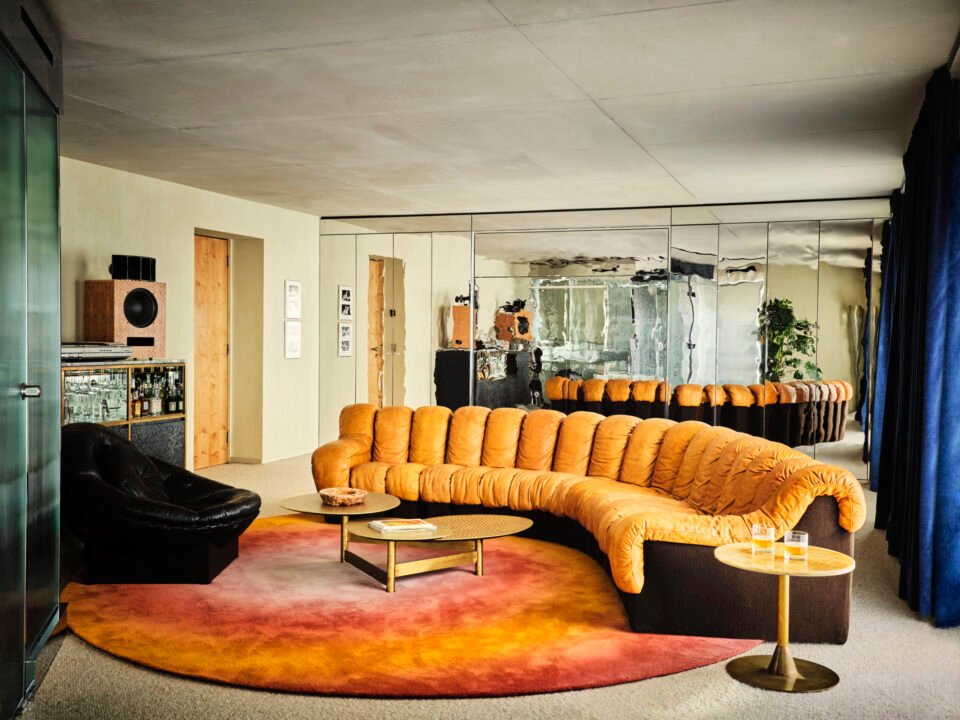
The largest suite – the Dalí Suite, or rock suite – has private access straight to the club and a balcony over the neon. Inside, a modular De Sede DS-600 sofa plays the seventies hard, and a fold-away bed tucks into a mirror-lined alcove. Fournier is candid about what the balcony is for: “It really is a spot, because it overlooks rue Fontaine and gives you the feeling of being in that famous foreground photograph of Patti Smith standing on the balcony of the Chelsea Hotel, with its mythical sign behind her.” The Chelsea is the reference the hotel keeps returning to – a place you check into and find reasons not to leave.
The restaurant, seating 70, is built around a vinyl bar: an entire wall of records, including James Arch’s own collection, bought back so it stays in the building. Banquettes curl around a planted patio, the carpet carries a psychedelic crystal motif, and a glass cube encloses a patch of dense greenery. Downstairs, the basement club (200 capacity, open midnight to five) keeps an L-Acoustics system, a monumental screen and a stage rebuilt almost identically to the original – the one part of the old Bus reproduced line for line.The club was never a bolt-on. The stage sits at the foot of the building and the rooms at the top, with concrete, cork and neon carried through both. The red letters are lit again over rue Fontaine, fronting a building that – the two original doors aside – is almost entirely new, and the fact that it still feels like the Bus Palladium is the harder feat by far. “We want to rediscover that same richness: a variety of ages, faces, social backgrounds, a free spirit, and a real desire to celebrate,” says Saltiel.