
Nearly two and a half months into the year, China’s economy is already booming.
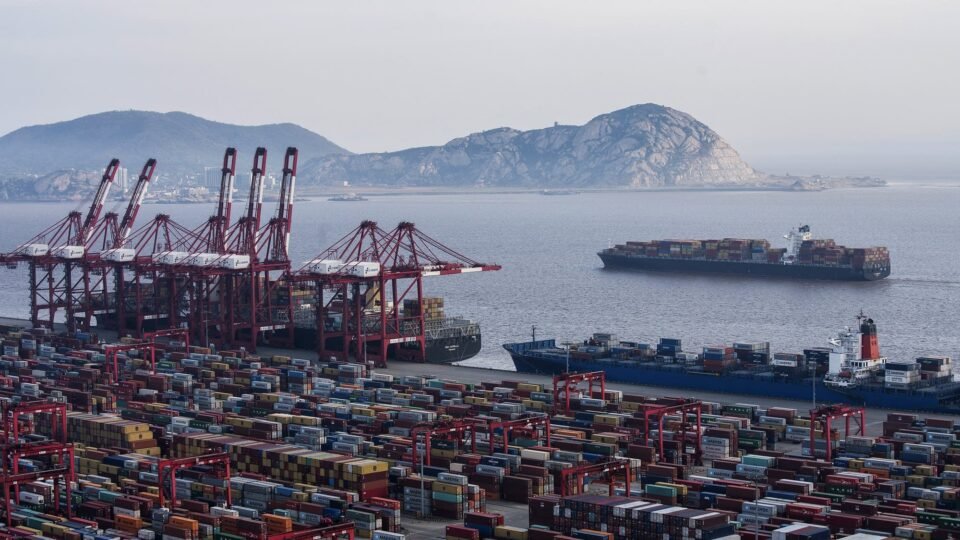
Exports rose more than 21% year over year, bringing the country’s trade surplus to $213.62 billion. That record surplus comes about a week after China unveiled its 15th five-year plan — one that aims to transform the country into a tech-driven global power, while also boosting domestic demand.
That’s no easy feat.
“Marketplace Morning Report” host Sabri Ben-Achour spoke with Logan Wright, a partner at the Rhodium Group who leads the firm’s China Markets Research work, about the plan and what it could mean for us here at home. The following is an edited transcript of their conversation.
Sabri Ben-Achour: China’s five-year plans. One aspect of them is to lay out the industries that China wants to dominate. What are the industries China has its eye on this time around that we should be paying attention to?
Logan Wright: I mean, I think that what China is interested in is developing industrial capabilities that can enhance the productivity of their broader manufacturing base, and they want to ensure that they remain at the center of global supply chains in what they consider sort of the new strategic industries of the future. So that includes battery technology, that includes artificial intelligence, that includes semiconductors, and there’s several others as well. It is more of a security-focused strategy from Beijing than really an economic development strategy,
Ben-Achour: If you’re the U.S. right now, you see China’s roadmap to become more self-sufficient to dominate high tech. What do you do?
Wright: I think the answer to policies that drive disinvestment abroad is to invest, and you need to protect those domestic investments. China is vulnerable to restrictions on trade via tariffs and other non-tariff barriers, but they are not vulnerable to just U.S. action alone. It requires coordinated action on tariffs, and that coordination is difficult precisely because in all countries, it’s not necessarily the worst proposition to have lower cost intermediate goods. This is very much a collective response that’s necessary to reduce the imbalances and the deflationary and disinflationary pressures that China’s manufacturing sector has produced.
Ben-Achour: If the answer is to keep some of that manufacturing out with tariffs, it sounds like we are doing that, but if the other piece of that is to also invest in industries in the U.S., that seems like a very mixed record right now, because the Trump administration is trying to cancel offshore wind projects, the incentives for EVs are gone. It sounds like we’re not hitting the investment side of the equation.
Wright: That’s completely right. There’s very little evidence of an investment response, and the investment response in new capabilities is more important than whatever measures are used to protect domestic markets. If you don’t want China’s overall share of global manufacturing value added to continue increasing, then it might require some protection of those markets and of those sources of demand in the near term, but the important thing is developing the capabilities. And when tariffs are uncertain, when you’re not sure whether tariffs are going to go up or down over time, that discourages investment, and that’s sort of what we’ve seen over the last over the last year or so.