
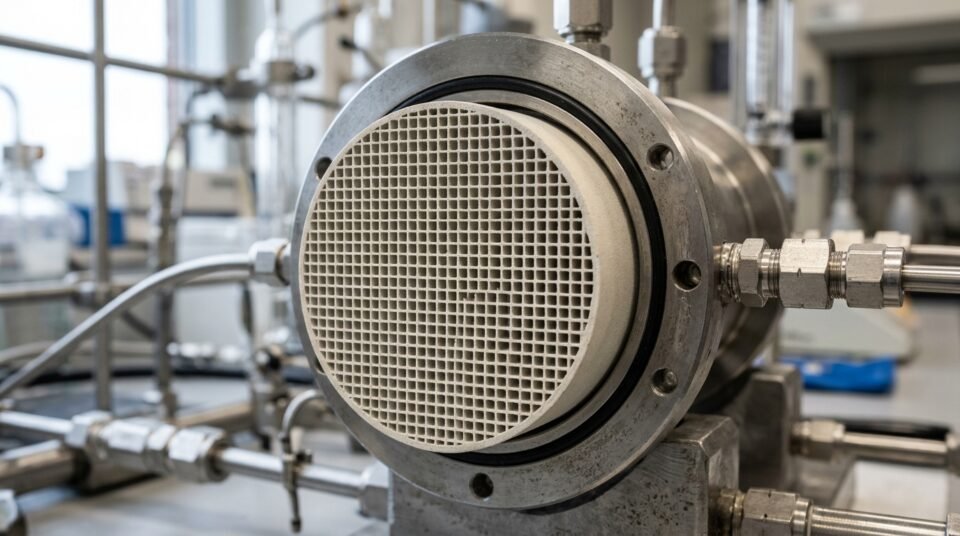
Chemical engineers investigating automotive emission abatement have demonstrated that dynamic light-off curves can reliably determine kinetic parameters and product distributions for the reduction of nitric oxide by carbon monoxide over an alumina-supported palladium catalyst. In gasoline engines, cold-start periods pose an operational hurdle because three-way catalytic converters initially sit at ambient temperatures while receiving pollutant-laden exhaust gases. Although the overarching reaction network targets the conversion of toxic emissions into inert nitrogen gas and carbon dioxide, the partial reduction of nitric oxide can yield nitrous oxide, an undesired byproduct and potent greenhouse gas. The research establishes that rapid temperature-ramped light-off experiments generate kinetic and selectivity trends consistent with conventional steady-state isothermal evaluations, validating a faster and less cumbersome experimental approach for catalyst design.
The study specifically addressed the interaction between nitric oxide and carbon monoxide, which represents one of the foundational reaction pairs responsible for simultaneous pollutant mitigation in catalytic converters. Gasoline vehicle exhaust typically contains nitrogen oxides dominated by nitric oxide, which constitutes approximately 90 to 95 percent of total nitrogen oxide emissions. Stricter environmental standards, such as Brazil’s PROCONVE Phase L8 regulations aligned with Euro 6 benchmarks, enforce stringent ceilings on carbon monoxide, non-methane hydrocarbons, nitrogen oxides, and particulate matter. Understanding the precise kinetic steps governing noble metal catalysts during thermal transients is therefore vital, particularly because nitrous oxide formation occurs across a low-to-intermediate temperature window between 200 and 400 degrees Celsius before the catalyst reaches full operational efficiency.
To evaluate these reaction dynamics, researchers prepared a model catalytic material comprising 0.3 weight percent palladium supported on gamma-alumina via a dry impregnation technique. Calcination of aluminum hydroxide precursor at 500 degrees Celsius for eight hours generated the gamma-alumina substrate, which was subsequently impregnated with an aqueous solution of tetraamminepalladium(II) chloride monohydrate calibrated precisely to match the substrate pore volume. After drying at 110 degrees Celsius for 18 hours and final calcination at 500 degrees Celsius for one hour, inductively coupled plasma optical emission spectroscopy verified the palladium loading at 0.3 weight percent. Nitrogen physisorption at 77 Kelvin revealed that the resulting catalyst retained high surface area and structural integrity, exhibiting a Brunauer-Emmett-Teller surface area of 207 square meters per gram, a pore volume of 0.49 cubic centimeters per gram, and an average pore diameter of 74 angstroms, parameters closely matching the parent alumina support.
Structural and thermal characterizations further demonstrated the high dispersion and physical durability of the active phase across the operating regime. Powder X-ray diffraction patterns displayed characteristic gamma-alumina reflections at 2-theta angles of 45.8 and 66.8 degrees, but lacked distinctive palladium oxide diffraction peaks around 33.8 degrees. This absence confirmed that palladium crystallites remained exceptionally well dispersed below the instrument detection threshold, consistent with low-loading formulations prepared by dry impregnation. Catalyst stability was corroborated by thermogravimetric and differential thermal analysis up to 1200 degrees Celsius under nitrogen flow. Thermodynamic modeling utilizing the Soave-Redlich-Kwong equation of state within the Aspen Plus process simulator confirmed that the reduction reactions are practically irreversible under exhaust conditions, showing complete equilibrium conversion up to 1200 degrees Celsius and confirming that nitrous oxide emergence stems entirely from reaction kinetics rather than chemical equilibrium limitations.
Dynamic catalytic evaluations were carried out in an automated plug-flow microreactor using a U-shaped Pyrex tube with an internal diameter of 6.6 millimeters. The reaction bed contained 120 milligrams of catalyst diluted with silicon carbide at a 1-to-3 mass ratio to eliminate internal hot spots during exothermic conversion. A feed gas mixture consisting of 1.0 mole percent nitric oxide and 1.0 mole percent carbon monoxide balanced in helium was passed through the bed at a space velocity of 115 cubic meters per kilogram per hour, corresponding to gas hourly space velocities between 57,000 and 112,000 reciprocal hours. Prior to testing, drying under helium at 150 degrees Celsius for one hour was established as a standard pretreatment, yielding catalytic performance identical to high-temperature reductive activation under hydrogen due to rapid in situ evolution toward an active partially oxidized palladium state under reaction conditions.
During temperature-programmed experiments, the microreactor was heated from ambient room temperature to 500 degrees Celsius at a constant ramp rate of 2 degrees Celsius per minute while effluent compositions were quantified every seven minutes using gas chromatography. The palladium catalyst displayed outstanding stability and activity across three consecutive heating and cooling cycles, showing no observable deactivation or structural degradation. Nitric oxide light-off, defined at 50 percent conversion, occurred near 300 degrees Celsius, with complete conversion attained at 470 degrees Celsius. Carbon and nitrogen elemental balances were monitored continuously throughout the runs, systematically closing between 95 and 102 percent. The experimental light-off profiles exhibited a characteristic separation between nitric oxide and carbon monoxide conversion curves, driven by the stoichiometry of intermediate nitrous oxide production.
To provide a rigorous benchmark against the transient light-off data, the investigators conducted extensive isothermal tests across three fixed temperature levels of 350, 400, and 450 degrees Celsius. At each temperature, four distinct space velocities—115, 150, 190, and 225 cubic meters per kilogram per hour—were investigated by adjusting catalyst bed mass between 60 and 120 milligrams. The system was allowed to stabilize until reaching a reproducible quasi-steady state, which in certain lower-temperature conditions required operational durations exceeding two hours. This prolonged stabilization reflected furnace thermal inertia and the slower accumulation, decomposition, or desorption of surface intermediates such as carbonates and isocyanates. At higher temperatures, such as 450 degrees Celsius, rapid surface kinetics and the removal of competitive adsorption barriers significantly diminished process inertia, allowing prompt attainment of stable effluent concentrations.
Direct comparison of the isothermal and dynamic datasets revealed that product distribution followed identical underlying mechanistic pathways regardless of the operational protocol. When plotted as a function of overall reactant conversion, nitrous oxide yields traced an identical trajectory in both experimental modes, confirming that the transient temperature ramp did not alter the fundamental reaction mechanisms. Nitrous oxide acted unambiguously as a reaction intermediate, accumulating during the initial stages of conversion, reaching a maximum yield of 0.25 moles per mole around 80 percent nitric oxide conversion at 350 to 375 degrees Celsius, and subsequently declining as higher temperatures promoted secondary reduction into nitrogen gas. Nitrogen yields rose steadily and dominated at temperatures above 400 degrees Celsius, accompanied by an equimolar progression of carbon dioxide formation.
Using the steady-state isothermal dataset, the team formulated a simplified pseudo-first-order kinetic model based on an established surface reaction framework. In this mechanism, the overall reaction network is represented by three primary steps: the direct reduction of nitric oxide by carbon monoxide to form nitrogen and carbon dioxide, the partial reduction of nitric oxide yielding nitrous oxide and carbon dioxide, and the subsequent reduction of nitrous oxide by carbon monoxide to nitrogen and carbon dioxide. Rate equations assumed first-order dependence on nitric oxide for the primary steps and first-order dependence on nitrous oxide for the secondary step. A non-linear simplex optimization algorithm employing the Nelder-Mead method was implemented in Scilab to estimate activation energies and pre-exponential factors by minimizing the sum of squared errors between experimental and calculated molar flow rates.
The kinetic parameters derived from isothermal data aligned closely with literature values for supported noble metal catalysts. The estimated activation energies matched published ranges around 1.19 times 10 to the fifth joules per mole for the direct formation of nitrogen and 7.2 times 10 to the fourth joules per mole for the partial reduction pathway. Kinetic rate calculations demonstrated that the rate of direct nitrogen formation remained the lowest across the entire 250 to 500 degrees Celsius range, establishing that overall nitrogen production proceeds predominantly through the consecutive formation and consumption of the nitrous oxide intermediate. Below 350 degrees Celsius, the rate of nitrous oxide production was dominant, whereas at elevated temperatures the secondary reduction rate accelerated markedly, converting the intermediate species into elemental nitrogen.
When these isothermal kinetic parameters were integrated into ordinary differential mass-balance equations in Wolfram Mathematica to simulate continuous reactor behavior, the model successfully reproduced both the isothermal profiles and dynamic light-off curves. The simulations captured the transient rise and fall of nitrous oxide, the overlap between carbon monoxide consumption and carbon dioxide appearance, and the spatial distribution of species along the catalyst bed. Discrepancies were modest and restricted primarily to temperatures below 350 degrees Celsius, where rapid shifts in catalyst surface coverage and thermal stabilization within the packed bed created slight offsets between dynamic measurements and simplified pseudo-first-order predictions. The researchers concluded that dynamic light-off curves capture genuine Arrhenius behavior because exponential kinetic acceleration dominates over slower sorption delays, providing a sound, accelerated methodology for assessing automotive catalyst formulations under realistic transient heating regimes.
Subject of Research: Heterogeneous catalysis and reaction kinetics of nitric oxide reduction by carbon monoxide over palladium-alumina catalysts
Article Title: Assessing the Accuracy of Isothermal Kinetic Tests in Reproducing Light-Off Profiles for Pd/Al₂O₃ Catalyzed NO–CO Reactions
Article References: Mello, N. M., Montani, S. D. S., Guimarães, M. M., Zotin, J. L. Z., Palacio, L. A., Zotin, F. M. Z., Costa, A. L. H., & Zotin, J. L. (2026). Assessing the Accuracy of Isothermal Kinetic Tests in Reproducing Light-Off Profiles for Pd/Al₂O₃ Catalyzed NO–CO Reactions. Brazilian Journal of Chemical Engineering. https://doi.org/10.1007/s43153-026-00676-2
Image Credits: AI Generated
DOI: 10.1007/s43153-026-00676-2
Keywords: Heterogeneous Catalysis, Palladium Catalyst, Gamma-Alumina, Nitric Oxide Reduction, Carbon Monoxide Oxidation, Nitrous Oxide Emissions, Light-Off Curves, Isothermal Kinetics, Reaction Kinetics, Automotive Catalytic Converters, Cold Start Emissions, Plug-Flow Microreactor, Three-Way Catalysts, Surface Reaction Mechanisms, Kinetic Modeling, Nelder-Mead Algorithm