
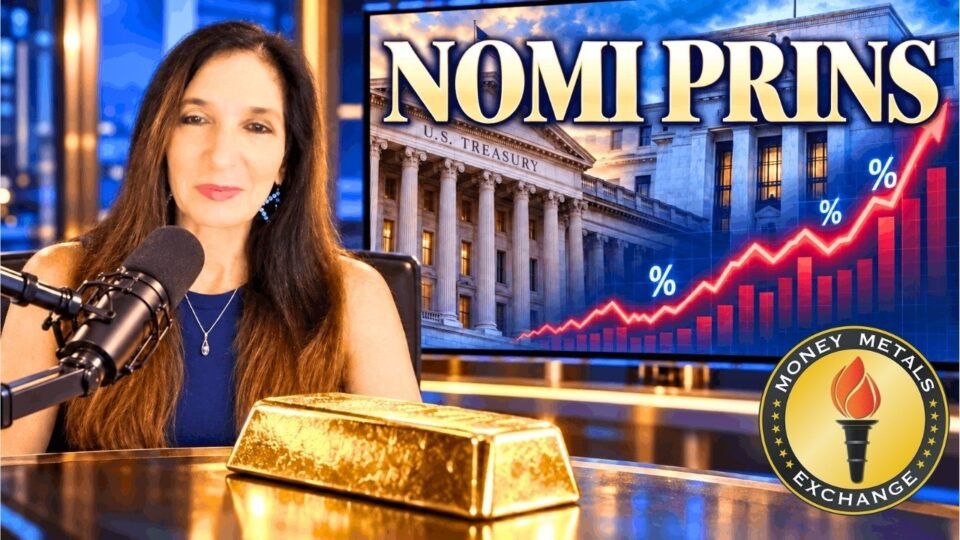
On a recent episode of Money Metals Weekly Market Wrap, the Money Metals podcast, host Mike Maharrey spoke with Nomi Prins about higher interest rates, rising oil prices, Treasury market strain, and accelerating government debt. Prins argued that these forces continue to reinforce the case for holding gold.
Don’t Sell Gold Because of a Fed Rate Hike
The Federal Reserve raised its benchmark rate by 25 basis points on Sept. 16, moving the federal funds target range to 3.75 percent to 4.00 percent. For many investors, a rate hike raises an immediate question about whether to sell gold.
Nomi Prins’ answer was emphatic. Speaking with Money Metals Weekly Market Wrap host Mike Maharrey, the author and international political economy analyst said the proper response is not to sell gold, but to add more.
Prins said gold had reached all-time highs near $5,500 an ounce before the Iran war and later fell in two stages as the conflict began and the prospect of a quick resolution faded. Since then, she said gold has settled into a healthy range around $4,300 to $4,400.
That consolidation, in her view, reflects a market with durable underlying demand. Short-term volatility has not changed gold’s long-term support from central banks, retail investors, and buyers seeking a physical monetary asset outside the financial system.
Oil Above $100 Is Driving the Inflation Debate
Prins said the Fed’s move was shaped by oil prices that had pushed above $100 per barrel. Oil previously retreated toward $80, easing inflation pressure, before rising again.
The Fed can raise the cost of money, but it cannot produce oil, open the Strait of Hormuz, create gold, or create silver. Prins argued that this is the key limitation in the popular claim that the central bank can simply control inflation through interest rates.
If oil returns to roughly $80 or $90 on a geopolitical resolution, inflation readings could decline. But Prins stressed that any such decline would come from lower energy costs, not because the Fed raised rates by 25 basis points.
The rate increase is more likely to land directly on households. Consumers with high credit-card balances, adjustable-rate mortgages, and home-equity loans can face higher monthly costs. Prins noted that these pressures arrive in an economy where people already see higher prices at the grocery store, gas station, and pharmacy.
Central Banks Keep Buying Gold
Prins said central banks registered their largest quarter of gold buying on record in the second quarter of 2026. They are using gold as a reserve asset, a diversification tool, a geopolitical hedge, a trade asset, and a sovereignty play.
That demand has remained in place despite the rise in Treasury yields. The People’s Bank of China, for example, is holding Treasury bonds at all-time lows while continuing to buy gold. The conventional argument is that Treasury yields near 5 percent should make bonds more attractive than gold because gold does not pay interest.
But Prins countered that gold has doubled over the last two years, even after its recent pullback. It may not provide an interest payment, but it can offer price appreciation, purchasing-power preservation, and protection against physical supply scarcity.
She also pointed to strong Western investment demand. Gold ETFs recorded a second record month in August, as buyers returned during a period when oil prices had declined, and hopes for a resolution in the Middle East briefly improved.
Dollar Weaponization Has a Counterweight
Maharrey asked whether the U.S. government’s use of the dollar as a foreign-policy tool is accelerating the so-called debasement trade. Prins said the U.S. is attempting to use the dollar as leverage, but other countries have a clear counter-response. They buy more gold.
She said the freezing and sanctioning of Russian assets after Russia invaded Ukraine helped accelerate central-bank gold accumulation. The reaction was not confined to countries facing an immediate threat. Gold buying became a more established reserve-management practice across central banks.
Every new use of the dollar, U.S. government policy, or U.S. Treasuries as a geopolitical tool gives foreign monetary authorities another reason to diversify. Prins said this dynamic must be considered alongside the traditional focus on Treasury yields.
Treasury Buybacks Are Tiny Against $40 Trillion in Debt
The Treasury Department bought back $6 billion in long-term Treasuries and announced another $6 billion operation the following day. Maharrey noted that the 30-year Treasury yield continued moving higher, reaching a session high near 5.38 percent and later nudging to 5.42 percent before the next buyback.
Prins called the operations a form of beta testing for a larger Treasury buyback program. Treasury Secretary Scott Bessent had discussed such a plan from the beginning of his tenure, she said, and the current operations show that the government has begun building the systems, language, and market expectations for a potentially larger program.
Still, $6 billion is negligible beside more than $40 trillion in U.S. public debt and roughly $1 trillion in annual interest costs. The government is effectively trying to reduce debt by issuing more debt, a circular process that resembles quantitative easing.
Prins traced the precedent back to the Panic of 1907, when the Treasury Department conducted a $25 million buyback before the Federal Reserve existed. The current effort may give the Treasury a tool it can use independently of the Fed, whether in a future market crisis, a war-related emergency, or a period of more serious debt stress.
A Gold Market Waiting for Breathing Room
Prins said the Iran conflict and high oil prices have created a temporary lid on gold. Even so, gold had started moving back toward $4,600 and $4,700 before the latest volatility and renewed attention to the Fed’s rate hike.
She expects gold buyers who entered around $4,300 to $4,400 to become more comfortable accumulating as the market steadies. ETF investors can move quickly in and out of positions, but central banks and sovereign wealth funds need physical gold. That difference matters because physical supply, new mine development, and access to dependable jurisdictions remain constrained.
For Prins, gold’s long-term outlook depends less on any single Fed meeting and more on the continuing demand from buyers who want a scarce, physical asset. Rate hikes may cause short-term price moves, but they do not resolve the debt problem, create commodities, or eliminate the incentive for central banks to diversify.
Commodity Wars and the Next Phase of the Global Economy
Prins is completing the manuscript for a new book, Commodity Wars, which she expects to be published in late 2027 or early 2028. The book examines the historical and current role of physical commodities in international competition.
In addition to gold and silver, it will cover uranium, copper, antimony, tungsten, and other strategic materials. Prins said countries use hard assets as weapons and as defenses, a pattern that has become more important in an era of financialization, debt expansion, and geopolitical conflict.
For more from
Nomi Prins
, visit NomiPrins.com and Printsights.Substack.com. For analysis of gold, silver, inflation, the Federal Reserve, Treasury markets, and sound money, follow Money Metals Weekly Market Wrap.
Originally Published on Money Metals.