
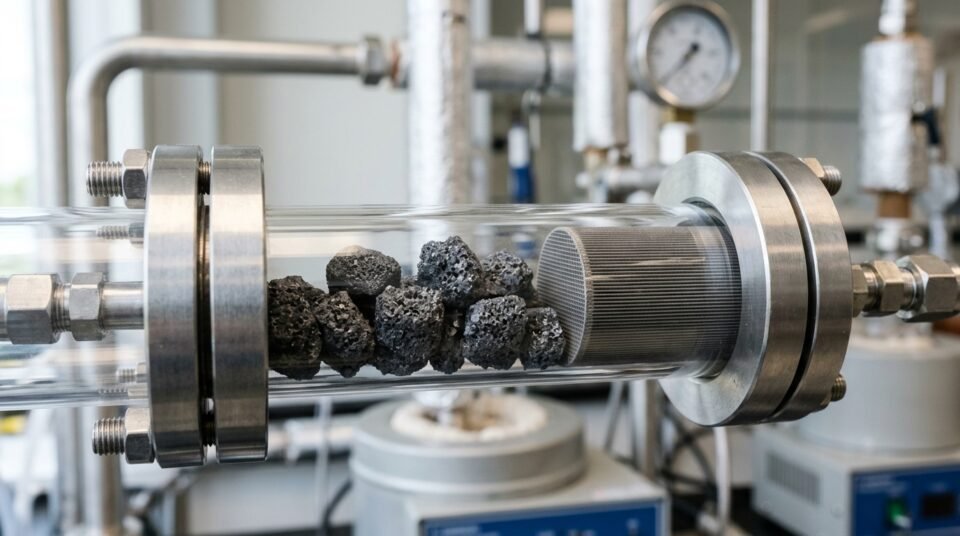
A comprehensive academic review covering international literature from 2010 to 2024 evaluates how tailored metal oxide catalysts and inorganic perovskites accelerate the thermochemical breakdown of ammonia into zero-carbon hydrogen. Hydrogen gas serves as an exceptional clean fuel and secondary energy transporter due to its substantial energy content per unit mass, yet its lower heating value volumetric energy density of 9.9 megajoules per cubic meter poses severe technical challenges for long-range transport and commercial storage. Because hydrogen distribution via conventional pressurized pipelines introduces significant risks of flammability, volatility, and microscopic joint leakages, ammonia has emerged as a practical chemical hydrogen vector. Composed of 17.6 weight percent hydrogen with zero intrinsic carbon, liquid ammonia provides an established intercontinental transport infrastructure encompassing maritime chemical carriers, subterranean storage caverns, pressurized tanker trucks, and transcontinental rail networks. While global hydrogen manufacturing remains heavily dependent on fossil energy, generating substantial carbon dioxide emissions and leaving less than 5 percent of current global production certified as green, catalytic ammonia cracking into a stoichiometric mixture of 75 percent hydrogen and 25 percent nitrogen gas offers an emission-free pathway to support global targets of net-zero greenhouse gas emissions by 2050.
The endothermic decomposition of ammonia requires an enthalpy change of 46 kilojoules per mole, meaning that ambient pressure systems demand operating temperatures above 180 degrees Celsius to initiate cracking and near 400 degrees Celsius to reach a 99 percent thermodynamic equilibrium conversion. Industrial reactor configurations often favor elevated pressures between 1 and 40 bars to shrink system footprints and lower downstream gas compression requirements, yet elevated operating pressures unfavorably shift thermodynamic equilibrium and accelerate reverse synthesis reactions. Researchers evaluate reaction kinetics through power-law models alongside Langmuir-Hinshelwood and micro-kinetic frameworks, noting that ammonia partial pressure promotes decomposition velocity whereas elevated product concentrations of dinitrogen and dihydrogen inhibit overall conversion. Catalytic ammonia dissociation progresses across three primary elementary phases: initial chemisorption of gaseous ammonia molecules onto metallic surface sites, consecutive stepwise dehydrogenation steps that generate adsorbed amidogen, imidogen, and elemental adatoms, and the final recombinative desorption of dinitrogen and dihydrogen gas molecules. Theoretical analyses indicate that the process is consistently governed by one of two distinct rate-limiting steps: the initial scission of the primary nitrogen-hydrogen bond during surface dehydrogenation, or the recombinative associative desorption of tightly bound dinitrogen atoms from active metal facets.
Empirical rankings establish that catalytic decomposition activity across supported metallic nanoparticles systematically decreases in the order of ruthenium, followed by nickel, rhodium, cobalt, iridium, iron, platinum, chromium, palladium, and copper, with tellurium, selenium, and lead displaying minimal activity. Ruthenium remains the benchmark elemental catalyst because its dissociative nitrogen adsorption enthalpy aligns closely with the peak of Sabatier volcano plots, falling directly within the optimal nitrogen binding energy window between 544 and 586 kilojoules per mole. When an active metal binds elemental nitrogen too aggressively, recombinative dinitrogen desorption is severely obstructed, poisoning the catalyst surface under steady-state conditions; conversely, excessively weak metal-nitrogen bonds fail to supply adequate thermodynamic driving force to trigger the initial nitrogen-hydrogen bond scission. Because precious metals such as ruthenium, rhodium, iridium, platinum, and palladium exhibit relatively weak metal-nitrogen chemisorption energies, their overall decomposition rates are kinetically throttled by initial dehydrogenation barrier heights. In contrast, earth-abundant transition metals including nickel, cobalt, and iron bind surface nitrogen adatoms with higher affinity, making recombinative dinitrogen desorption the governing rate-determining stage that dictates catalytic turnover frequency.
Because the high cost and scarce supply of noble ruthenium restrict extensive commercial scale-up, catalytic research has increasingly focused on optimizing non-precious nickel and cobalt formulations supported on basic metal oxides. Support basicity exerts a profound influence on ammonia cracking kinetics by modulating the local electronic density of deposited active metal nanoparticles. Transition metal surfaces supported on electron-donating basic oxides such as magnesium oxide, calcium oxide, cerium dioxide, and lanthanum oxide exhibit accelerated dinitrogen desorption compared to those supported on neutral or acidic substrates like silica or acidic zirconia. Basic sites supply electron density to the transition metal centers, lowering the activation energy barrier required for adjacent surface nitrogen atoms to recombine and desorb into the gas phase. Furthermore, promotional dopants including alkali metals such as potassium, lithium, cesium, and sodium, alkaline-earth elements like barium, strontium, and calcium, and rare-earth additions such as lanthanum and cerium systematically expand the population of active basic centers, lower intermediate activation barriers, and stabilize transient charge balances across catalyst surfaces during prolonged thermal operation.
Solid oxide supports also modify catalytic behavior through strong metal-support interactions, charge transfer mechanisms, perimeter active boundary formation, and structural nanoparticle stabilization against high-temperature agglomeration. Unstabilized metal nanoparticles remain thermodynamically vulnerable to thermal sintering and coalescence during severe thermal processing, which drastically reduces accessible surface areas and lowers turnover frequencies. Mesoporous metal oxide frameworks synthesized through surfactant-assisted, nano-casting, sol-gel, or co-precipitation routes deliver high surface areas that disperse metal crystallites uniformly across accessible pore networks. For instance, mesoporous ceria-zirconia supports engineered with elevated surface areas promote efficient hydrogen spillover from active metallic nickel sites toward the underlying oxide lattice through interfacial metal-oxygen-metal bonds. Because surface hydrogen adatoms compete directly with incoming ammonia molecules for catalytic active sites, particularly at lower operating temperatures and elevated dihydrogen partial pressures, this spillover mechanism alleviates active-site blockage and preserves continuous steady-state ammonia turnover.
Inorganic perovskite oxides possessing the general ABO3 crystalline formulation introduce unprecedented opportunities for rational catalyst architecture due to their exceptional structural flexibility, mixed ionic-electronic conductivity, and robust thermal stability. Within the typical perovskite lattice, larger alkaline-earth or rare-earth cations occupy the twelve-fold coordinated A-sites, while smaller catalytic transition metals such as nickel, cobalt, or iron occupy the octahedrally coordinated B-sites. The structural integrity and crystallographic symmetry of these mixed oxides are defined by the Goldschmidt tolerance factor, where ionic radius ratios govern transitions between ideal cubic symmetries and distorted orthorhombic or rhombohedral phases. Isovalent and aliovalent partial substitutions at the A-site, the B-site, or both positions generate complex multi-cationic formulations capable of altering transition metal valence states and adjusting the occupancy of catalytic e-g orbitals. These substitutions modulate local p-d orbital hybridization and metal-oxygen bond covalency, directly regulating surface chemical adsorption energies and enhancing catalytic resistance to high-temperature structural degradation.
Beyond serving as stable bulk catalysts, perovskite oxides function as sophisticated catalytic supports that enable in situ exsolution of anchored transition metal nanoparticles under controlled reducing atmospheres. When exposed to reducing conditions at elevated temperatures, transition metal cations situated within the bulk B-sites migrate toward the external oxide surface, nucleating as finely dispersed, highly stable metallic nanoparticles anchored directly into the parent oxide lattice. This exsolution process creates unique socketed interfaces between the nucleated metal nanoparticles and the host substrate, preventing severe metal sintering and particle coalescence during sustained operation above 500 degrees Celsius. For example, the controlled reduction of lanthanum nickelate perovskites yields finely dispersed nickel nanoparticles socketed securely across lanthanum oxide matrices. Furthermore, perovskites doped with basic cations exhibit enhanced proton transport characteristics via the hydration of lattice oxygen vacancies, enabling rapid interfacial proton conduction away from active metal surfaces to mitigate competitive hydrogen poisoning during continuous cracking reactions.
Atomic-level insights derived from density functional theory calculations and spin-polarized electronic modeling have illuminated the critical importance of specific crystallographic metal facets, defect structures, and localized active site geometries. Computational simulations demonstrate that ammonia adsorption and subsequent dehydrogenation depend strongly on surface terrace and step coordination. For ruthenium nanoparticles, exceptional catalytic efficiency is predominantly governed by the abundance of B5-type active sites, which consist of three ruthenium atoms in a close-packed terrace layer coordinated with two step-edge atoms situated in the adjacent atomic layer above. These irregular B5-type ensembles form at the intersections of crystallographic planes and reach their highest surface concentration on ruthenium crystallites sized precisely between 2 and 3 nanometers, beyond which particle agglomeration diminishes site density. On nickel catalysts, the nickel (110) and nickel (100) facets demonstrate lower activation energy barriers for initial nitrogen-hydrogen dissociation and subsequent nitrogen desorption compared to close-packed surfaces. On iron-based catalysts, stepped (111) and (211) surfaces containing seven-coordinated C7 active sites display markedly higher turnover frequencies than planar terraces, confirming the governing role of nanoscale surface geometry.
Theoretical simulations further connect catalytic reactivity to electronic descriptors including surface oxygen vacancy formation energies and the d-band center position relative to the Fermi energy level. Inducing localized oxygen vacancies within oxide lattices modifies the local electronic structure and enhances metal dispersion, generating interfacial coordination environments that accelerate reaction kinetics. Simultaneously, the Hammer-Norskov d-band center model illustrates how shifts in the d-electron density of states govern adsorbate binding strength, where metal surfaces with d-band centers positioned closer to the Fermi level exhibit stronger intermediate chemisorption but require higher activation energies for subsequent reaction steps. Computational frameworks also clarify deactivation pathways that undermine long-term catalyst stability, distinguishing between reversible surface poisoning and permanent thermal deterioration. Prolonged thermal exposure between 500 and 800 degrees Celsius can trigger metal volatilization through the generation of transient metal nitrides, amides, or suboxides, while unmitigated metal sintering progressively degrades surface active area, emphasizing the necessity of engineering thermally durable, defect-stabilized interfaces.
Addressing the technical bottlenecks of ammonia cracking requires moving beyond conventional empirical screening toward predictive, multi-scale catalyst design. While conventional binary metal oxides offer inexpensive, straightforward synthesis routes, their limited electronic tunability and susceptibility to competitive poisoning hinder low-temperature operation. Inorganic perovskite oxides and compositionally complex multi-cationic materials provide superior control over defect chemistry, surface basicity, and exsolution dynamics, yet their lower baseline surface areas and complex crystallization pathways necessitate further synthetic refinement. Bridging the gap between fundamental laboratory discoveries and commercial hydrogen production will depend on establishing standardized kinetic evaluation protocols, measuring rigorous intrinsic turnover frequencies under realistic industrial pressures, and tailoring catalyst interfaces that decouple nitrogen-hydrogen bond activation barriers from recombinative nitrogen desorption energies. Continued integration of atomic-scale computational modeling with robust materials engineering will be essential to establish durable, high-efficiency catalytic cracking systems capable of unlocking ammonia as a cornerstone of the global renewable hydrogen economy.
Subject of Research: Catalytic materials and reaction mechanisms for ammonia decomposition into clean hydrogen fuel
Article Title: Advances in catalysts development and catalytic activity trends of conventional metal oxides and inorganic perovskites for hydrogen production via ammonia decomposition: a review
Article References: Maqunga, N. P., Opembe, N., Mathaba, M., & Bingwa, N. (2026). Advances in catalysts development and catalytic activity trends of conventional metal oxides and inorganic perovskites for hydrogen production via ammonia decomposition: a review. Discover Catalysis, 3(1), Article 5. https://doi.org/10.1007/s44344-026-00034-x
Image Credits: AI Generated
DOI: 10.1007/s44344-026-00034-x
Keywords: Ammonia decomposition, Hydrogen production, Heterogeneous catalysis, Perovskite oxides, Metal oxide catalysts, Ruthenium catalysts, Nickel catalysts, Reaction kinetics, Rate-determining steps, Nitrogen desorption, Hydrogen poisoning, Catalyst deactivation, Exsolution, Density functional theory, Renewable energy storage, Active site engineering, Surface basicity