
The Hidden Material Layer Powering Every AI Data Center
Most conversations about the physical infrastructure of artificial intelligence orbit a familiar set of materials: silicon for chips, copper for interconnects, lithium for batteries, and water for cooling. These are legitimate concerns, but they collectively obscure a deeper and more structurally complex materials challenge quietly embedded inside every hyperscale facility. Six rare, chemically similar, and geographically concentrated metals sit at the hardware layer beneath the hardware layer, enabling the storage, power resilience, and electronic components that make AI infrastructure function at scale. These are platinum group metals in AI data centers, and their supply dynamics are about to become one of the most consequential materials stories of the coming decade.
Understanding why requires looking not at chip fabrication roadmaps or battery chemistry breakthroughs, but at the physics of magnetic data storage, the electrochemistry of hydrogen fuel systems, and the economic geology of a handful of ore deposits in southern Africa and Russia.
When big ASX news breaks, our subscribers know first
The six platinum group metals — platinum, palladium, rhodium, ruthenium, iridium, and osmium — occupy an unusual position in the materials hierarchy. They are simultaneously precious metals, industrial catalysts, and critical minerals. Their chemical properties, including exceptional resistance to corrosion, high melting points, remarkable catalytic activity, and stable electrical conductivity under extreme conditions, make them nearly impossible to substitute in many of their highest-value applications.
What makes PGMs genuinely distinctive from a supply chain perspective is their geological co-occurrence. These metals are not found in separate deposits that can be mined selectively. They exist together in ore bodies, extracted as a basket, with the production economics of any single metal determined by the viability of mining the entire assemblage. This creates a supply architecture that is fundamentally inelastic in ways that lithium or copper are not. Furthermore, PGM supply constraints are structural rather than cyclical, meaning short-term capital investment cannot resolve them.
- A surge in demand for ruthenium cannot trigger a targeted increase in ruthenium output without simultaneously increasing platinum, palladium, rhodium, and iridium production.
- The economic driver for PGM mining has historically been platinum and palladium, whose combined market dominance subsidises the extraction of rarer co-products.
- If the primary economic drivers weaken, the entire basket suffers, including the niche metals now emerging as critical AI infrastructure materials.
“Critical Insight: The co-production constraint means PGM supply inelasticity is structural, not temporary. No amount of capital investment in mining can rapidly decouple ruthenium or iridium output from the broader basket economics. This is a fundamental limit that AI hardware supply chains have not yet priced in.”
Among the six PGMs, ruthenium is the metal most directly tied to AI data center expansion, and it is the one least familiar to most technology and investment analysts.
Hard disk drives remain the dominant storage medium for cold and warm data tiers in hyperscale data centers. Despite the growing prevalence of solid-state drives in performance-critical applications, HDDs retain a decisive cost-per-terabyte advantage for storing the enormous datasets used to train and operate AI models. The economics of storing petabytes of training data on SSDs remain prohibitive at hyperscale, which means HDD demand is not declining — it is growing in absolute terms alongside AI infrastructure expansion.
Ruthenium performs a specific and difficult-to-replace function within the magnetic recording layers of hard disk drives. Its presence enables higher areal data density, meaning more data can be stored on the same physical area of disk surface. This is not a peripheral application. It is central to the storage density roadmap that allows data center operators to meet exponentially growing storage requirements without proportional increases in physical footprint or cost.
Why HAMR Technology Deepens Ruthenium Dependency
The transition to heat-assisted magnetic recording (HAMR) technology extends ruthenium’s importance further. HAMR pushes storage density beyond the limits of conventional perpendicular magnetic recording by using a laser to briefly heat the recording medium during writing. Ruthenium and platinum alloys in iron-platinum (FePt) configurations provide the thermal stability and magnetic coercivity required for HAMR media to function reliably. This makes both metals structurally embedded in the next generation of storage technology, not merely the current one.
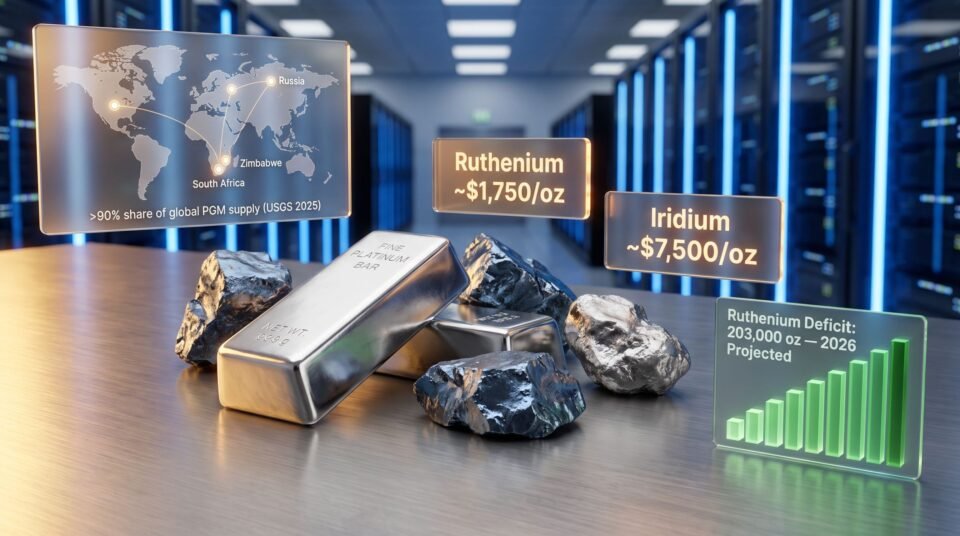
The market has begun to reflect this dynamic. According to Reuters reporting from March 2026, ruthenium prices climbed from approximately $560 per ounce to around $1,750 per ounce over the preceding twelve months, driven by tightening supply against accelerating data center procurement. Metals Focus projected a 203,000-ounce ruthenium supply deficit for 2026, a figure directly linked to AI infrastructure demand growth. (Source: Reuters, March 2026; Metals Focus, 2026)
Platinum operates across two distinct AI data center functions simultaneously, which is part of what makes its demand trajectory so compelling to analysts tracking the intersection of AI infrastructure and critical minerals demand.
In the storage layer, platinum contributes to the advanced magnetic recording media used in high-density HDDs, particularly within FePt alloy structures designed for HAMR technology. Its high magnetic anisotropy — the property that determines how strongly a material resists changes to its magnetisation — makes it essential for achieving the thermal stability that HAMR requires at extreme data densities.
In the power layer, platinum functions as a catalyst in proton exchange membrane (PEM) fuel cells, which are increasingly being evaluated and deployed as backup power systems for large data campuses. PEM technology expansion is consequently creating a secondary demand channel for platinum that operates independently of automotive and industrial applications. PEM fuel cells offer several operational advantages over traditional diesel generators:
- Response time: PEM fuel cells can reach full power output significantly faster than diesel generator systems.
- Emissions profile: Fuel cell backup power generates water and heat rather than particulate matter and NOx emissions.
- Operational alignment: Corporate sustainability commitments are creating institutional pressure to move away from diesel backup at scale.
- Grid resilience: Fuel cells can operate independently of grid power for extended periods when paired with adequate hydrogen storage.
Industry analyst estimates suggest that combined platinum and ruthenium demand from AI data center construction could reach 200,000 to 400,000 ounces, with projections pointing toward significantly higher consumption as the buildout continues toward 2030.
Iridium: The Rarest Bottleneck in Green Hydrogen Backup Power
Iridium sits at an even more constrained position in the PGM supply hierarchy. It is produced almost exclusively as a byproduct of South African PGM mining, with no primary iridium mining operations anywhere in the world. Global annual production is measured in a few tonnes, and its price reflects this chronic scarcity, trading at approximately $7,500 per ounce as of 2026.
The connection between iridium and AI data centers runs through PEM electrolyser technology. PEM electrolysers use electricity to split water into hydrogen and oxygen, producing green hydrogen that can serve as a long-duration energy storage medium and backup fuel source for large-scale data campuses. Iridium is the catalyst of choice for the oxygen evolution reaction in PEM electrolysers, a function for which no commercially viable substitute currently exists at scale.
Johnson Matthey’s 2026 PGM market assessment indicated that iridium is expected to remain in deficit, with the first commercial-scale deployment of iridium in PEM electrolysis for green hydrogen emerging in 2026. (Source: Johnson Matthey PGM Market Report, 2026)
“Speculative Scenario: If PEM electrolyser deployment accelerates faster than efforts to reduce iridium loadings per unit of output, iridium’s annual production volume could become a hard physical ceiling on the pace of green hydrogen infrastructure deployment. Unlike copper or aluminium, where production can be scaled through investment and exploration, iridium output is structurally bounded by the economics of co-production mining.”
The AI Data Center Materials Landscape: A Structured Overview
| PGM | Primary AI Data Center Function | Secondary Function | Supply Constraint Level |
|---|---|---|---|
| Ruthenium | HDD magnetic recording layers, HAMR media | Electrical contacts, catalysts | Very High (deficit 2026) |
| Platinum | FePt HAMR media, PEM fuel cell catalyst | Electronic components | High (deficit expected) |
| Iridium | PEM electrolyser catalyst (green hydrogen) | Specialty alloy hardening | Extreme (byproduct only) |
| Palladium | MLCCs, electronic components, contacts | Chemical process catalysts | Moderate (near surplus) |
| Rhodium | Specialty alloys, electronic durability | ICE catalytic converters | Moderate (easing) |
| Osmium | Narrow scientific applications | Not significant in AI stack | Not on U.S. critical minerals list |
The next major ASX story will hit our subscribers first
How AI Demand Interacts With PGM Market Scale
A figure that rarely appears in AI infrastructure discussions is the total size of the global PGM market: approximately $45 billion, comparable in total value to lithium and nickel markets, but operating at dramatically lower physical volumes. This scale asymmetry is what makes AI data center demand so consequential even at relatively modest ounce volumes.
The International Energy Agency projects global data center electricity consumption to approximately double from 485 terawatt-hours in 2025 to 950 TWh by 2030, with AI-specific data center power demand expected to grow at roughly three times the overall rate over the same period. (Source: IEA, 2025 estimates)
In large commodity markets, a new demand vector representing two to three percent of global consumption is a rounding error. In PGM markets, however, particularly for co-produced niche metals like ruthenium and iridium, the same percentage shift can represent a structurally significant portion of global supply. This is the key analytical insight that mainstream commodity models have not yet integrated: AI data center demand for platinum group metals in AI data centers does not need to rival automotive demand to move prices and expose supply vulnerabilities.
“Market Psychology Insight: Commodity markets price expectations, not just current consumption. Once the AI data center demand vector for ruthenium becomes a standard line item in PGM market models — which it currently is not — the repricing of future supply risk could be rapid and significant. Investors who understand this analytical gap before it closes hold an informational advantage.”
Geographic Concentration: Mapping the Supply Chain Vulnerability
| Country | Palladium Production 2025 (kg) | Platinum Production 2025 (kg) |
|---|---|---|
| South Africa | 70,000 | 120,000 |
| Russia | 84,000 | 20,000 |
| Zimbabwe | 15,000 | 18,000 |
| Combined Share of Global Supply | >90% | >90% |
(Source: U.S. Geological Survey, 2025 estimates)
The three-country concentration of PGM supply creates systemic exposure for AI hardware procurement chains that currently receives far less attention than rare earth dependency or lithium supply concentration. Geopolitical tensions involving Russia, which contributes the largest share of global palladium supply, represent a supply shock risk that has no near-term domestic mitigation strategy for the United States.
The U.S. domestic PGM footprint is minimal. The USGS reported that a single company in Montana conducted primary PGM mining and processing in 2025, with minor byproduct recovery from copper-nickel operations in Michigan. After accounting for catalytic converter recycling, U.S. net import reliance sits at approximately 57% for palladium and 89% for platinum, placing these metals among the highest critical mineral import dependencies in the national supply chain. (Source: USGS, 2025)
The Critical Minerals Hub’s Amanda Van Dyke has described PGMs as representing one of the most geographically concentrated mineral supply chains in existence, noting that any disruption would immediately cascade through U.S. manufacturing, regulatory compliance, and high-value technology production. (Source: Amanda Van Dyke, Critical Minerals Hub, Substack)
The Automotive Transition Paradox: Why Declining ICE Demand Could Hurt AI Supply Chains
One of the least-discussed dynamics in PGM supply chain analysis is the economic paradox created by the automotive transition. Catalytic converters for internal combustion engine vehicles remain the single largest domestic use of PGMs in the United States, according to USGS data. The slow decline of this demand vector, driven by battery EV adoption, is commonly framed as a headwind for PGM markets.
The more complex reality is that catalytic converter production finances the mining economics that make PGM extraction viable. If palladium and rhodium demand deteriorates faster than new demand vectors from hydrogen, electronics, and AI data storage can compensate, the profitability of PGM mining operations could erode, reducing output of every co-produced metal simultaneously.
This creates a counterintuitive supply chain risk: the faster the automotive sector transitions away from ICE vehicles, the more vulnerable AI data center supply chains could become for ruthenium and iridium. In addition, the critical minerals for semiconductors compound this vulnerability further, as overlapping demand pressures converge on a constrained supply base.
What the PGM Basket Signals for 2026 and Beyond
Johnson Matthey’s 2026 PGM market analysis reflects the divergent trajectories now operating simultaneously within the basket. Platinum demand is expected to exceed supply in 2026 even as EV production rises, driven by industrial, hydrogen, and data center applications. Palladium is moving toward a small surplus as gasoline vehicle production declines and catalytic converter recycling volumes increase. Rhodium demand pressure is easing as ICE vehicle production contracts. (Source: Johnson Matthey PGM Market Report, 2026)
The PGM basket is not moving in a single direction. Understanding which metals within it face tightening versus loosening supply-demand balances is therefore essential for both supply chain planners and investors.
Recycling: Where the Secondary Supply Story Has Limits
PGMs benefit from a more mature recycling infrastructure than most critical minerals, primarily because spent catalytic converters are a well-established and economically viable secondary source. The USGS estimated that approximately 140,000 kg of palladium and platinum combined were recovered from new and old scrap globally in 2025, including around 50,000 kg of palladium and 8,600 kg of platinum recovered from catalytic converters in the United States alone. (Source: USGS, 2025)
This recycling pathway is a genuine strategic asset for platinum and palladium supply chains. It provides a domestic secondary source that reduces import dependence and buffers against geopolitical supply disruptions.
However, the recycling story breaks down precisely where AI data center demand is most acute. Iridium and ruthenium have no mature, high-volume recycling infrastructure. Their recovery from end-of-life electronics and industrial applications remains technically complex, and the processing challenges associated with recovering these metals from data center hardware are considerable. Hard disk drives, the primary AI data center application for ruthenium, are long-lived assets with slow fleet turnover, meaning secondary supply from decommissioned data center hardware will not provide meaningful relief for years.
Future circular economy pathways for PGMs in AI applications will require investment in:
- E-waste processing infrastructure capable of economically recovering ruthenium from HDD magnetic layers.
- Spent PEM fuel cell recovery systems capable of reclaiming platinum from data center backup power units.
- Industrial catalyst recycling pathways for iridium from decommissioned electrolyser installations.
- Data center decommissioning protocols that treat PGM-containing hardware as secondary mineral resources rather than waste streams.
A Supply Chain Risk Framework for AI Infrastructure Developers
For data center operators and AI infrastructure developers, PGM supply risk is not yet a standard line item in procurement strategy. It should be. The following framework provides a structured approach to assessing and managing exposure:
- Map PGM content by hardware category — identify which storage, power, and electronic components in your procurement stack contain platinum, ruthenium, iridium, palladium, or rhodium.
- Estimate ounce exposure per unit of capacity — calculate approximate PGM content per petabyte of storage and per megawatt of fuel cell backup power.
- Trace geographic supply origin — determine what proportion of your hardware supply chain traces back to South African or Russian PGM mining operations.
- Stress-test procurement budgets — model hardware cost sensitivity against ruthenium price scenarios using the 2025-to-2026 price range ($560/oz to $1,750/oz) as a reference.
- Evaluate substitution timelines realistically — assess how quickly alternative storage technologies or power systems could be deployed if PGM costs escalate materially, noting that HAMR technology integration timelines are measured in years, not months.
- Engage secondary supply channels proactively — explore partnerships with PGM recyclers, e-waste processors, and spent catalyst recovery specialists to diversify material sourcing before supply conditions tighten further.
Which platinum group metals are directly used in AI data centers?
The primary PGMs with direct AI data center applications are ruthenium (HDD magnetic recording layers and HAMR media), platinum (FePt HAMR media alloys and PEM fuel cell catalysts), and iridium (PEM electrolyser catalysts for green hydrogen backup power systems). Palladium appears in multilayer ceramic capacitors and electronic components throughout the data center hardware stack, whilst rhodium contributes to specialty alloys in high-durability electronic components.
Why is ruthenium so important to AI data storage specifically?
Ruthenium enables higher areal data density in hard disk drives by functioning within the magnetic recording layer structure. At hyperscale, where cost-per-terabyte economics make HDDs the dominant medium for storing large AI training datasets, this density function is directly linked to infrastructure efficiency. The transition to HAMR technology deepens this dependency by incorporating ruthenium-containing FePt alloys that provide the thermal stability HAMR requires.
Can AI data centers simply switch to solid-state drives to avoid PGM exposure?
Not at economically viable scale in the near term. The cost-per-terabyte gap between SSDs and HDDs remains substantial for the cold and warm storage tiers where the majority of AI training data resides. Whilst SSD technology continues to improve, the volume economics of hyperscale AI storage infrastructure mean HDDs — and the ruthenium and platinum embedded within them — remain the practical reality for the foreseeable future.
Are platinum group metals on the U.S. critical minerals list because of AI demand?
The 2025 U.S. critical minerals list includes platinum, palladium, rhodium, ruthenium, and iridium based on USGS methodology assessing supply concentration risk, economic importance, and substitutability. AI data center demand was an emerging consideration at the time of the most recent review but had not yet been formalised as a primary designation factor. It is widely anticipated that AI infrastructure demand will strengthen the strategic case for PGMs in future critical mineral policy reviews.
Why is osmium not on the U.S. critical minerals list?
Osmium has narrower scientific and specialty applications compared to the other five PGMs and does not meet the threshold for economic importance and substitutability risk that the USGS applies in its critical mineral designation methodology. Its absence from the list reflects a genuine difference in strategic exposure, not a classification oversight.
The Convergence of Three Forces Shaping PGM Markets Through 2030
The long-term trajectory of platinum group metals in AI data centers and adjacent applications is being shaped by three structural forces operating simultaneously, and occasionally in tension with one another.
Declining legacy automotive demand is gradually eroding the economic foundation that has financed PGM mining for five decades. The transition is not linear — hybrid vehicles, tighter emissions standards, and slower-than-projected EV adoption are sustaining near-term catalytic converter demand — but the direction is clear.
Accelerating clean energy deployment is opening new demand pathways for platinum and iridium in hydrogen production and fuel cell systems, with potential scale that could partially offset automotive demand loss if iridium supply constraints do not act as a binding ceiling on electrolyser deployment.
AI-driven data infrastructure expansion is creating a new and previously unmodelled demand vector for ruthenium and platinum in magnetic storage media, alongside emerging demand for fuel cell backup power. This is the most rapidly developing and least analytically integrated of the three forces.
The interaction of these forces within the co-production constraint of PGM mining is what makes the coming decade so consequential for supply chain planners, policymakers, and investors. The global PGM market, operating at approximately $45 billion in total value with relatively limited physical volumes, is entering a period where multiple high-growth demand vectors are competing for supply that cannot be rapidly scaled. For those who understand the structural dynamics of platinum group metals in AI data centers before they become consensus knowledge, the opportunity to act — whether through procurement strategy, investment positioning, or policy advocacy — is narrowing.
Readers seeking broader coverage of the critical minerals landscape and its intersection with AI infrastructure and energy transition technologies can find ongoing analysis in Metal Tech News, including their Critical Minerals Alliances 2026 series.
Disclaimer: This article contains forward-looking statements, market projections, and price forecasts drawn from third-party sources including the IEA, USGS, Reuters, Metals Focus, and Johnson Matthey. These projections involve inherent uncertainty and should not be interpreted as investment advice. Readers should conduct independent research and consult qualified financial advisers before making investment decisions related to platinum group metals or related equities.
As platinum group metals emerge as a critical and structurally constrained input across AI data centre hardware, Discovery Alert’s proprietary Discovery IQ model delivers real-time notifications on significant ASX mineral discoveries — instantly translating complex geological data into actionable investment insights. Explore historic examples of major mineral discoveries and their market returns, then begin your 14-day free trial to position yourself ahead of the market before these supply dynamics become consensus knowledge.