
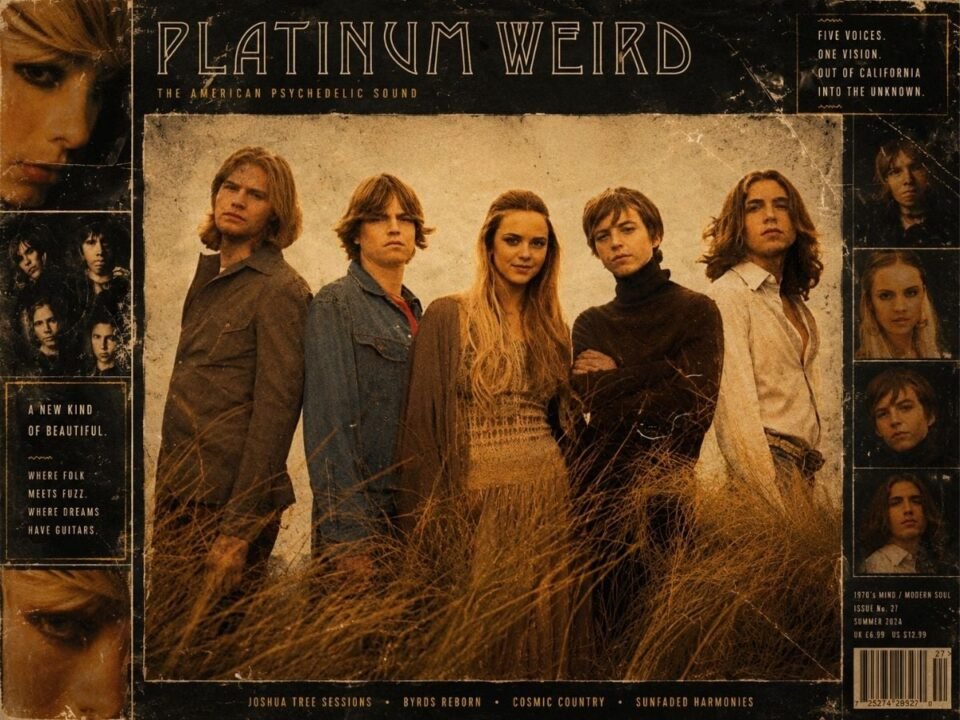

Credit: Far Out / Platinum Weird
So-called marketing psyops have been a buzzword of late, but they’re no particularly new. Many artists have musical skeletons in their closets from the days when they were cutting their teeth in the business.
Billy Joel was once in a heavy metal duo called Attila that he describes as “psychedelic bullshit”. David Bowie was busy trying to change the world through the power of laughing gnomes before he found his knack, and Dave Stewart, before the Eurythmics, was part of the long-forgotten but wildly revered Platinum Weird.
The band consisted of Stewart and the enigmatic American vocalist Erin Grace. To many of you, that name might not mean much, but to Stevie Nicks, she was an inspiration of style and sound that Fleetwood Mac will forever be indebted to. Together, Stewart and Grace crafted a melodic pop-rock sound that brought a rhythmic reverie to the depths of the blues.
They began laying this to tape in 1974, sheltered from the world in their artistic bubble, which was only penetrated by the inspiration of their heroes. Then tragedy struck when one of their great icons passed. Not many people knew of Nick Drake’s music at the time, but Grace was one of them.
The news devastated her. She withdrew from the studio and searched for solace in the world, eventually running away with Elton John’s boyfriend. The unnamed boyfriend apparently broke it off with the Queen of Pop and ran off with Grace, with whom he had been romantically entangled for a while. Grace was searching out a life away from music, and now she had a lover to help her find a new lease without the muse of Nick Drake. She never returned to the professional creative industry.
So, while their time in the studio back in ‘74 might not have seen the light of day for the public, those in the industry who were privy to the mysterious Platinum Weird tape passed it on to their luckiest clients. Soon, the likes of Elton John, Mick Jagger, and Ringo Starr were all basking in its brilliance and dishing out secret five-star reviews at swanky cocktail parties.
Annie Lennox was so impressed that it inspired her to track down and recruit Stewart, and soon the Eurythmics were born, leaving Platinum Weird and Grace as strange quirks in the sands of musical history, relics fated to be forgotten.

And then something peculiar happened: while working with the songwriter Kara DioGuardi, Stewart, having recently rediscovered the old masters for Platinum Weird, indulgently decided to take a trip down memory lane and play her one of the few surviving demos in the studio. To his amazement, somehow, DioGuardi started singing along.
Perplexed, Stewart asked how the hell she knew it, and it turns out that DioGuardi’s neighbour growing up had been Erin Grace, the very same star-crossed starlet who fled the industry a lifetime ago. And even more than that, her songwriting stewardship was the sole reason DioGuardi was in the music business today.
Rattled by this revelation, Stewart decided to heed the callings of fate and release the once highly-praised portion of the album that Platinum Weird had managed to record in ‘74 before Grace abandoned the project and eloped with Elton John’s love interest. Alongside this came a VH1 Documentary on the mystic existence of the greatest band there never was. Therein, even the grumbling Bob Geldof spoke glowingly about the group.
Only it turned out that the existence of Platinum Weird was far more mystic, in the true palm-reading sense, than the documentary led you to believe. Something about this uncanny tale seemed amiss.
Thus, sleuths got on the case, and soon after, the truth was revealed. Stewart and DioGuardi were, indeed, working with each other in 2004, but the Fleetwood Mac-esque demo played in the studio that day was all their own work. It was borne from a writing session between the pair aimed at providing songs for their Interscope labelmates, The Pussycat Dolls.
The boss, Jimmy Iovine, accepted that the material wasn’t quite what they were looking for. However, having once produced Fleetwood Mac himself, he appreciated the quality of the pop-rock tracks they had mustered. So, he suggested that they finish the songs and release them into the world.
But, naturally, ‘rejected songs by a songwriting duo for the Pussycat Dolls‘ doesn’t read as the greatest press release. Understanding the importance of marketing as a label head in the 2000s, Iovine suggested that they concoct an elaborate marketing scheme first. Now, it might be called a psyop, but back then it was called, ‘Throwing a bit of money at a funny white lie’.
Stewart based Grace on a singer he once knew in Amsterdam, but aside from her name, everything else about their story was fabricated, cooked up in the same studio where Stewart and DioGuardi had concocted the entire discography of Platinum Weird.
While the truth might sour things with a tinge of frustration, there is a level of elevated artistry about the scheme that elucidates the interplay of music’s role within society. The great hoax of Platinum Weird illuminates that when it comes to pop culture, it is not merely the songs that we are interested in but the stories that go along with them.
What the Platinum Weird episode exposes is neither the gullibility of audiences nor the blinding flash of a grabbing story, but a deeper structural condition of contemporary culture. The mechanisms of pop make any distinction between authenticity and fabrication notably difficult when we beg for something performative in the first place.
As Stewart’s caper exposed, the question is no longer whether something is ‘real’, is usurped by whether it can be made to circulate as if it were. Under Iovine’s guidance, Platinum Weird were engineered more so than marketed.
But beyond that, in a music landscape already saturated with myth-making, it is notable that the hoax stretched back into the nostalgia of the past, only to reveal that’s just an effect too. If anything, ironically, there was more telling depth to this grand lie than the Pussycat Dolls anyway. If one of the purposes of art is to interplay with society, then pysop campaigns that stir up meaningful conversations do just that with creative aplomb.
The only bad play, if any, is that Stewart let the cat out of the bag too soon, revealing the truth moments after the documentary aired.
