
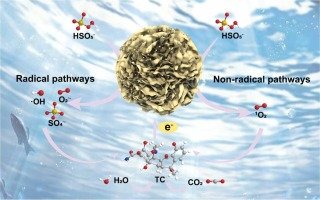
Antibiotics are widely utilized across various fields, including production and daily life. Tetracycline (TC), a typical antibiotic, is extensively employed in clinical settings, animal husbandry, and aquaculture due to its affordability and potent antibacterial properties [1], [2]. Given that TC is not fully absorbed by organisms, its accumulation through the food chain leads to significant pollution of aquatic environments [3], [4]. Therefore, developing effective and reliable methods for removing TC from aquatic environments is crucial for safeguarding both human health and ecological safety. Currently, the methods commonly employed for the removal of TC include membrane separation [5], biodegradation [6], adsorption [7], and advanced oxidation processes (AOPs) [8], [9]. Among these methods, peroxymonosulfate (PMS)-based AOPs has garnered significant research interest due to its high catalytic activity [10], elevated redox potential, extended half-life [11], and remarkable selectivity for complex environmental pollutants in water [12], thus presenting considerable potential for environmental protection [11], [13]. Specifically, the PMS-based AOPs generate reactive oxygen species (ROS) including SO4•−, •OH, O2•−, and 1O2 to degrade organic pollutants in aquatic environments. Nonetheless, PMS poses challenges for self-decomposition to generate ROS, highlighting the urgent need to identify suitable methods that can effectively activate PMS.
Various methods, including heating, ultrasonic irradiation, ultraviolet light, semiconductors, and transition metals, have been employed to activate PMS. Among these methods, transition metals, such as Fe, Co, Ni, and Mn [14], [15], [16], are extensively utilized in PMS activation due to their advantages of high efficiency [17], [18]. In particular, Co-based catalysts demonstrate superior activity in PMS activation compared to other transition metals [19]; however, their application is hindered by issues related to metal leaching and recycling difficulties [20]. Consequently, research on PMS activation systems has predominantly concentrated on Co-based composites, with spinel-structured Co3O4 being widely utilized due to its ease of synthesis, low cost, low leaching rate, and high stability [8], [21]. Nonetheless, the low dispersibility, large particle size, and poor conductivity of Co3O4 result in a reduced number of active sites and catalytic activity [22], [23], [24]. Recently, Ru, recognized as the most affordable precious metal, has received considerable interest because of its favorable performance in PMS activation [25], [26], [27]. Especially, the introduction of Ru can effectively tune the electronic structure of Co oxides, thereby enhancing the ability to activate PMS [28]. Additionally, powder metal-based catalysts face challenges such as separation difficulties, agglomeration, and limited mass/electron transfer efficiencies [29]. A promising solution involves immobilizing metals on three-dimensional (3D) macroporous materials with a large specific surface area. Nickel foam (NF), characterized by its 3D interconnected framework, exceptional mechanical strength, high porosity, thermal stability, and high conductivity, serves as an ideal substrate material [11], [30], [31]. Furthermore, its bulk structure facilitates easy separation from solutions, thereby simplifying the catalyst recycling process. Based on the above analysis, the rational design of self-supported Ru-doped Co spinel oxide catalysts presents a promising approach to enhancing the PMS-involved TC degradation.
Herein, we reported a strategy for modulating electronic structures by embedding Ru into Co spinel oxide via the electrodeposition of a Ru-Co precursor onto an NF substrate, followed by an annealing process. The NF support with substantial porosity effectively enhanced both the specific surface area and the mass/electron transfer, thus increasing the availability of active sites. Compared to the Co3O4/NF catalyst, the incorporation of Ru significantly improved both the activity and stability of the Ru-Co3O4/NF catalyst. The Ru-Co3O4/NF/PMS system exhibited an excellent performance for TC degradation. To explore its potential applications, we investigated the effects of reaction temperature, initial pH of the solution, various interfering ions, and organic matter on the catalytic activity of the Ru-Co3O4/NF/PMS system. The active species involved in degradation process were investigated through quenching experiments, electron paramagnetic resonance (EPR) tests, and electrochemical analyses. Furthermore, we explored the possible intermediate products of TC degradation using LC-MS and assessed their residual biotoxicity and potential environmental risks through wheat cultivation experiments and toxicity simulation tests.