
- Market Size (2026)
- USD 104.5 Mn
- Forecast (2036)
- USD 585.2 Mn
- CAGR (2026 to 2036)
- 18.8%
How big is Ruthenium Interconnect Precursors Market in 2026?
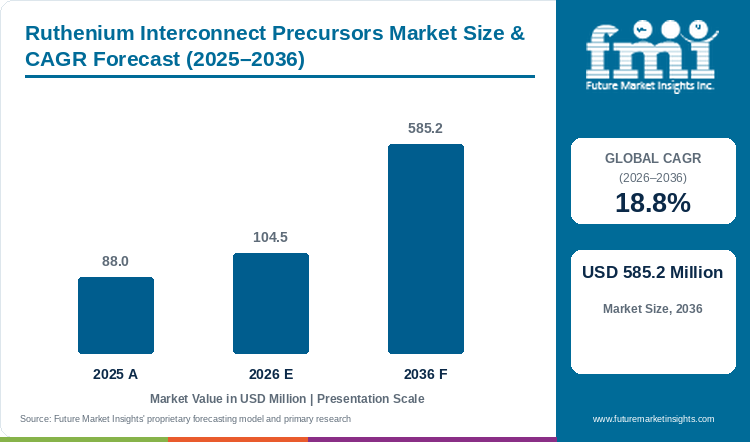
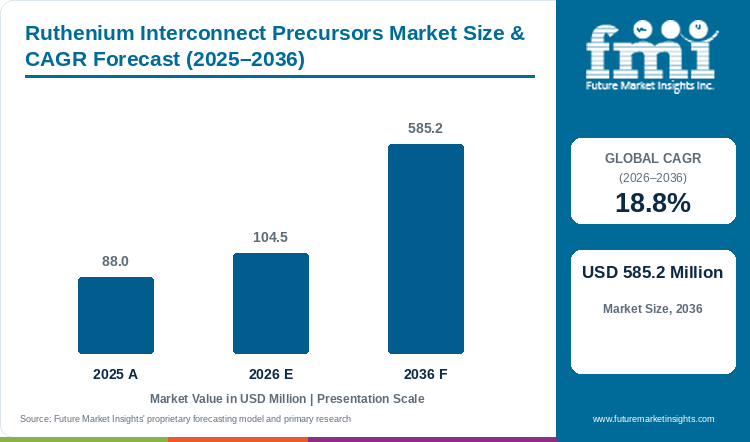
Starting from USD 88.0 million in 2025, the global ruthenium interconnect precursors market valuation advanced to USD 104.5 million in 2026, with projections pointing toward USD 585.2 million by 2036 at a CAGR of 18.8%.
Foundry procurement of organometallic ruthenium precursors has accelerated because copper damascene lines suffer severe resistance spikes and electromigration failures at sub-2-nanometer logic pitches, forcing wafer fabs to adopt barrierless noble-metal interconnects to protect die yields. Due to this shift in front-end metallization budgets, global ruthenium interconnect precursor market size will climb from USD 88.0 million in 2025 to USD 104.5 million in 2026 and reach an industry valuation of USD 585.2 million by 2036, advancing at an 18.8% CAGR to add USD 480.7 million in annual market value. For instance, researchers from Ulsan National Institute of Science and Technology and Tanaka Precious Metal Technologies reported in a November 2025 Advanced Science study that a thermally stable [Ru(trimethylenemethane)(p-cymene)] precursor achieved 1.28 angstroms per cycle and 10.6 microhm-centimeter resistivity at 350 degrees Celsius without post-annealing, which lowers thermal budget barriers for high-volume fab adoption [1]. Owing to these low-temperature processing gains, 57.4% of 2026 organometallic precursor chemistry demand is anticipated to come from Zero-Valent Carbonyl Diene (Ru(CO)3(C6H8) / EBECHRu) as foundries co-qualify liquid ampoules with vapor-phase ALD precursors.
Key Market Trends & Insights
- By organometallic precursor chemistry: Oxygen-free ligand volatility that protects underlying titanium-nitride contacts is forecast to give Zero-Valent Carbonyl Diene (Ru(CO)3(C6H8) / EBECHRu) a 57.4% segment share in 2026.
- By deposition process: Cyclic pulse purging that eliminates overhang pinch-off voids is expected to place Thermal & Plasma-Enhanced Atomic Layer Deposition (ALD) at 64.2% of deposition process demand in 2026.
- By metallization layer in fab: Full-trench conductive metal recovery at sub-18nm pitches is anticipated to lift Sub-2nm Barrierless Local Interconnects (M0/M1/Vias) to 53.6% of fab-layer consumption in 2026.
Regional Highlights
- Top national expansion: Ireland is projected to lead country growth at a 21.1% CAGR through 2036, supported by high-volume EUV logic wafer capacity in Leixlip and Ireland’s EUR 13.5 billion semiconductor export base.
- Broader country progression: Japan is forecast to expand at a 19.5% CAGR ahead of Singapore at 19.0% and Taiwan at 18.5%, while South Korea (18.2%) and the USA (18.0%) scale gate-all-around lines.
Market Size & Forecast
Table 1: Market Size and Forecast for the Ruthenium Interconnect Precursors Market (USD million and CAGR percentage), 2025 to 2036
| Metric | Value |
|---|---|
| 2025 Market Size | USD 88.0 million |
| Estimated Market Size in 2026 | USD 104.5 million |
| Projected Market Size by 2036 | USD 585.2 million |
| CAGR, 2026 to 2036 | 18.8% |
| Added Revenue, 2026 to 2036 | USD 480.7 million |
High extreme-ultraviolet lithography masking costs and chemical-mechanical planarization defects have historically slowed the commercial rollout of alternative interconnect metals across mainstream wafer fabs. To overcome this cost bottleneck, in July 2026, a mechanistic atomic hydrogen deposition study in ACS JACS (PubMed PMID 42265843) demonstrated that dissociated hydrogen radicals strip organic ligands at 100 degrees Celsius to yield 23.7 microhm-centimeter ruthenium films while strategic inhibitor redosing enables bottom-up area-selective patterning [2]. Because area-selective growth deposits metal only on exposed via bottoms without extra lithography etch steps, unit-process costs per wafer drop substantially and expand precursor consumption across gate-all-around nanosheet and backside power rail layers. Consequently, foundry integration teams are pairing pressurized ruthenium canisters with high-k and CVD metal precursors across 300mm cluster tools to scale void-free metallization.
Wafer-Pass and Ampoule Consumption Sizing
Table 2: Wafer-Pass and Precursor Consumption Sizing for the Ruthenium Interconnect Precursors Market (USD million and operational ranges), 2025 to 2036
| Metric | 2025 | 2026 | 2036 |
|---|---|---|---|
| Market size (USD million) | 88.0 | 104.5 | 585.2 |
| Sub-3nm logic & 3D DRAM wafer passes (million 300mm equivalents) | 3.8 to 4.2 | 4.5 to 5.1 | 22.5 to 26.0 |
| High-purity Ru precursor mass dispensed (metric tons) | 4.1 to 4.6 | 4.9 to 5.5 | 27.0 to 31.5 |
| Precursor chemical value per 300mm wafer pass (USD) | 21.0 to 23.2 | 20.5 to 23.2 | 22.5 to 26.0 |
Operational note: Wafer-pass ranges apply 0.9 to 1.2 grams of organometallic ruthenium dosed per 300mm wafer pass across chamber purge and foreline abatement cycles.
Consumption patterns in Table 2 show that precursor revenue grows faster than overall wafer starts because each transition from FinFET to 2-nanometer nanosheet logic multiplies the number of ruthenium metallization passes per 300mm wafer from one liner step to three or four local routing layers. As a result, annual high-purity precursor mass dispensed rises from 4.9 to 5.5 metric tons in 2026 to 27.0 to 31.5 metric tons by 2036, prompting fabs to lock in automated liquid delivery cabinets on atomic layer deposition equipment to guarantee uninterrupted chemical dosing.
Fab Chamber & Metallization Economics
Table 3: Chamber Utilization and Purity-Tier Indicators for the Ruthenium Interconnect Precursors Market (USD and operational ranges), 2025 to 2036
| Metric | 2025 | 2026 | 2036 |
|---|---|---|---|
| Qualified 300mm ALD/CVD Ru chambers globally (units) | 620 to 690 | 740 to 820 | 3,600 to 4,100 |
| Annual precursor value per active chamber (USD thousand) | 127.5 to 141.9 | 127.4 to 141.2 | 142.7 to 162.6 |
| 6N+ (99.9999%) trace-metal grade contract share (%) | 71.0% to 75.0% | 74.0% to 78.0% | 86.0% to 90.0% |
| Chamber shield and exhaust Ru reclaim yield (%) | 58.0% to 62.0% | 61.0% to 65.0% | 75.0% to 80.0% |
Table 4: Fab & Metallization Layer Valuation Indicators for the Ruthenium Interconnect Precursors Market (USD and percentages), 2026
| Metric | Value | Institutional Reference Basis |
|---|---|---|
| Market size, 2026 | USD 104.5 million | 2026 global organometallic precursor baseline |
| Qualified sub-3nm logic & 3D DRAM fabs globally | 48 facilities | Global 300mm advanced logic and memory fab registry |
| Average annual precursor allocation per fab | USD 2.18 million | Annualized 2026 canister procurement per facility |
| Sub-2nm local interconnect share, 2026 | 53.6% (USD 56.0 million allocation) | 53.6% metallization layer segment allocation |
Procurement indicators in Tables 3 and 4 explain why incumbent chemical suppliers enjoy high contract retention once a precursor is qualified into a 300mm fab process of record. Because qualifying a 6N+ purity ampoule across 48 advanced logic and memory facilities requires 18 to 24 months of split-lot reliability testing and USD 2.18 million in average annual chemical spend per fab, materials directors rarely switch vendors mid-node and instead bundle ruthenium canister contracts with trisilylamine dielectric precursors.
Analyst Perspective
“Foundry metallization architects can no longer afford the conductive trench volume lost to tantalum-nitride barriers at sub-2nm pitches. Precursor formulators that pair zero-valent liquid carbonyl-diene complexes with closed-loop precious-metal reclaim contracts will lock in sole-source process-of-record slots on gate-all-around logic and 3D DRAM lines.”
– , Principal Consultant, Future Market Insights.
How is the ruthenium interconnect precursors market segmented?
The ruthenium interconnect precursors market is segmented by organometallic precursor chemistry, deposition process, metallization layer in fab, and region. In 2026, Zero-Valent Carbonyl Diene (Ru(CO)3(C6H8) / EBECHRu) is expected at 57.4%, Thermal & Plasma-Enhanced ALD is estimated at 64.2%, and Sub-2nm Barrierless Local Interconnects are projected at 53.6%.
By organometallic precursor chemistry: Zero-Valent Carbonyl Diene (Ru(CO)3(C6H8) / EBECHRu), Tricarbonyl Ruthenium (Ru3(CO)12) Solid/Vapor Precursor, Bis(ethylcyclopentadienyl)ruthenium (Ru(EtCp)2), and Others.
By deposition process: Thermal & Plasma-Enhanced Atomic Layer Deposition (ALD), Area-Selective Chemical Vapor Deposition (AS-CVD), and Others.
By metallization layer in fab: Sub-2nm Barrierless Local Interconnects (M0/M1/Vias), Copper Diffusion Liner / Seed Layer (<1.5 nm), 3D DRAM Capacitor Bottom Electrodes, and Others.
Why does Zero-Valent Carbonyl Diene (Ru(CO)3(C6H8) / EBECHRu) lead the organometallic precursor chemistry segment?
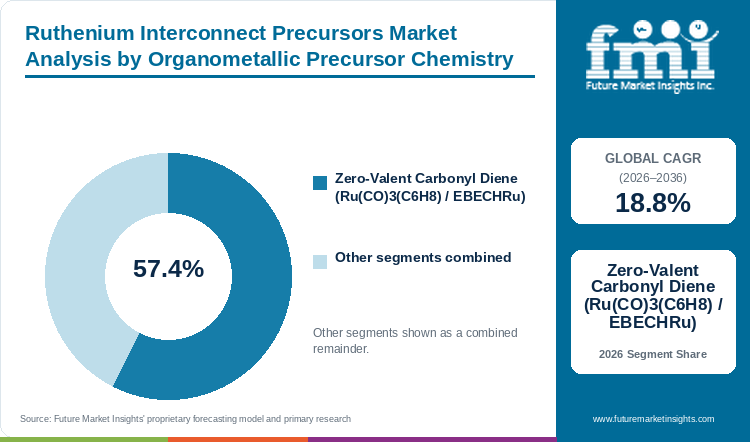
Rapid surface nucleation on dielectric liners is projected to place Zero-Valent Carbonyl Diene (Ru(CO)3(C6H8) / EBECHRu) at 57.4% of global chemistry demand in 2026.
Table 5: Organometallic Precursor Chemistry Share for the Ruthenium Interconnect Precursors Market (percentage share), 2026
| Organometallic Precursor Chemistry | Share (2026) |
|---|---|
| Zero-Valent Carbonyl Diene (Ru(CO)3(C6H8) / EBECHRu) | 57.4% |
| Other Segments Combined | 42.6%* |
| Total | 100.0% |
*Calculated as the balance remaining after deducting the leading segment’s reported share from 100.0%.
Table 6: Organometallic Precursor Chemistry Leadership and Market Growth for the Ruthenium Interconnect Precursors Market (segment and CAGR percentage), 2026 to 2036
| Metric | Value |
|---|---|
| Global CAGR (2026 to 2036) | 18.8% |
| Leading Segment | Zero-Valent Carbonyl Diene (Ru(CO)3(C6H8) / EBECHRu) |
Wafer fab consumption patterns strongly favor zero-valent carbonyl diene and ethylbenzyl-cyclohexadienyl ruthenium liquids because conventional metallocene precursors such as Ru(EtCp)2 require high-temperature oxygen co-reactants that oxidize underlying titanium-nitride contacts and ruin via yield. Because the ruthenium atom in a zero-valent complex already sits in the zero oxidation state, ligands desorb cleanly below 220 degrees Celsius without oxidative damage. As a result, wafer throughput per hour doubles while porous low-k dielectrics remain intact across tools connected to high-purity semiconductor process systems.
- Pressurized liquid ampoule delivery that prevents solid-sublimation particle bursts is slated to secure a 57.4% share for Zero-Valent Carbonyl Diene (Ru(CO)3(C6H8) / EBECHRu) in 2026.
- For instance, first-principles high-throughput screening published in the Journal of Materials Chemistry C in March 2026 confirmed that zero-valent ruthenium compounds minimize cohesive and surface resistance penalties in scaled interconnects [3].
Why does Thermal & Plasma-Enhanced Atomic Layer Deposition (ALD) lead the deposition process segment?
Angstrom-scale sidewall uniformity across high-aspect-ratio trenches is predicted to give Thermal & Plasma-Enhanced Atomic Layer Deposition (ALD) 64.2% of the deposition process segment in 2026.
Demand for cyclic thermal and hydrogen-ammonia plasma ALD is expanding rapidly because physical vapor deposition and standard chemical vapor deposition pinch off the top corners of sub-2nm vias at aspect ratios above 5:1, leaving hollow center seams that cause open-circuit chip failures. To eliminate those voids, foundries alternate self-limiting precursor chemisorption with plasma reduction and atomic layer etching supercycles that strip overhanging nuclei before they block the trench opening. Consequently, this supercycle adoption is shifting fab equipment budgets away from sputtering deposition equipment toward multi-chamber ALD cluster tools that consume higher precursor volumes per wafer.
- An estimated 64.2% of deposition process demand in 2026 is forecast to flow through Thermal & Plasma-Enhanced Atomic Layer Deposition (ALD) chambers across 300mm logic and memory fabs.
- As a matter of fact, Hanyang University and Samsung Electronics researchers reported in Small Methods in March 2025 that cyclic ALD with EBECHRu followed by 2,4-pentanedione atomic layer etching produced atomically smooth ruthenium films down to 1 nanometer [4].
What keeps Sub-2nm Barrierless Local Interconnects (M0/M1/Vias) ahead in the metallization layer in fab segment?
Across 2026 foundry process-of-record recipes, 53.6% of the metallization layer in fab segment is slated to center on Sub-2nm Barrierless Local Interconnects (M0/M1/Vias) for M0 and M1 routing.
Adoption of ruthenium precursors is heavily concentrated in bottom-level M0 and M1 local interconnects because a conventional 2-nanometer tantalum-nitride diffusion barrier consumes more than half of the conductive cross-section inside a 14-nanometer logic trench. Since ruthenium resists electromigration and adheres directly to low-k dielectrics without a barrier liner, replacing copper at M0 and M1 restores 100% of the trench volume to conductive metal and cuts via resistance by up to 40%. This electrical performance gain directly boosts processor clock speeds per watt prior to die packaging with semiconductor encapsulants.
- Direct metal fill without resistive barrier liners at bottom logic levels is expected to put Sub-2nm Barrierless Local Interconnects (M0/M1/Vias) at a 53.6% share in 2026.
- For example, at the June 2025 IEEE International Interconnect Technology Conference, imec demonstrated 16-nanometer pitch semi-damascene direct-etched ruthenium lines achieving a record-low 656 ohm-per-micrometer line resistance and over 90% wafer yields [5].
What are the drivers, restraints, and opportunities in the ruthenium interconnect precursors market?
In the ruthenium interconnect precursors market, gate-all-around nanosheet scaling and backside power rails are projected to expand canister consumption, whereas precious-metal price swings restrain mature-node adoption and area-selective inhibitor kits create margin opportunities.
- Driver: Gate-all-around 2nm and 1.4nm logic ramps plus backside buried power rails convert organometallic ruthenium ampoules into recurring wafer-pass consumables.
- Restraint: Platinum-group metal spot price volatility and low single-pass chamber utilization elevate per-wafer chemical costs across cost-sensitive fabs.
- Opportunity: Co-dosing zero-valent ruthenium precursors with small-molecule silane surface inhibitors enables bottom-up area-selective deposition without lithography masks.
Growth Analysis and Future Potential: Qualitative Demand Catalysts
Foundry transitions from FinFET to 2-nanometer and 1.4-nanometer gate-all-around nanosheet architectures are the primary catalyst expanding precursor volumes because backside power delivery networks and Cu-Cu hybrid wafer bonding require oxidation-resistant metal layers that copper cannot provide alone. In addition to local vias, 3D wafer-to-wafer bonding pads oxidize rapidly during thermal annealing unless capped with a noble metal passivation film. For instance, in October 2025, surface-engineering tests published in Applied Surface Science (PubMed PMID 41120460) confirmed that ALD ruthenium passivation layers prevent copper pad oxidation during hybrid bonding when deposition parameters optimize film density [6]. Because of this dual utility across front-end vias and hybrid bonding pads, chemical consumption is rising rapidly across fabs producing semiconductor memory chips.
Risk Assessment of the Ruthenium Interconnect Precursors Market: Operational and Formulation Friction
Despite strong sub-2nm demand, market adoption on cost-sensitive 5-nanometer and 7-nanometer nodes is restrained by high platinum-group metal raw material costs and unreacted vapor loss during pulsed ALD cycles. During standard chamber purging, more than half of the dosed organometallic vapor exits into sub-fab abatement scrubbers without reacting on the wafer, while incomplete ligand stripping at low temperatures can leave carbon impurities that degrade line conductivity. Specifically, a March 2026 Journal of Materials Chemistry C study on nanoscale copper-alternative interconnects demonstrated that low-temperature ruthenium ALD films suffer residual carbon and oxygen contamination unless three-step ABC-type pulsed dosing sequences are carefully tuned [7]. These chamber utilization losses and recipe complexities keep per-wafer chemical costs too high for mature nodes serving standard printed circuit board assemblies.
Commercial Opportunity Analysis: Formulation Differentiation and Value-Add Formats
Specialty chemical formulators are capturing high-margin revenue streams by bundling zero-valent ruthenium precursors with small-molecule aminosilane surface inhibitors and targeting single-wafer agile foundries. When fabs co-dose hydrophobic silane inhibitors that passivate silicon-dioxide sidewalls, ruthenium nucleates selectively from the bottom metal contact upward without requiring expensive EUV lithography masks. For example, in July 2025, Rapidus Corporation announced the successful prototyping of 2-nanometer gate-all-around transistors at its IIM-1 foundry in Chitose using a fully single-wafer front-end processing line that enables per-wafer metallization recipe tuning [8]. This shift toward single-wafer agile processing creates lucrative opportunities for suppliers offering pre-matched precursor and inhibitor kits across AI processor and high-density electronic connectors supply chains.
Ruthenium Interconnect Precursors Market by Country (2026 to 2036)
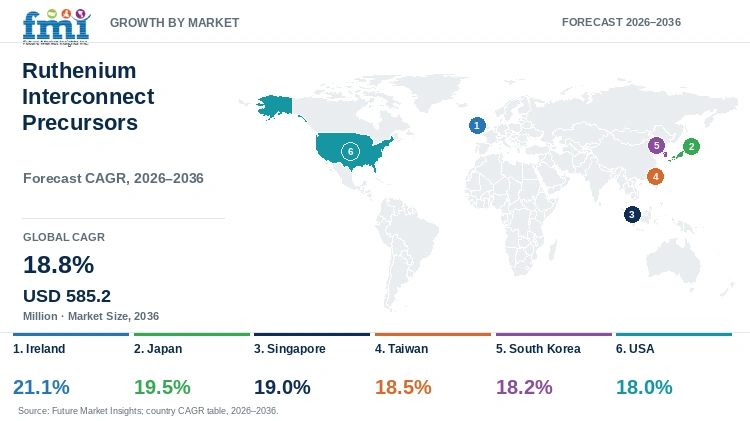
Foundry wafer-start schedules place Ireland at the lead of national ruthenium interconnect precursor growth with a 21.1% CAGR through 2036 ahead of Japan at 19.5% and Singapore at 19.0%, while Taiwan expands at 18.5% followed by South Korea (18.2%) and the USA (18.0%). High-volume 300mm EUV logic tool installations and localized organometallic transfilling plants shape country-level chemical procurement.
Table 7: Country CAGR and Primary Growth Levers for the Ruthenium Interconnect Precursors Market (CAGR percentage and operational drivers), 2026 to 2036
| Country | CAGR (2026 to 2036) | Primary Growth Lever |
|---|---|---|
| Ireland | 21.1% | National Silicon Island semiconductor expansion and Leixlip EUV logic wafer output with local chemical staging |
| Japan | 19.5% | Rapidus IIM-1 2nm GAA pilot wafer ramp in Hokkaido and domestic precious-metal precursor synthesis |
| Singapore | 19.0% | USD 24 billion advanced memory wafer fab expansion and Jurong Island specialty chemical transfilling |
| Taiwan | 18.5% | High-volume 2nm (N2) and A14/A13 Super Power Rail foundry ramps in Hsinchu and Kaohsiung |
| South Korea | 18.2% | 2nm GAA foundry mass production and 1c-nm DRAM capacity expansion in Pyeongtaek and Hwaseong |
| USA | 18.0% | Angstrom-node logic fabs in Arizona and Ohio paired with domestic organometallic R&D alliances |
Source: Future Market Insights analysis
Ireland Ruthenium Interconnect Precursors Market Outlook (2026 to 2036)
Unlike Asian semiconductor markets that synthesize organometallic ligands domestically, Ireland operates as an export-driven extreme-ultraviolet logic wafer hub that relies entirely on imported ultra-pure canisters staged through local bonded depots. In fact, Ireland’s Department of Enterprise and Employment launched its Silicon Island national semiconductor strategy in May 2025, documenting EUR 13.5 billion in annual chip exports across 130 firms while targeting 34,500 new roles by 2040 [9]. With Leixlip Fab 34 scaling high-volume EUV logic wafer starts for European cloud servers, Ireland’s ruthenium interconnect precursor market size is projected to expand at a leading 21.1% CAGR through 2036, driven by fine-pitch liner and local via upgrades. However, strict European hazardous-cargo rules force chemical vendors to maintain Kildare ICP-MS certification labs.
Key takeaway: In Ireland, national Silicon Island fab investments and Leixlip EUV logic wafer output are projected to anchor rapid procurement of certified ruthenium ampoules.
Japan Ruthenium Interconnect Precursors Market Outlook (2026 to 2036)
What sets Japan apart from every other precursor market is its vertical integration between domestic platinum-group metal refiners and specialty ligand synthesizers under sovereign 2-nanometer foundry investment. Domestic ruthenium interconnect precursor market value in Japan is forecast to register a 19.5% CAGR from 2026 to 2036, supported by internal TRuST and zero-valent complex synthesis from Tanaka Kikinzoku Kogyo and ADEKA Corporation. Specifically, in April 2026, Japan’s New Energy and Industrial Technology Development Organization approved Rapidus Corporation’s fiscal 2026 plan and budget after the Chitose IIM-1 pilot line verified 2-nanometer gate-all-around transistor operation on 300mm wafers ahead of 2027 mass production [10]. This domestic co-location insulates Japanese fabs from cross-border canister shipping bottlenecks while accelerating chamber recipe qualification with Tokyo Electron.
Key takeaway: In Japan, the Rapidus IIM-1 2nm gate-all-around fab ramp in Hokkaido and domestic TRuST precursor synthesis are forecast to accelerate local organometallic supply.
Singapore Ruthenium Interconnect Precursors Market Outlook (2026 to 2036)
Whereas European demand centers on logic vias, Singapore’s precursor consumption is uniquely weighted toward high-aspect-ratio 3D memory capacitor bottom electrodes and Southeast Asian chemical transfilling. For instance, the Singapore Economic Development Board reported in May 2026 that national semiconductor commitments exceeded S$30 billion, anchored by Micron’s January 2026 groundbreaking on a USD 24.0 billion advanced memory wafer fab complex and UMC’s 22-nanometer expansion [11]. Consequently, Singapore’s ruthenium interconnect precursor industry valuation is anticipated to garner a 19.0% CAGR through 2036, owing to heavy ALD ruthenium electrode consumption per memory wafer pass in Tampines and Woodlands. Even so, high industrial power and cleanroom land costs in Singapore push chemical suppliers to concentrate bulk solvent purification on Jurong Island.
Key takeaway: In Singapore, multi-billion-dollar 300mm memory and foundry capacity expansions are anticipated to sustain strong demand for locally staged ruthenium ALD canisters.
Taiwan Ruthenium Interconnect Precursors Market Outlook (2026 to 2036)
Taiwan commands the largest baseline consumption volume in the global market, but its growth dynamic is shifting from imported canisters toward mandatory on-island chemical synthesis and transfilling to mitigate geopolitical supply risks. Because Hsinchu Fab 20 and Kaohsiung Fab 22 are transitioning to semi-damascene M0/M1 via liners and backside power rails, local ruthenium interconnect precursor demand in Taiwan is expected to post an 18.5% annual growth rate between 2026 and 2036. Illustrating this roadmap, at its April 2026 North America Technology Symposium, TSMC detailed its N2 and N2P nanosheet ramps and its A14 and A13 Super Power Rail backside power delivery architecture [12]. This massive wafer volume compels Merck KGaA and Air Liquide to run dedicated Kaohsiung purification plants.
Key takeaway: In Taiwan, commercial N2 and A14 gate-all-around logic wafer ramps in Hsinchu and Kaohsiung are expected to anchor global bulk consumption of zero-valent ruthenium precursors.
South Korea Ruthenium Interconnect Precursors Market Outlook (2026 to 2036)
South Korea is the only market globally where single-conglomerate megafabs simultaneously qualify ruthenium precursors for both sub-2nm gate-all-around logic interconnects and 1c-nanometer DRAM capacitor electrodes. Specifically, in its October 2025 third-quarter earnings release, Samsung Electronics reported KRW 33.1 trillion in Device Solutions revenue while ramping 2-nanometer GAA mass production and expanding 1c-nanometer DRAM wafer capacity into 2026 [13]. National ruthenium interconnect precursor demand in South Korea is predicted to climb at an 18.2% yearly pace through 2036 since Hansol Chemical and domestic synthesizers co-develop custom EBECHRu derivatives directly with Pyeongtaek and Icheon process engineers. That domestic chemical localization helps Korean chipmakers curb foreign precursor import premiums despite periodic memory capex cyclicality.
Key takeaway: In South Korea, simultaneous 2nm GAA logic foundry ramps and 1c-nm DRAM capacitor scaling are predicted to drive domestic consumption of zero-valent carbonyl diene precursors.
USA Ruthenium Interconnect Precursors Market Outlook (2026 to 2036)
Demand across the USA is defined by early-stage precursor recipe architecture in New York and Oregon paired with greenfield angstrom-node logic fab construction in Arizona and Ohio. For example, at the June 2025 AVS 25th International Conference on Atomic Layer Deposition (ALD/ALE 2025), U.S. and international semiconductor researchers presented area-selective ruthenium metallization and low-resistivity precursor chemistries that set global process-of-record baselines [14]. Within the USA, the ruthenium interconnect precursor market is estimated to expand at an 18.0% compound annual rate from 2026 to 2036, enabled by Intel 18A/14A and TSMC Arizona wafer fabs entering volume production. Although skilled cleanroom construction delays occasionally stretch U.S. fab commissioning timelines, domestic synthesis plants operated by Entegris and Gelest secure high-margin supply contracts.
Key takeaway: In the USA, angstrom-node logic fab ramps in Arizona and Ohio combined with domestic precursor R&D alliances are estimated to support steady long-term growth.
Full report country CAGRs cover: North America; Latin America; Western Europe; Eastern Europe; East Asia; South Asia and Pacific; Middle East and Africa.
Who are the notable companies in the ruthenium interconnect precursors market?
Merck KGaA (EMD Electronics / Intermolecular), Air Liquide S.A. (ALOHA Precursors), Tanaka Kikinzoku Kogyo K.K., Entegris, Inc., Hansol Chemical Co., Ltd., ADEKA Corporation, Umicore N.V., and Gelest, Inc. (Mitsubishi Chemical Group) are the notable companies in the ruthenium interconnect precursors market.
Supplier positioning in the ruthenium interconnect precursors sector depends on 6N+ trace-metal purification and closed-loop platinum-group metal recovery. Global electronic materials platforms led by Merck KGaA and Air Liquide pair high-purity organometallic synthesis with automated sub-fab vapor delivery cabinets. Precious-metal refiners including Tanaka Kikinzoku Kogyo and Umicore use internal ruthenium sponge refining and chamber-shield recycling to stabilize precursor pricing. Meanwhile, specialty synthesizers Hansol Chemical and ADEKA Corporation plus Gelest develop patented zero-valent diene and inhibitor molecules.
- Global Integrated Electronic Materials Platforms: Merck KGaA (EMD Electronics / Intermolecular) and Air Liquide (ALOHA Precursors) supply global 300mm fabs with 6N+ organometallic precursors while Entegris provides heated vapor canisters.
- Precious-Metal Refining & Organometallic Specialists: Tanaka Kikinzoku Kogyo and Umicore combine platinum-group metal refining and spent-trap reclaim with proprietary ruthenium ALD/CVD complex synthesis.
- Specialty Organometallic & Precursor Synthesizers: Hansol Chemical and ADEKA Corporation engineer zero-valent diene complexes while Gelest (Mitsubishi Chemical Group) synthesizes specialty carbonyl precursor molecules.
Competitive Benchmarking: Ruthenium Interconnect Precursors Market
Table 8: Competitive Benchmarking for the Ruthenium Interconnect Precursors Market (qualitative capability ratings), 2026
| Company | Organometallic Ligand Breadth | 6N+ Trace-Metal Purity Control | Ampoule Delivery & PGM Reclaim | Geographic Reach |
|---|---|---|---|---|
| Merck KGaA (EMD Electronics / Intermolecular) | High | High | High | High |
| Air Liquide S.A. (ALOHA Precursors) | High | High | High | High |
| Tanaka Kikinzoku Kogyo K.K. | High | High | High | Medium |
| Entegris, Inc. | High | High | High | High |
| Hansol Chemical Co., Ltd. | High | High | Medium | Medium |
| ADEKA Corporation | High | High | Medium | Medium |
| Umicore N.V. | Medium | High | High | High |
| Gelest, Inc. (Mitsubishi Chemical Group) | High | Medium | Medium | High |
Evaluation basis: Capability tiers evaluate documented ligand synthesis across zero-valent diene and carbonyl chemistries plus ICP-MS 6N+ trace-metal certification and closed-loop precious-metal reclaim infrastructure.
Key Developments in the Ruthenium Interconnect Precursors Market
- Merck KGaA (EMD Electronics) inaugurated its EUR 500 million, 150,000-square-meter Kaohsiung Semiconductor Solutions megasite in December 2025 to scale thin-film precursor and specialty chemical manufacturing starting in 2026 [15].
- Gelest, Inc. (Mitsubishi Chemical Group) entered a joint research agreement with IBM in February 2026 to evaluate organometallic and dry-resist EUV precursors for advanced logic nodes [16].
- Air Liquide S.A. expanded its ALOHA liquid and solid deposition precursor delivery infrastructure in March 2026 across leading-edge logic and 3D memory fabs [17].
Key Players in the Ruthenium Interconnect Precursors Market
Global Integrated Electronic Materials Platforms
- Merck KGaA (EMD Electronics / Intermolecular)
- Air Liquide S.A. (ALOHA Precursors)
- Entegris, Inc.
Precious-Metal Refining & Organometallic Specialists
- Tanaka Kikinzoku Kogyo K.K.
- Umicore N.V.
Specialty Organometallic & Precursor Synthesizers
- Hansol Chemical Co., Ltd.
- ADEKA Corporation
- Gelest, Inc. (Mitsubishi Chemical Group)
Ruthenium Interconnect Precursors Market – Report Scope
Table 9: Report Scope for the Ruthenium Interconnect Precursors Market (coverage fields and definitions), 2026 to 2036
| Coverage field | Report scope |
|---|---|
| Market breakdown | Organometallic Precursor Chemistry; Deposition Process; Metallization Layer in Fab; Region |
| Quantitative Units | USD Million |
| Market Definition | Includes commercial supplier revenue from ultra-high-purity organometallic and inorganic ruthenium chemical precursors (zero-valent carbonyl dienes and cyclopentadienyl or carbonyl complexes) packaged in ampoules or canisters for semiconductor ALD and CVD metallization. Segment Scope Note: Excludes physical vapor deposition (PVD) metallic ruthenium sputtering targets and deposition reactor hardware. |
| Regions Covered | North America; Latin America; Western Europe; Eastern Europe; East Asia; South Asia and Pacific; Middle East and Africa |
| Countries Covered | Ireland, Japan, Singapore, Taiwan, South Korea, USA, and additional countries in the full report |
| Key Companies Covered | Merck KGaA (EMD Electronics / Intermolecular), Air Liquide S.A. (ALOHA Precursors), Tanaka Kikinzoku Kogyo K.K., Entegris, Inc., Hansol Chemical Co., Ltd., ADEKA Corporation, Umicore N.V., Gelest, Inc. (Mitsubishi Chemical Group) |
| Forecast Period | 2026 to 2036 |
| Approach | Primary and secondary research with top-down and bottom-up market triangulation. |
Ruthenium Interconnect Precursors Market – Research Methodology
Table 10: Research Methodology for the Ruthenium Interconnect Precursors Market (research methods and approach), 2026 edition
| Method | Approach |
|---|---|
| Primary Research | Structured interviews with foundry unit-process metallization engineers and electronic materials procurement directors across Taiwan, South Korea, Japan, the USA, and Europe. |
| Secondary Research | Analysis of IEEE IITC proceedings, PubMed and Royal Society of Chemistry peer-reviewed ALD studies, AVS ALD/ALE technical programs, and corporate annual reports. |
| Market Sizing and Forecasting | Top-down semiconductor precursor expenditure budgets reconciled against bottom-up 300mm sub-3nm logic and 3D DRAM wafer passes and grams of ruthenium dosed per wafer from 2026 to 2036. |
| Country Forecasting Model | Econometric national projections weight announced 300mm EUV logic and advanced memory fab capacity additions with local chemical transfilling investments across six key semiconductor nations. |
| Operational Benchmark Traceability | Wafer-pass and resistivity benchmarks in Tables 2, 3, and 4 trace to Advanced Science, ACS JACS, Small Methods, and imec IITC empirical measurements. |
| Data Triangulation and Validation | Demand estimates are cross-checked against specialty chemical canister shipment volumes and fab chamber counts while excluding metallic PVD sputtering targets and non-semiconductor catalysts. |
Ruthenium Interconnect Precursors Market by Segments
Ruthenium Interconnect Precursors Market segmented by Organometallic Precursor Chemistry:
- Zero-Valent Carbonyl Diene (Ru(CO)3(C6H8) / EBECHRu)
- Tricarbonyl Ruthenium (Ru3(CO)12) Solid/Vapor Precursor
- Bis(ethylcyclopentadienyl)ruthenium (Ru(EtCp)2)
- Others
Ruthenium Interconnect Precursors Market segmented by Deposition Process:
- Thermal & Plasma-Enhanced Atomic Layer Deposition (ALD)
- Area-Selective Chemical Vapor Deposition (AS-CVD)
- Others
Ruthenium Interconnect Precursors Market segmented by Metallization Layer in Fab:
- Sub-2nm Barrierless Local Interconnects (M0/M1/Vias)
- Copper Diffusion Liner / Seed Layer (<1.5 nm)
- 3D DRAM Capacitor Bottom Electrodes
- Others
Ruthenium Interconnect Precursors Market by Region
- North America
- Latin America
- Brazil
- Mexico
- Argentina
- Chile
- Western Europe
- Ireland
- Germany
- France
- United Kingdom
- Italy
- Spain
- Benelux
- Nordics
- Eastern Europe
- Poland
- Czech Republic
- Romania
- Hungary
- East Asia
- Taiwan
- South Korea
- Japan
- China
- South Asia and Pacific
- Singapore
- India
- ASEAN
- Australia and New Zealand
- Middle East and Africa
- GCC Countries
- South Africa
- Türkiye
- Israel
Research Sources and Bibliography
- [1] Nakatsubo, H., Mohapatra, D., Lee, E.-S., Kim, J., Cho, I., Iseki, M., Shigetomi, T., Harada, R., Na, S.-W., Cheon, T., Shong, B., & Kim, S.-H. (2025, November 23). Small and Simple Molecular Structure Based Thermally Stable Ruthenium Precursor in Advancing Ruthenium ALD Process for Scaled Interconnect Metallization. Advanced Science / PubMed PMID 41276950.
- [2] Min, K., Nguyen, C. T., Cho, E.-H., Lee, M., Kim, W., Sunwoo, Y., Heo, E., Kim, B., Bui, H. V., & Lee, H.-B.-R. (2026, July 15). Mechanistic Atomic Hydrogen Chemistry for Ruthenium Deposition: From Ligand Elimination to Area-Selective Patterning. Journal of the American Chemical Society / PubMed PMID 42265843.
- [3] Royal Society of Chemistry. (2026, March 13). First-principles high-throughput screening of ruthenium compounds for advanced interconnects. Journal of Materials Chemistry C.
- [4] Lee, J., Kim, J.-T., Oh, J., Lee, D., Lee, S.-H., Kim, H., Oh, J., Wang, Y., & Kim, W.-H. (2025, March 21). Advanced Fabrication of Ultrathin Ruthenium Films Using Synergistic Atomic Layer Deposition and Etching. Small Methods / PubMed PMID 40116341.
- [5] imec. (2025, June 03). 16nm Ru lines using semi-damascene integration approach | imec. imec Press Release (2025 IEEE IITC).
- [6] National Center for Biotechnology Information (PubMed). (2025, October 21). Influence of deposition conditions on ALD based Ru passivation for Cu-Cu hybrid bonding. Applied Surface Science / PubMed PMID 41120460.
- [7] Royal Society of Chemistry. (2026, March 12). Enhanced functional properties of ABC-type atomic layer deposited Ru thin films for advanced Cu alternative nanoscale interconnects. Journal of Materials Chemistry C.
- [8] Rapidus Corporation. (2025, July 18). Rapidus Achieves Significant Milestone at its State-of-the-Art Foundry with Prototyping of Leading-Edge 2nm GAA Transistors. Rapidus Corporation Newsroom.
- [9] Department of Enterprise, Tourism and Employment (Government of Ireland). (2025, May 19). Silicon Island: Ireland’s National Semiconductor Strategy. Government of Ireland (gov.ie).
- [10] Rapidus Corporation. (2026, April 11). NEDO Approves Rapidus’ FY2026 Plan and Budget for 2nm Semiconductor Projects. Rapidus Corporation Newsroom.
- [11] Singapore Economic Development Board (EDB). (2026, May 07). What makes Singapore a prime location for semiconductor companies driving innovation? | Singapore EDB. Singapore Economic Development Board (edb.gov.sg).
- [12] Taiwan Semiconductor Manufacturing Company Limited (TSMC). (2026, April 23). TSMC Debuts A13 Technology at 2026 North America Technology Symposium. TSMC Press Center.
- [13] Samsung Electronics Co., Ltd. (2025, October 30). Samsung Electronics Announces Third Quarter 2025 Results. Samsung Electronics Newsroom.
- [14] AVS Science and Technology Society. (2025, June 22). ALD/ALE 2025 Program Overview. AVS 25th International Conference on Atomic Layer Deposition.
- [15] Merck KGaA, Darmstadt, Germany (EMD Electronics). (2025, December 01). Merck KGaA, Darmstadt, Germany, Inaugurates Semiconductor Solutions Site in Taiwan to Support AI Growth. Merck KGaA / EMD Group Newsroom.
- [16] Gelest, Inc. (Mitsubishi Chemical Group). (2026, February 05). Gelest Announces Collaboration with IBM to Test Dry Resist EUV Lithography Precursors. Gelest, Inc.
- [17] Air Liquide S.A. (2026, March 20). 2025 INTEGRATED ANNUAL REPORT. L’Air Liquide S.A.
- [18] TANAKA PRECIOUS METAL GROUP Co., Ltd. (2025, July 30). Precious Metals. TANAKA Group Guide 2025-2026.
- [19] Umicore Precious Metals Chemistry. (2026, January 15). Ruthenium Precursors for ALD and CVD. Umicore N.V.
- [20] ADEKA Corporation. (2025, November 18). SEMICONDUCTOR MATERIALS : ADEKA. ADEKA Corporation.
This bibliography is provided for reader reference and is not exhaustive. The full report contains the complete reference list and detailed citations.
This Report Answers
- How large is the ruthenium interconnect precursors market in 2026 and what is forecast for 2036?
- Which sub-2nm interconnect scaling pressures support demand for organometallic ruthenium precursors?
- Why does Zero-Valent Carbonyl Diene (Ru(CO)3(C6H8) / EBECHRu) lead the chemistry segment?
- Why does Thermal & Plasma-Enhanced ALD lead the deposition process segment globally?
- How do growth rates differ across Ireland, Japan, Singapore, Taiwan, South Korea, and the USA?
- Which leading chemical companies supply 6N+ ruthenium ALD and CVD precursors today?
- What limits adoption or supplier switching in the ruthenium interconnect precursors market?
- What should foundry buyers evaluate before qualifying a ruthenium interconnect precursor?
Frequently Asked Questions
How big is the ruthenium interconnect precursors market in 2026, and what is forecast for 2036?
Global ruthenium interconnect precursor market size is estimated to reach USD 104.5 million in 2026 from USD 88.0 million in 2025 and is forecast to hit an industry valuation of USD 585.2 million by 2036 as 300mm wafer fabs scale sub-2nm logic and 3D DRAM nodes.
What is the CAGR for the ruthenium interconnect precursors market from 2026 to 2036?
Global ruthenium interconnect precursor demand is projected to expand at an 18.8% compound annual growth rate from 2026 to 2036, generating a USD 480.7 million increase in annual market value across semiconductor foundries.
Which organometallic precursor chemistry segment leads the ruthenium interconnect precursors market?
Wafer foundry procurement places Zero-Valent Carbonyl Diene (Ru(CO)3(C6H8) / EBECHRu) in the lead at an expected 57.4% share of the organometallic precursor chemistry segment in 2026 thanks to high ampoule vapor pressure and carbon-free film growth.
Which deposition process segment leads the ruthenium interconnect precursors market?
Semiconductor cluster-tool qualifications assign Thermal & Plasma-Enhanced Atomic Layer Deposition (ALD) an estimated 64.2% share of the deposition process segment in 2026 because cyclic surface saturation prevents center-seam voids in 300mm wafer contacts.
Which country has a notable growth outlook during the assessment period?
Ireland is projected to lead national growth at a 21.1% CAGR through 2036, supported by Silicon Island semiconductor expansion and high-volume EUV logic wafer production at Leixlip.
Who are the key players in the market?
Merck KGaA (EMD Electronics / Intermolecular), Air Liquide S.A. (ALOHA Precursors), Tanaka Kikinzoku Kogyo K.K., Entegris, Inc., Hansol Chemical Co., Ltd., ADEKA Corporation, Umicore N.V., and Gelest, Inc. (Mitsubishi Chemical Group) lead commercial precursor supply.
Preview the report firsthand – request a free sample
Get the brochure for pricing and purchase details.