
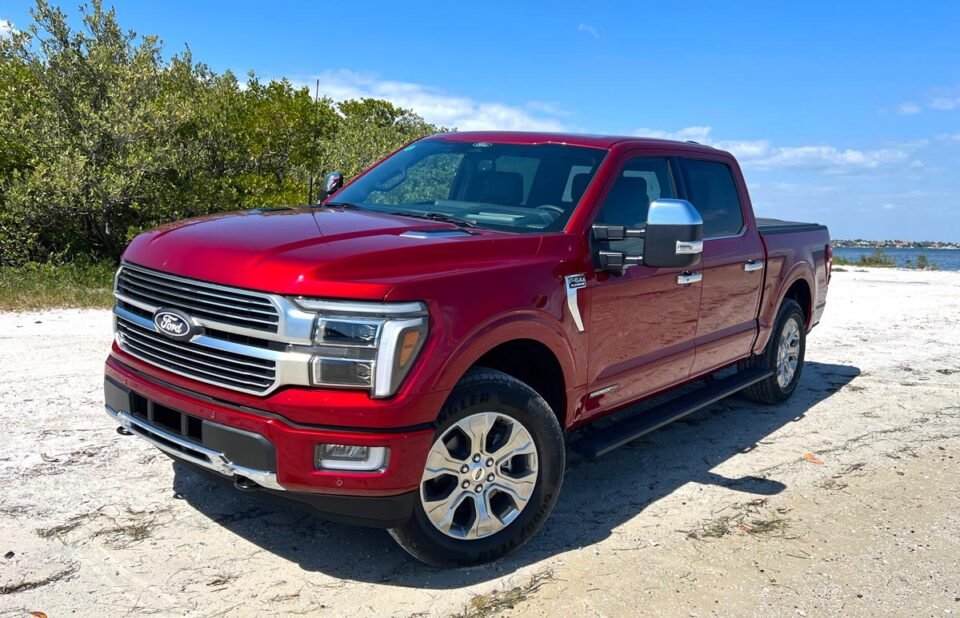

There are definite pros and cons with the 30.6-gallon fuel tank that comes with Ford’s F-150 4×4 Supercrew PowerBoost hybrid we’re driving this week.
A huge pro is range. Brim the tank and with this V6 hybrid’s 23-to-the-gallon combined mpg, you can, in theory, go for an impressive 703 miles. Plan bathroom breaks well ahead.
Check the box for the optional 36-gallon tank and you’ll go an impressive 830 miles.

Of course the con is that with the current lofty $4.30-a-gallon average, you’re looking at a non-trivial $132 to fill up. Or $155 with the big tank.
But then, if you can afford the eye-watering $89,725 sticker price of our loaded Platinum-spec F-150—the base including the $2,595 destination charge runs $75,195—you probably won’t worry about the hit.
A word on those fuel economy numbers. For a full-size, monster truck of a pick-up, the EPA figures of 24 mpg highway, 22 city, and 23 combined, are quite astonishing.

Much of this is down to what’s under that helipad of a hood. In place of the traditional, honking-big V8, this flagship F-150 rocks a 3.5-liter EcoBoost V6 mated to beefy electric motor squeezed between the engine and 10-speed, smooth-shifting automatic.
Combined, this thing packs more muscle than Arnold, cranking out 430 horsepower and 570 pound-feet of torque.
Yet what I really love about the Platinum Hybrid is its impressive refinement. Cruising at 75 mph on I-75, this thing is more hushed than a basket of kittens, smoother than a Teflon-coated sauce pan.

Even under pedal-to-the-metal acceleration, where it slingshots from 0 to 60 mph in just 5.5 seconds, that big V6 is never harsh or coarse. Just turbine smooth.
And it’s complimented by a 10-speed automatic that shifts gears with the immediacy and imperceptible smoothness of flicking a light switch. This combo has to be the best pairing since Dolly and Kenny.
Of course, the beauty of that hybrid assistance is the boost you get off the line, the extra oomph for passing, and the gentle assist you get in stop-start city traffic.

Defying all logic as well, it rides more like a Lexus than a hard-toiling work truck. Put that down to 51 years of constant evolution and improvement. Even with the bed empty, lumps, bumps, and potholes are soaked up like Downy on kitchen spills.
There’s something Lexus-like about the cabin with its wall-to-wall leather trim and Barcalounger-like front seats with heating and cooling. That said, look closely and there’s no shortage of cheap-looking black plastic.
And from the driver’s seat, you’re constantly reminded of the Ford’s work-truck origins by that cheap, Pep-Boys-style fixed radio antenna on the front fender. Hello, 1973.

Thankfully, getting up and into the cabin is made easier by those big, power-deployable side steps and he-man grab handles.
As you’d expect from a full-size pick-up as long as Kentucky, room in the back seat is cavernous, with legroom up there with that of a stretch limo.
From behind the wheel, it’s the SuperCrew’s size that defines it. Pick your parking spots with care as there are times when you feel you’re docking a cruise ship. And beware those humongous door mirrors the size of Dumbo’s ears.

But you’ll love the 360-degree camera, the multitude of parking sensors and, my favorite, the post-collision braking that hit the brakes before that unseen obstruction re-shapes your rear fender.
Of course, as a load-hauler, the big Ford rules supreme. Introduced with the latest F-150 is the game-changing Pro-Access Tailgate where the tailgate not only drops down, but can swing to the side like a barn door.
There’s a reason this mighty truck continues not only to be America’s best-selling truck, but the best-selling vehicle. By far.