
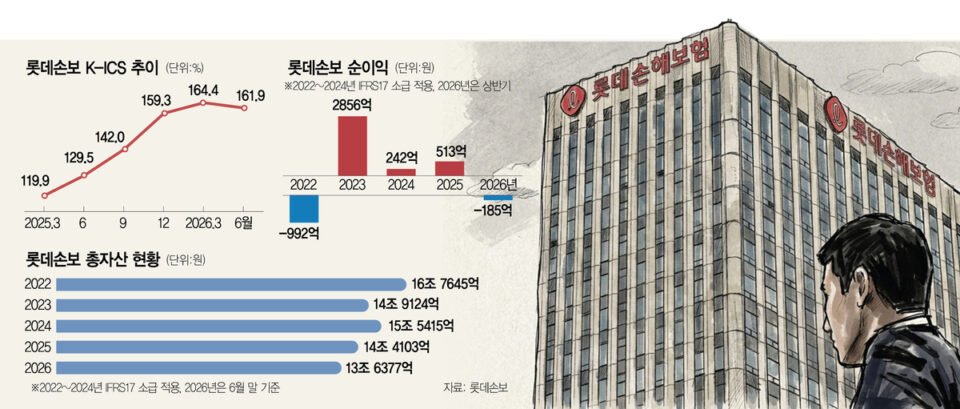

Soured overseas alternative investments at Lotte Non-Life Insurance (000400.KS), which Shinhan Financial Group is acquiring, amount to no more than 200 billion won ($136 million) even under conservative estimates, according to findings reviewed by the group. Shinhan has concluded that the acquisition price is appropriate and that a capital injection of about 300 billion won, as originally planned, will be enough to put the insurer back on track.
Shinhan Financial Group recently shared that assessment internally, financial industry sources said on the 5th.
In overseas alternative investments, the area drawing the most market attention, about 200 billion won — or 8% of the roughly 2.5 trillion won invested — could turn sour, the analysis showed. That is higher than the 150 billion to 170 billion won in additional losses from securities holdings, including overseas alternative investments, that the group had projected when it was reviewing the deal. Still, Shinhan says the increase is not large. “Barring a worst-case scenario such as a sharp spike in global interest rates, we see 200 billion won as the ceiling for bad assets even on a conservative calculation,” an official at Shinhan Financial Group said. “At that level, it is manageable and within what we can absorb.”
Shinhan earlier signed a share purchase agreement to buy the 77.04% stake in Lotte Non-Life held by private equity firm JKL Partners for 693.3 billion won. It plans to acquire the remaining 22.96% as well, bringing the total cost of the full stake to an estimated 900 billion won.
Alongside the acquisition, Shinhan will pursue a capital increase of 300 billion won. Given that the group currently puts in an average of about 50 billion won a year to cover losses at Shinhan EZ General Insurance, it judges that the effective additional burden is not heavy. As of the end of June, Lotte Non-Life’s Korean Insurance Capital Standard (K-ICS) ratio stood at 161.9% with transitional measures applied, but its basic-capital K-ICS ratio remained at -5.4%.
Shinhan also expects to cut much of Lotte Non-Life’s interest burden once the insurer joins the group, including by refinancing hybrid capital securities. As of the end of June, Lotte Non-Life had a combined 856 billion won outstanding in subordinated bonds and hybrid capital securities, carrying interest rates in the 6% to 7% range. Interest paid on subordinated bonds alone came to 54.2 billion won over the past year.
If Lotte Non-Life’s credit rating rises after it is brought under Shinhan Financial, issuance rates could fall, the group says. Shinhan is also considering having the holding company issue bonds directly to refinance the debt. Korea Investors Service has assigned Lotte Non-Life’s subordinated bonds and hybrid capital securities ratings of “BBB+” and “BBB,” respectively. “We expect to be able to bring rates down by around 1 percentage point,” an official at Shinhan Financial Group said. “We believe that can save about 8 billion won in interest costs a year.”
The group is also mapping out ways to boost business synergy among affiliates. Options include linking auto insurance with auto loans, or selling Lotte Non-Life products through bank branches to expand market share. Tying the insurer into the group’s integrated app, Shinhan Super SOL, is also expected to help generate synergy. Lotte Non-Life currently has 3.34 million customers of its own. “From Shinhan Financial Group’s standpoint, there are a number of options to weigh,” a financial industry official said. “The first thing they will look at is how to extract the most synergy with affiliates.”
Some observers, however, say the turnaround could cost more than expected. NH Investment & Securities put the effective total burden, including further normalization costs, at a minimum of 1.5 trillion won and as much as 2 trillion won. “Shinhan Financial has not had a large insurance business until now,” a banking industry official said. “There is a lot to examine in detail, such as insurance contracts, and there is a possibility that bad assets will grow significantly depending on market conditions.”