
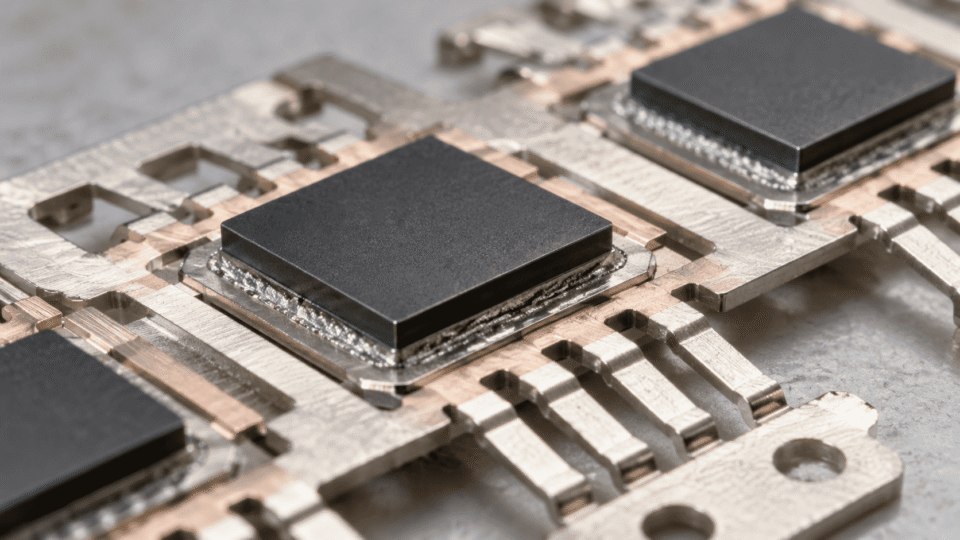
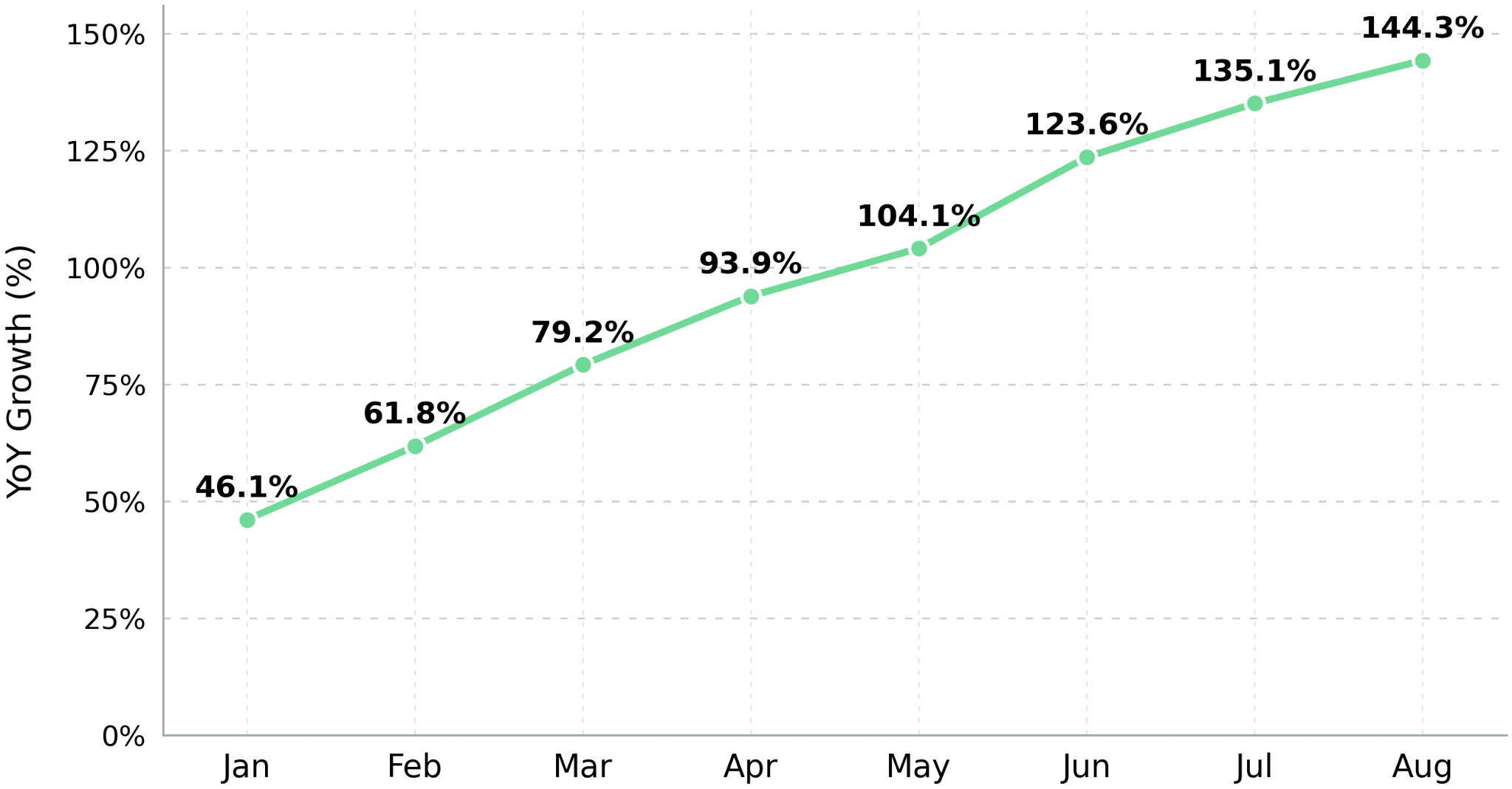
- Worldwide semiconductor sales rose 144.3% year over year to US$159.7 billion in August 2026, strengthening the potential market for silver used in chip packaging and power electronics.
- Semiconductor Equipment and Materials International (SEMI) forecasts 300-millimeter chipmaking equipment spending to rise 31% to US$149 billion in 2026, expanding manufacturing capacity and potential demand for silver-containing components.
- Silver is used in semiconductor packaging, electrical contacts, and power electronics, with data centers projected to account for more than 10% of electrical and electronics silver demand in 2027.
- International Energy Agency (IEA) projects data-center electricity consumption to rise from 485 terawatt-hours in 2025 to 950 terawatt-hours by 2030.
- Growing silver use in semiconductors and data centers could help offset reduced solar demand, supporting a more diversified long-term industrial demand outlook.
Semiconductor Sales Growth Expands Market for Silver Components
Global semiconductor sales reached US$159.7 billion in August 2026, up 144.3% from US$65.4 billion a year earlier and 8% from July, according to the Semiconductor Industry Association (SIA). Cumulative sales exceeded US$1 trillion through August, highlighting the scale of semiconductor market expansion.
SEMI forecasts global spending on 300-millimeter chipmaking equipment to rise 31% to US$149 billion in 2026 and reach US$227 billion by 2029. Construction is also expected to begin on 20 new semiconductor fabrication facilities or production lines in 2026. This growth broadens the potential market for silver-containing electronic components.
Advanced Packaging Opens New Silver Applications
Silver’s high electrical and thermal conductivity makes it valuable in semiconductor packaging, electrical connectors, power modules, and thermal-management materials. US Geological Survey (USGS) estimates that electrical and electronics applications accounted for 25% of US silver consumption in 2025, while photovoltaics accounted for 15%.
On October 1, 2026, TANAKA Precious Metal Technologies announced a three-year partnership with the Netherlands Organisation for Applied Scientific Research (TNO) to develop and evaluate advanced semiconductor packaging materials, including silver- and copper-based pastes for chip bonding. The research could support wider adoption of silver-based bonding materials in advanced chip manufacturing.
AI Infrastructure Spending Expands Silver Demand
IEA reported in April 2026 that capital expenditure by major technology companies exceeded US$400 billion in 2025 and could rise another 75% in 2026. Global data-center electricity consumption is projected to nearly double from 485 terawatt-hours in 2025 to approximately 950 terawatt-hours by 2030, with electricity use at AI facilities expected to triple. The buildout requires additional servers, power-conversion equipment, and electrical connections that can incorporate silver.
The Silver Institute’s World Silver Survey 2026 forecasts that data centers will account for more than 10% of total electrical and electronics silver demand in 2027. This projected share highlights the growing importance of AI infrastructure to silver’s industrial market.
Electronics Growth Reinforces Mine Output Expansion
Rising demand for silver-containing electronics places greater importance on the ability of operating mines to deliver consistent silver output. Higher processing capacity, improved recoveries, and efficient mining operations can increase saleable silver production, supporting the market’s ability to meet growing industrial requirements.
Americas Gold & Silver reported record third-quarter 2026 silver production of 800,458 ounces and sales of 860,850 ounces across its Galena and Cosalá operations. Cosalá’s production increased 23% quarter over quarter to 415,879 ounces, while ongoing infrastructure improvements at Galena are designed to support higher and more consistent output. With US$113 million in available liquidity as of September 30, the company maintained its full-year silver production guidance of 3.2 million to 3.6 million ounces, supported by operating performance and continued investment in mine expansion.
Oliver Turner, Executive Vice President of Corporate Development at Americas Gold & Silver, discusses how Mexican operations support future silver growth:
“We’ve been generating a lot of cash from Mexico. Mexico recorded a record in 2025, 1.1 million ounces. That is going to be exceeded this year and next year we’ll see some growth beyond that.”
Multi-Year Chip Investment Highlights Future Silver Supply
Beyond existing mine output, the semiconductor industry’s multi-year expansion brings future silver supply into focus. Projects with defined mineral reserves, established feasibility studies, and available financing offer a clearer path toward production, with development progress determining when additional silver can enter the market.
Vizsla Silver is advancing its Pánuco silver-gold project in Mexico, supported by US$411 million in cash and short-term investments as of July 31, 2026. Its November 2025 feasibility study projects average annual production of 17.4 million silver-equivalent ounces over 9.4 years, with initial capital costs of US$238.7 million and an after-tax net present value at a 5% discount rate (NPV5%) of US$1.802 billion. With underground mine-access development underway and first silver production targeted for the second half of 2028, the company’s funding position supports its path toward production.
Long-Term Industrial Demand Elevates Silver Growth
Silver’s expanding applications in advanced electronics also bring attention to exploration projects that could contribute to the longer-term supply pipeline. Targeted drilling can extend known mineralization and improve resource confidence, while updated resource estimates and a preliminary economic assessment (PEA) can help establish a project’s potential scale and economic viability.
GR Silver Mining is expanding the potential silver resource at its San Marcial project in Mexico, where September 2026 drilling confirmed mineralization extending at least 300 meters beyond the existing resource boundary. Results included 16.1 meters grading 162 grams per tonne (g/t) silver and 11.7 meters grading 147 g/t silver. Its ongoing 20,000-meter drilling program aims to expand the resource ahead of an updated estimate and PEA planned for the first half of 2027.
Eric Zaunscherb, President and Chief Executive Officer of GR Silver Mining, discusses industrial silver consumption trends and market inventories:
“With regard to the industrial uses, we continue to see growth in silver consumption in photovoltaics, solar cells, and in EVs. So, I think that the outlook is pretty good for silver. Finally, I’d point out that silver physical inventories have declined dramatically.”
Solar Thrifting Raises Importance of Non-Solar Demand
The Silver Institute’s World Silver Survey 2026 forecasts industrial silver demand to decline 3% to 639.6 million ounces in 2026. Photovoltaic demand is projected to fall 19%, from 186.6 million ounces in 2025 to 151.0 million ounces, while total electrical and electronics demand is forecast to decline 6% to 422.9 million ounces.
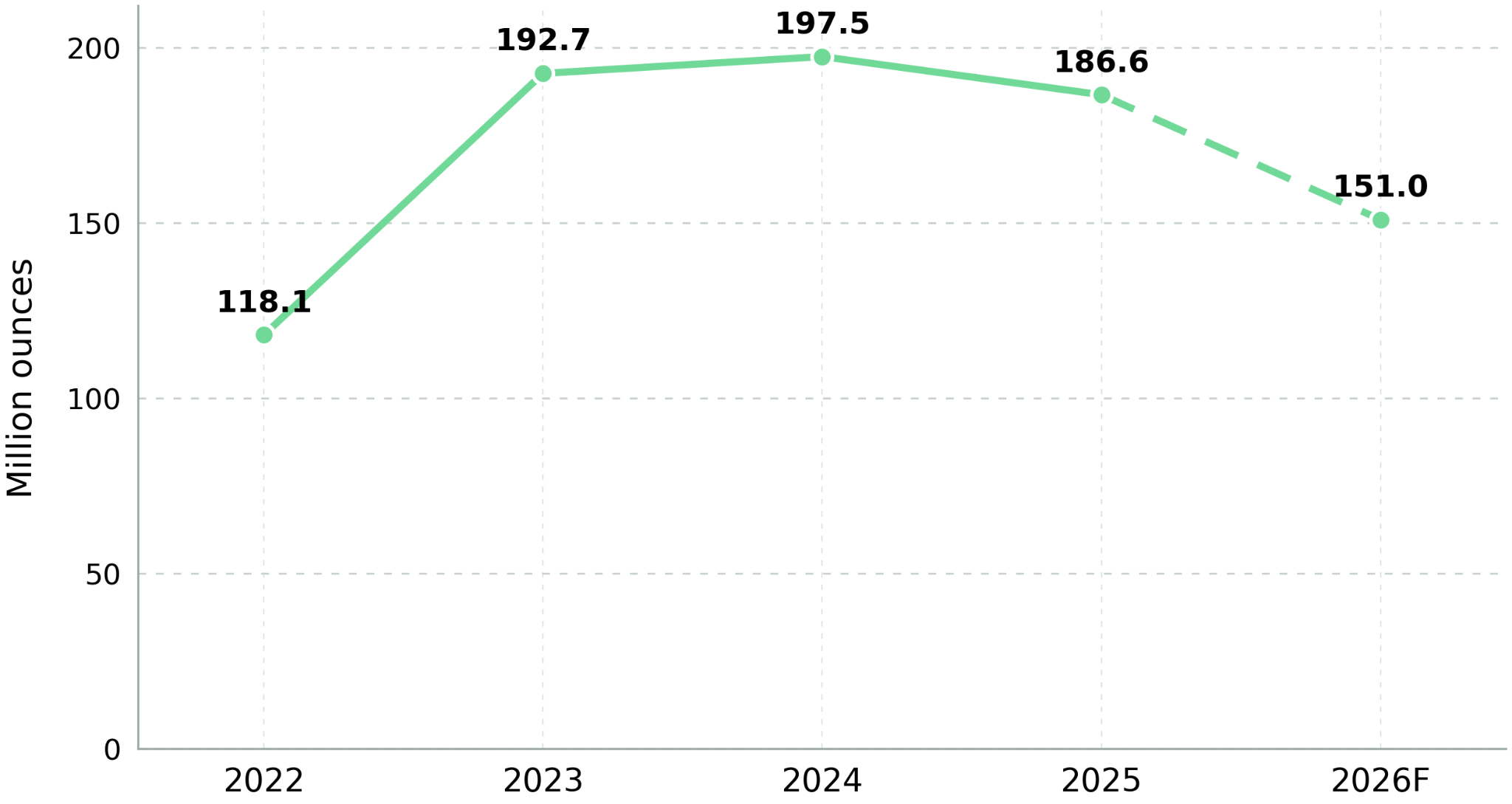
Reduced silver content per solar cell and material substitution are expected to outweigh near-term gains from AI infrastructure and other electronics applications. This places greater importance on the commercial adoption of silver-based chip bonding materials, power electronics, and other advanced components. Their production volumes and silver content will help determine how quickly non-solar applications contribute to future industrial demand growth.
The Investment Thesis for Silver
- Semiconductor and data-center expansion increases the potential market for silver-containing packaging, electrical connections, and power equipment, diversifying long-term industrial demand beyond solar manufacturing.
- Producers supply current silver demand, with recoveries, operating costs, and sustaining capital shaping cash margins and reinvestment capacity.
- Developers offer modeled future silver production, with reserves, project economics, financing, and permitting progress influencing valuations and production timelines.
- Explorers offer silver resource growth potential, with drilling results, updated resource estimates, and economic assessments establishing the scale and viability of prospective projects.
- Photovoltaic thrifting and changes in silver content per electronic component help determine how semiconductor manufacturing growth translates into actual industrial silver consumption.
Expanding semiconductor manufacturing and AI infrastructure investment are creating new opportunities for silver’s long-term industrial demand, strengthening the investment case for silver mining assets. As advanced electronics become an increasingly important market for silver-containing materials, wider adoption of semiconductor packaging, electrical connections, and power equipment could provide additional demand beyond solar manufacturing. The key investment opportunity lies in translating this expanding industrial market into sustained silver consumption, supporting the long-term value of existing mine output and economically viable future supply.
TL;DR
Global semiconductor sales surged 144.3% year over year to US$159.7 billion in August 2026, while chipmaking equipment spending is forecast to rise 31% in 2026. Expanding AI infrastructure and advanced semiconductor packaging could increase demand for silver-containing electrical components. The Silver Institute forecasts data centers will account for more than 10% of electrical and electronics silver demand in 2027. Although industrial silver consumption is projected to decline 3% in 2026 due partly to solar thrifting, broader electronics applications offer opportunities for longer-term demand diversification. Producers, developers, and explorers provide different investment exposure through existing output, planned production, and resource expansion.