
Experts believe that these items belonged to someone of wealth and high social standing, and may have been worn for ceremonial or even protective purposes such as warding off harm or evil.

Vornic et al., Revista Arheologică (2026)Archaeologists discovered a treasure trove of unique silver jewelry in Moldova, likely dating back to the first half of the 1600s.
Archaeologists excavating the plains of northern Moldova just uncovered a large collection of unique silver jewelry dating back to around the first half of the 1600s.
The jewelry includes buttons designed to jingle when worn, and a belt clasp adorned with two snake heads. Archaeologists believe that these rare silver treasure likely belonged to someone of high status, and these relics could now shed light on how customary jewelry was used to show social standing in the region some four centuries ago.
The Discovery Of A Centuries-Old Silver Treasure Trove In Moldova
The treasure, which consists of around 36 objects, was found near the village of Ordășei in northern Moldova during a dig that began in 2024.
The region is known for eight burial mounds that have been dated as far back as the Early Bronze Age, but were continuously used by later communities, including the Sarmatians in the early centuries C.E.
The silver objects were scattered around the plateau that stretched around 2,500 square feet, according to a study published in the journal Revista Arheologică this year. The team dated the silver jewelry to the late 16th or early 17th century.

Wikimedia CommonsArchaeologists began excavating the plains in northern Moldova in 2024.
The treasure trove included seven large buttons that measure around an inch in diameter. The spherical buttons were constructed by craftsmen by joining together two hollow hemispheres with small metal bits inside.
The researchers concluded that these buttons were created so they would make a gentle jingle as their wearer moved and walked around. The team was also able to compare these buttons to other objects they found and identify those as small bells or rattling jewelry, as well.
Similar large silver buttons that made sound were found within centuries-old treasure troves at the archaeological sites Onești, Musaitu, and Dezghingea, also in Moldova, which indicates to the researchers that this jewelry was a cultural custom in the region.
The recent jewelry found also included 21 smaller buttons, and three silver earrings with intricate details, such as small metalwork that hung down off of the earring, and likely the central pendant of a necklace.
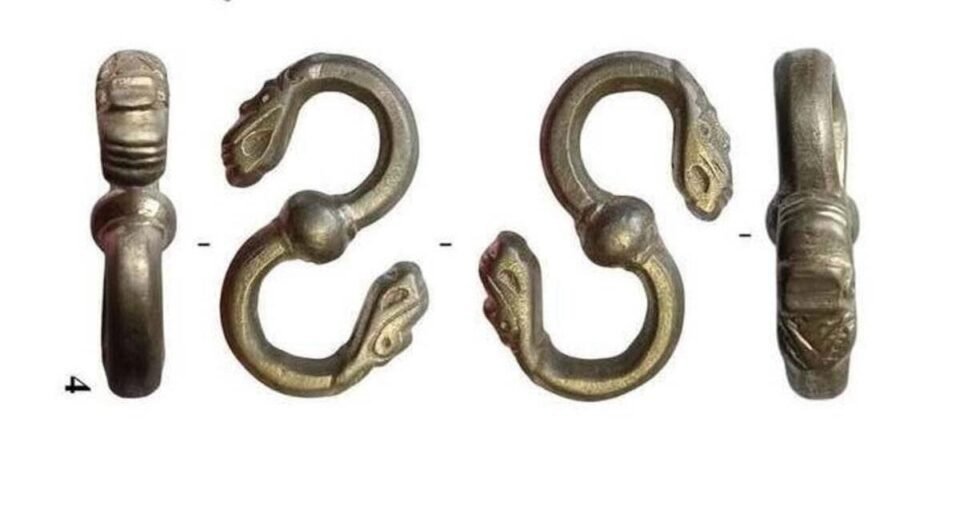
The most remarkable discovery was a striking silver belt clasp. The clasp is just an inch and a half long, and weighs less than an ounce.

Vornic et al., Revista Arheologică (2026)Researchers discovered a belt clasp adorned with snake heads.
Despite its small size, the clasp stood out to researchers because of its ends shaped as two stylized snake heads, with intricate features presumed to be the snake eyes and mouths.
Beyond the interesting decoration on the clasp, the researchers were impressed by its fastening mechanism, where the ends hooked onto each other, secured by a thickened central section.
Other S-shaped belt fasteners have been uncovered in Eastern Europe during the late medieval period, and have been historically associated with ceremonial sword belts worn by the military. However, no direct equivalent within late medieval treasure troves has been discovered and published from the Eastern European region.
What This Jewelry Reveals About Ceremonial Dress In 17th-Century Moldova
The artifacts were analyzed with x-ray fluorescence at the Institute of Applied Physics of Moldova State University, to identify their composition.

Vornic et al., Revista Arheologică (2026)Researchers determined that the treasure likely belonged to a high-status individual who buried it during a time of instability.
The three earrings were around 90 percent silver, while the other objects contained more copper and tin. The variation in metal composition opens a window into the techniques of the craftsmen, and their knowledge of which metals were suitable for detailed work.
The researchers believe the objects they found belonged to ceremonial—rather than everyday—clothing. Some of this conjecture is based on the rattling objects, as the sound-making might have had a protective function to ward off evil spirits and influences.
Still, the archaeologists cautioned that there is no evidence of a specific religious ceremony in which they were used—just that these buttons were likely special, and worn by high-status individuals.
The remaining question for the researchers is why this special jewelry was buried in the first place. During the 16th and 17th centuries, Moldova was experiencing some political instability, as it became a liege state of the Ottoman Empire and underwent intense uprisings.
It is a possibility that a high-status person buried their valuables during this period of uncertainty, and never came back for them, but archaeologists hope to reveal more about the background of the silver jewelry during further research.
After reading about the silver jewelry discovered in Moldova, go inside nine of the weirdest everyday medieval customs. Then, discover what the fall of the Soviet Union was like in 36 rarely-seen photographs.