
JUMP → Ratings | Groups | Knockout | Bracket | Match Projections | Track Record & History
⚽ The latest World Cup projections: Updated June 20, 2026
USA wins Group D!
The United States benefited from an own goal, and the second half wasn’t the best showcase of elegant soccer. But we were pretty clearly the better team — and we clinched advancement to the knockout stage after defeating Australia 2-0. It’s been an unusually smooth path so far for a country that has long awaited its soccer breakthrough.
We later also clinched 1st place in Group D after Turkey lost to Paraguay 1-0 despite Paraguay playing more than half the match a man down. Turkey, one of the most disappointing teams in the tournament, has been eliminated. That means Thursday’s match between the U.S. and Turkey doesn’t have any consequences for the bracket, although the USMNT will use it to prove the improvement they’ve shown so far is for real.
See below for more details on the U.S.’s potential matchuos in the Round of 32, but it’s likely to be a relatively favorable opponent.
Mexico will also advance to the knockout round after a fun but fluky 1-0 win against South Korea on Thursday. And Canada is essentially certain to advance also after a 6-0 win against Qatar.
Brazil and Morocco have also virtually clinched advancement. Haiti joins Turkey as the other team to be mathematically eliminated. The Netherlands is also in great shape after demolishing Sweden 5-1 today.
The model adjusts its odds after each game, playing out the rest of the tournament 100,000 times while giving teams credit (or blame) for their performance so far. We don’t want to overpromise, and we have a small team, so expect one update per day, but you may occasionally see intraday updates after important matches. We’ve also been tracking injury updates, which are becoming a problem for some of the frontrunners.
For our methodology, see here.
See also: PELE International Football Rankings.
So, who’s gonna win the World Cup? While our model doesn’t deviate too much from the conventional wisdom, we don’t have teams in quite the same order. Each time we run the model, we play out 100,000 simulated World Cups, accounting for the difficulty of each team’s draw, meticulously calculating tiebreakers, and even the possibility of a dark-horse contender getting hot and unexpectedly being in top form. Let’s look at the PELE ratings and some specific adjustments that we’ve made to them for the World Cup.
Our baseline PELE ratings are adjusted in several ways for the tournament. First, we account for differences between PELE’s algorithmically calculated rosters and the actual, announced World Cup rosters. Thus, we correct for the impact of injuries or otherwise unexpected player absences.
Second, we update each team’s rating based on the quality of their performance relative to PELE’s expectations for each match. For instance, while Mexico beat South Africa 2-0 in the opening game, this result was pretty much what PELE expected so it doesn’t produce much of a revision to the overall ratings. And third, we adjust for home-field advantage on a match-by-match basis. The factor is customized for each team: as it happens, the U.S., Canada and especially Mexico have above-average home-field advantages.
You can see the impact of some of PELE’s advanced features. Norway, for instance, receives a boost from Erling Haaland because PELE accounts for player market values.
You might have noticed that our table introduced some mascots: a fox (🦊) for Group F, for instance. (By the way, that’s a hedgehog 🦔, not a porcupine, for Group H.) We figured that might be helpful because with 12 groups this year, the group stage could be roughly as confusing as the Tokyo Subway Map. Here are all the groups, with their mascots, along with the pre-tournament composite ratings for each one.
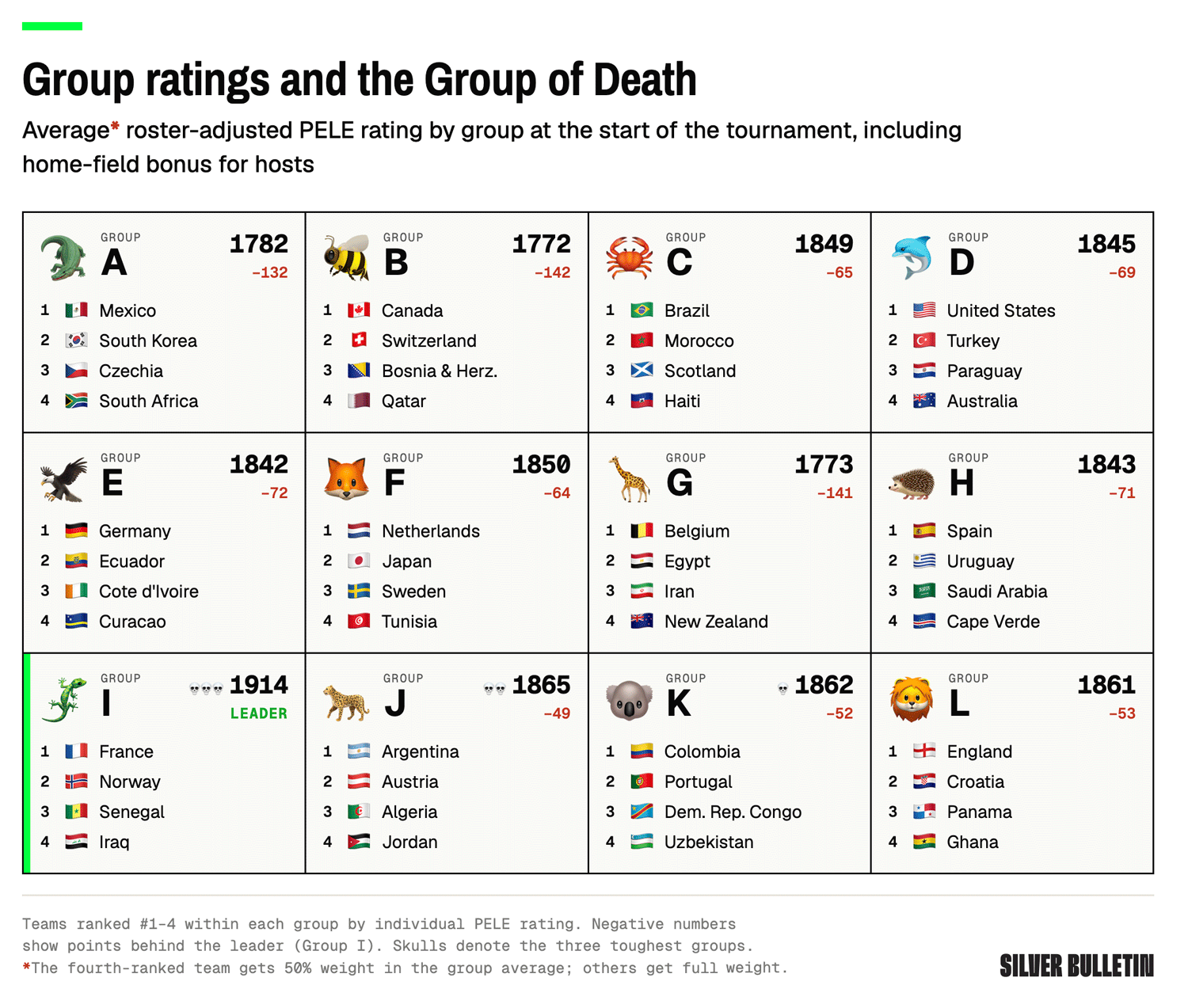
Some groups are tougher than others, particularly France’s Group I (🦎), which also features Norway and Senegal. Under the old format, this would be a proverbial Group of Death, but now all three teams have a chance to get through. The United States’ Group D (🐬) is also a little tougher than reputed, with no elite teams but also no easy outs. Canada and Mexico have among the easier draws in the tournament, however.
But let’s be honest: 32 teams out of 48 advancing makes for a forgiving format. (The eight highest-ranked of the 12 3rd-place finishers will go to the knockout stage along with the winner and runner-up from each group.) Yes, we put a lot of work into precisely incorporating FIFA’s complicated tiebreaker rules into our simulations. (Head-to-head results now take precedence over goal differential.) But no country that has any pretension of being a soccer superpower has a good excuse not to advance. The expansion from 32 to 48 teams also lowers the floor significantly, with teams like Uzbekistan, Cape Verde and Curacao potentially providing for easy group-stage fodder and possibly yielding a higher-scoring tournament.
Let’s take the rest of this in phases. We’ve accounted for pretty much every detail that we can think of, from how teams’ odds of advancing will change based on the results of each group stage game to the biggest upsets in World Cup history:
Ratings and forecasts will be updated at the end of each match day. As a heads-up, we’ll show all of you some data from the first four groups as a preview, but most of this incredibly detailed analysis is reserved for paying subscribers. (Paid subscribers will also get access to our full suite of PELE ratings and our forthcoming midterm election forecasts.)
As we’ve said, 12 groups are a lot, especially with as much detail as we’re going to show you. So let’s pair our mascots off into squads of four, starting with Groups A through D, which include the three co-hosts. Here are the latest results of our 100K simulations. Once the tournament gets underway, we’ll hardcode any actual results and simulate the rest of the World Cup from there.
We’ve opted to show you a lot of detail here because of FIFA’s complicated tiebreakers. Here’s what determines group stage placement, in precise FIFA order:
-
Points: 3 for a win and 1 for a draw
-
Head-to-head results between tied teams
-
Goal differential
-
Goals scored
-
Fair play points (FPP), or basically yellow cards and red cards: the fewer, the better for advancement (appropriately, this is the yellow column in the chart)
-
Finally, the FIFA rankings
The U.S. and Canada began as more like co-favorites in their groups along with Turkey and Switzerland — Canada’s Group B is rather weak — although the U.S.’s superior performance in their opener have put “us” in a good position. So what exactly are their odds of advancing? That’s in our next table: