
The Most Liquid Silver Coins, Ranked
1. American Silver Eagle — The Global Benchmark
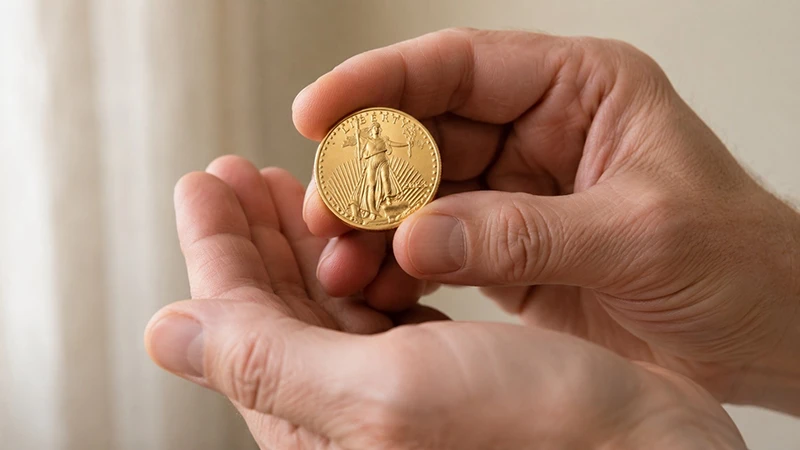
The American Silver Eagle is the world’s most widely traded silver coin (U.S. Mint), in continuous production since 1986. Each coin contains 1 troy ounce of .999 fine silver and carries legal tender status under U.S. federal law (31 U.S.C. § 5112(e)). Every authorized precious metals dealer in the United States — and the vast majority internationally — will buy one on sight, without testing or verification. Transactions typically complete the same day.
Silver Eagles are IRA-eligible under IRS Publication 590-B, which broadens demand significantly: institutional buyers, self-directed IRA custodians, and major bullion banks all maintain active two-way markets. As of June 2026, retail premiums on single-coin purchases run approximately 20–25% over spot (nFusion Solutions, June 3, 2026) — roughly $88–$92 per ounce with silver at $73.35. Tube purchases (20 coins) reduce that premium meaningfully; monster-box quantities (500 coins) achieve the tightest per-coin spreads.
The 2021 redesign introduced the Type II Eagle, featuring a new reverse design by sculptor Emily Damstra and a missing-reed anti-counterfeiting edge feature across all post-2021 issues (U.S. Mint).
2. Canadian Silver Maple Leaf — Maximum Purity, Competitive Premiums
The Canadian Silver Maple Leaf is the Eagle’s closest global rival for liquidity — and it often wins on value efficiency. Each Maple Leaf contains 1 troy ounce of .9999 fine silver (four nines of purity versus the Eagle’s three) with a legal tender face value of CA$5 (Royal Canadian Mint). Retail premiums typically run $1–$3 per coin below equivalent Eagles. On a 500-coin monster box at June 2026 spot prices, that gap represents $500–$1,500 in acquisition savings with no meaningful sacrifice in dealer recognition or resale depth.
The Maple Leaf leads the industry on anti-counterfeiting technology. Starting with the 2014 issue, the Royal Canadian Mint introduced radial-line backgrounds as a permanent feature and added a laser-engraved micro-security mark — a textured maple leaf containing the two-digit year, visible only under magnification (Royal Canadian Mint; CoinWorld, December 2013). In 2018, the RCM introduced MintShield surface protection — an invisible barrier applied during production that significantly reduces milk-spotting (Royal Canadian Mint MintShield announcement, February 2018).
Outside the United States, the Maple Leaf often carries a recognition edge, with strong institutional distribution across European and Asian markets. Any reputable dealer worldwide will buy either a Maple Leaf or a Silver Eagle without question.
3. Austrian Silver Philharmonic — European Benchmark
The Austrian Mint (Münze Österreich) has produced the Silver Philharmonic since 2008. Each coin contains 1 troy ounce of .999 fine silver and carries a legal tender face value of €1.50 (Austrian Mint). It is the most widely sold silver bullion coin in Europe, with strong institutional liquidity across European dealer networks. Premiums typically run 13–17% over spot — lower than Maple Leaf levels, reflecting shallower North American distribution versus deep European reach. It meets IRS .999 fineness requirements for IRA inclusion (IRS Publication 590-B).
4. British Silver Britannia — IRA-Eligible, Growing Global Presence
The Royal Mint has produced the Silver Britannia since 1997. Each coin contains 1 troy ounce of .999 fine silver and carries a £2 legal tender face value (The Royal Mint). Retail premiums are comparable to the Philharmonic, typically 13–16% over spot.
IRA eligibility note: Only Britannias minted from 2013 onward meet the IRS .999 minimum fineness threshold. Pre-2013 issues were struck in .958 fineness and therefore do not qualify (The Royal Mint; IRS Publication 590-B). Verify the issue year before purchasing for IRA use.
Security features added progressively since 2021 — including surface animation, a latent trident-to-padlock image, and tincture-line micro-engraving — make modern Britannias among the most technically secure bullion coins available (The Royal Mint).
Sovereign Coin Comparison
| Coin | Mint | Purity | Typical Premium | IRA Eligible | Strongest Market |
|---|---|---|---|---|---|
| American Silver Eagle | U.S. Mint | .999 | 20–25% over spot | Yes (statutory) | United States, global |
| Canadian Silver Maple Leaf | Royal Canadian Mint | .9999 | 15–20% over spot | Yes | North America, Europe, Asia |
| Austrian Silver Philharmonic | Austrian Mint | .999 | 13–17% over spot | Yes | Europe |
| British Silver Britannia (2013+) | The Royal Mint | .999 | 13–16% over spot | Yes (2013+ only) | UK, Europe |
What About Silver Rounds and Bars?
Are Silver Rounds Liquid?
Silver rounds from well-established private mints occupy the middle tier of the liquidity ladder. Buffalo, Morgan-design, and Sunshine Minting rounds are the most widely recognized, and most reputable dealers accept them. However, because authentication risk is non-zero on private-mint products, dealers apply a recognition discount and bid more conservatively than they do for sovereign coins. Rounds that cost 5–8% over spot to acquire may sell at margins tighter to spot — narrowing or eliminating the apparent cost advantage over time.
For investors stacking maximum ounces per dollar over a long horizon, rounds from established private mints are a rational choice. One qualifier applies: stick to widely recognized brands. Obscure or novelty designs from unknown issuers carry real liquidity risk — some dealers will not bid them at all.
Are Silver Bars Liquid?
Silver bars from LBMA-accredited refiners carry legitimate institutional liquidity in wholesale markets. At retail, however, a 100 oz bar requires selling the entire position at once — there is no cutting a bar in half, and most dealers will not attempt it. Bar authentication is also more demanding than coin verification, producing wider bid-ask spreads at the retail level.
Bars are a sound choice for investors with long time horizons and no anticipated need for near-term partial liquidation. For anyone who may need quick access to part of their silver position — during a job change, a home purchase, or a market window — coins offer divisibility and instant recognition that bars structurally cannot replicate.
Why the Standard Liquidity Ranking Breaks Down When You Need It Most
Most buyer guides treat liquidity as a fixed hierarchy: Eagles first, Maples second, bars last. That ranking holds in normal markets. In stressed markets, it is dangerously incomplete.
Liquidity is not a stable property of a coin. It is a function of market conditions at the moment you need to sell. In the 2008 financial crisis and the March 2020 dislocation, the spread between sovereign coins and everything else did not merely widen — generic silver became genuinely difficult to trade at any competitive price. The question is not which silver is cheapest to buy. It is which silver a dealer will buy from you on the day you need them to.
The Network Effect Behind Sovereign Coin Liquidity
What sovereign coins represent is a network effect built over decades. The U.S. Mint, the Royal Canadian Mint, and the Austrian Mint have all cultivated institutional relationships with authorized purchaser networks, major dealers, and central bank collateral departments worldwide (U.S. Mint Authorized Purchaser Program; Royal Canadian Mint bullion distribution). That network cannot be replicated quickly by a private mint — it is embedded in every transaction as a dealer’s willingness to buy without hesitation at competitive spreads.
This matters more in 2026 than it did five years ago. The silver market is currently in its sixth consecutive annual supply deficit. The Silver Institute projects a 46.3 million troy ounce shortfall for the year (Silver Institute World Silver Survey 2026, April 15, 2026). In a tightening physical market, the bid for instantly verifiable silver is systematically firmer than the bid for silver that requires extra authentication steps.
One more thing investors should watch: premium cycles, not just spot price. Premiums on sovereign coins widen during bull markets and compress during corrections. Buying Eagles at compressed premiums versus elevated premiums on the same spot price produces a meaningfully different all-in cost. Spot price tells you half the story. Premium tells you the rest.