
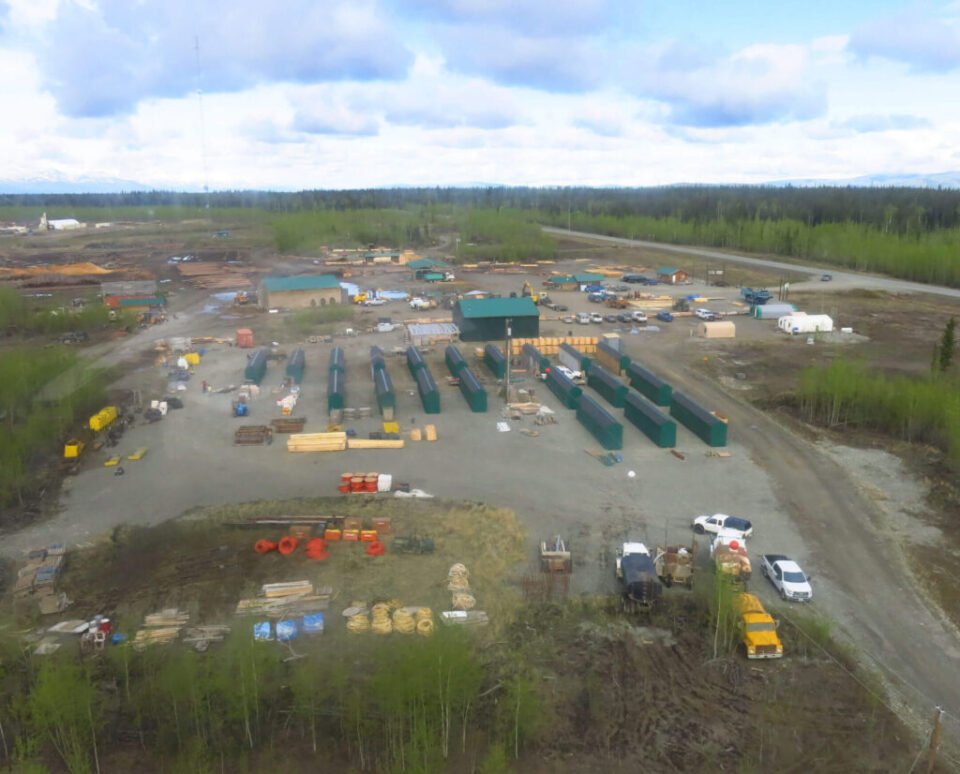
- Manh Choh’s distributions continue to fund Contango’s growth plan as 2026 output nears 40,000-45,000 oz after rain paused Fort Knox.
- CEO Rick Van Nieuwenhuyse states preliminary 2027 figure is about 70,000 oz and around $150 million in free cash flow to Contango’s share, below the published 75,000 to 80,000 oz guidance.
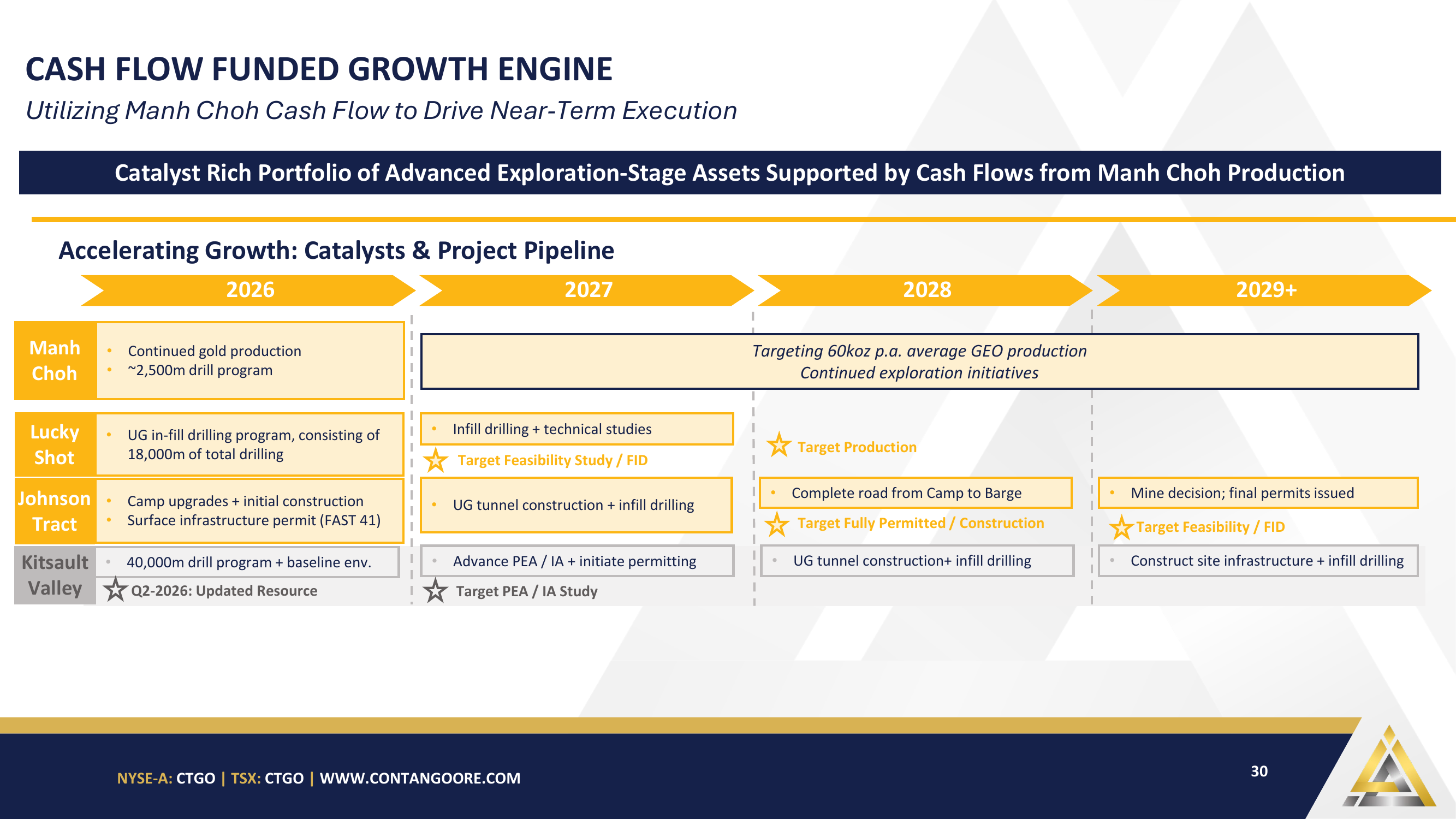
- Lucky Shot is fully permitted with an MRE targeted for May 2027 and 40,000 to 50,000 oz a year targeted from 2028.
- Kitsault’s 89.5 Moz silver-equivalent Indicated resource excludes over 56,400 m of 2026 drilling, and an update is due in the first half of 2027.
Gold and silver prices have pulled back from their highs, and mining equities have fallen further than the metals. For producers with cash flow, that gap separates companies that need to raise money at depressed prices from those that can keep building. Contango Silver & Gold Inc. (TSX: CTGO) falls into the second group. It holds 30% of the Manh Choh gold mine in Alaska, operated by Kinross Gold, and is using that cash to advance three wholly owned projects in Alaska and British Columbia.
Chief Executive Officer Rick Van Nieuwenhuyse restated a target of growing from about 60,000 ounces (oz) of attributable gold a year to 200,000 oz of gold and 5 million ounces (Moz) of silver within five years. He described each asset as a stepping stone. Manh Choh funds Lucky Shot, and the two together fund Johnson Tract and Kitsault Valley to production decisions.
Lower 2026 Output, Cash Still Funds the Plan
Manh Choh is the company’s first direct shipping ore (DSO) operation. There is no mill or tailings facility at site. Ore is mined, trucked about 240 miles (mi) to Kinross’s Fort Knox mill, and processed there. Contango’s share of 2025 output was 59,500 oz of gold, and it received a $102 million cash distribution.
This year is lighter. Van Nieuwenhuyse confirmed that 2026 production will come in near the low end of the 40,000 to 45,000 oz guidance. Heavy September rain forced Fort Knox to pause because the heap leach could not hold the extra water, and the remaining Manh Choh ore moves into the fourth processing campaign of 2026, beginning in November. Costs have also risen. The ore is now all sulfide, with more copper and sulfur, which consumes more cyanide and lime. Diesel and salaries are also higher.
For 2027, the company’s published guidance from March 16, 2026 is 75,000 to 80,000 oz at cash costs of $1,200 to $1,300 per oz. Van Nieuwenhuyse gave a lower preliminary figure, pending formal joint venture guidance in December, of about 70,000 oz and around $150 million in free cash flow to Contango’s share. He put the remaining mine life at this year plus three more. Distributions arrive net of all costs, including reclamation set aside by Kinross, so Contango does not face separate closure bills.
Lucky Shot: The Next Direct-Ship Step
Lucky Shot is 100% owned, fully permitted for mining, and planned as a second DSO operation. The current resource is about 110,000 oz at 14.5 grams per tonne (g/t) gold. Underground drilling continues through February 2027, with a mineral resource estimate (MRE) targeted for May 2027. Van Nieuwenhuyse called the follow-on study a “feasibility light,” built around a mine plan, a transportation plan and a tolling arrangement. Fort Knox is the most likely mill.
The company is targeting 40,000 to 50,000 oz a year from 2028. At a $4,000 gold price, Van Nieuwenhuyse estimated cash costs near $2,000 per oz and a similar margin. The mine will start with a five-year plan that is renewed as underground drilling extends the veins. He cited Kensington, which has run on a three to five year mine life for about 20 years. Drilling began on October 22, 2026 from the 2070 East Drift, the first modern program to test the eastern extent of the vein system, with 3,650 meters (m) planned. A second rig in the 2300 East Drift adds 5,320 m from November 15.
Interview with Rick Van Nieuwenhuyse, Director & CEO of Contango Silver & Gold
Johnson Tract & Kitsault: Scale With Processing Decision
The 200,000 oz target depends on two larger polymetallic deposits, each containing copper, lead, zinc, gold and silver. Johnson Tract in Alaska is gold-rich and holds about 1.1 Moz at 9.4 g/t gold equivalent, averaging 40 m wide and open at depth. A May 2025 Initial Assessment estimated a post-tax net present value at a 5% discount rate of $615 million and an internal rate of return above 60% at $4,000 gold. The deposit is about 15 mi from the ocean. In 2026 the company completed the access road from camp to the portal site, the portal laydown area and a new camp pad originally planned for 2027. Van Nieuwenhuyse is targeting road and port permits by May 2028, about two years of underground drilling toward a feasibility study, and production by 2030.
Kitsault Valley in British Columbia’s Golden Triangle is silver-rich. The September 2026 MRE reported Indicated resources of 89.5 Moz silver equivalent at 363 g/t and Inferred resources of 64.92 Moz at 320 g/t. The company then drilled 56,492 m across 152 holes, about 40% more than the 40,000 m planned, and none of it is in the current estimate. An updated MRE is scheduled for the first half of 2027, followed by an IA later in the year. Van Nieuwenhuyse’s arithmetic, at $50 silver, puts mining at two to three oz of silver and transport and processing at about two more, against a grade near 10 oz of silver per ton.
Neither deposit suits Fort Knox, and both need the same type of sulfide mill. Contango is weighing two routes: buying a built but idle mill, or building on a fully permitted site close to Kitsault, with Johnson Tract ore shipped in. Van Nieuwenhuyse said this step will require capital and some equity.
Capital Discipline
Contango spent about $75 million across its three development projects in 2026. It reported $89 million in cash at June 30, 2026, against $45.3 million of bank debt and a $20 million convertible debenture. Remaining hedges were settled by July 1, 2026, and the company now has full exposure to the gold price. Van Nieuwenhuyse noted the share price is about half its March level.
Van Nieuwenhuyse is a significant shareholder, and he treats the low share count as a priority and says future issuance will be kept to a minimum:
“When I’ve got these two big projects, we can get into production with our existing cash flow. The other projects I can get to a feasibility level decision but they still need a place to process them. So I either acquire it or build it and that’s going to take some capital some equity.”
Existing cash flow can fund Lucky Shot into production and the two larger projects to feasibility-level decisions. Van Nieuwenhuyse also said the company is not limited to DSO and would consider a merger that brings in different expertise.
Permitting & First Nations Support in British Columbia
Kitsault is a brownfield site. Its historic mines were themselves direct shipping operations, and power sits nearby, though road access needs to be re-established. Van Nieuwenhuyse said the permitting timelines for Johnson Tract and Kitsault should align within about a year of each other, with Kitsault production around 2030 to 2031.
In British Columbia, he identified coordination with First Nations as the main source of delay for mining projects. Kitsault’s advantage is the Nisga’a Nation, a treaty nation that has settled its rights with the provincial government and runs businesses that support mining. Contango already uses Nisga’a corporations for much of its site work. In its October 2026 corporate update, the company also noted that the new majority Conservative government elected on October 24 has signalled support for faster resource development.
The Investment Thesis for Contango Silver & Gold
- Manh Choh distributions fund Lucky Shot and the two larger projects, management giving preliminary 2027 indication of about 70,000 ounces and roughly $150 million in free cash flow to Contango’s share.
- A share count of about 33 million spreads production growth across a small equity base, and management has said it intends to limit new share issuance.
- Lucky Shot is fully permitted and targeting 40,000 to 50,000 ounces a year from 2028, with a mineral resource estimate planned for May 2027 as the next milestone to monitor.
- More than 56,000 meters of 2026 drilling at Kitsault are excluded from the September resource, so the first-half 2027 update is a near-term watch-item.
- The processing route for Johnson Tract and Kitsault is unresolved, and buying or building a mill is likely to require new equity.
- Manh Choh has three more years of mine life, so the timing of Lucky Shot and the larger projects decides how long internal funding lasts.
Contango’s plan depends on execution against dates it has now published. Lucky Shot’s resource in May 2027 and the Kitsault update in the first half of 2027 are the first two tests.
Macro Thematic Analysis
Gold and silver have corrected from their highs, and the conversation referenced gold near $4,200 per oz and silver near $53. Van Nieuwenhuyse estimated the fall at about 30% for gold and closer to 50% for silver, which he said is normal for the metals, while mining equities have fallen further than fundamentals justify. He pointed to buying by central banks and by investors in China, and to a break in the old link between gold and inflation-protected Treasury bonds, as signs that China now leads the gold market.
Margins frame his case for DSO. Cost inflation in diesel, reagents and labour has lifted operating costs, but the spread between price and cost remains far wider than in earlier cycles.
Van Nieuwenhuyse described the economics when he entered the gold business:
“When I started in Nevada in the gold business, a typical gold mine in Nevada was producing gold for about $300-350 an ounce when the gold price was $400-450 so you had a $50 to $100 margin. And we made that was a good business. Now, we have a $1,000-2,000 margin. Everybody’s freaked out.”
Today he puts that margin at $1,000 to $2,000 per oz, enough to absorb trucking, rail or barge haulage, so high-grade deposits near roads or tidewater can reach production without a dedicated mill. He also sees value in deposits of about 1 Moz that major producers pass over, and Johnson Tract fits that description after a larger shareholder lost interest when drilling found about 1 Moz instead of a far bigger target. Van Nieuwenhuyse founded NovaGold, which discovered Donlin. He said the project is still in permitting and litigation years after he left in 2011, and that experience shapes Contango’s preference for smaller, higher-grade deposits that can be permitted and producing within a few years.
TL;DR
Contango Silver & Gold holds 30% of Alaska’s Manh Choh mine, operated by Kinross, and uses its cash distributions to fund three wholly owned projects. Chief Executive Officer Rick Van Nieuwenhuyse is targeting growth from about 60,000 oz of gold a year to 200,000 oz of gold and 5 Moz of silver within five years. Manh Choh output for 2026 will be near the low end of guidance after rain paused Fort Knox. His preliminary 2027 figure is about 70,000 oz and around $150 million in free cash flow to Contango. Lucky Shot is targeting a resource in May 2027 and production in 2028. Johnson Tract and Kitsault still need a sulfide mill, which will likely require some equity.