

(Kitco NewsWire) – Spot gold and silver prices were sharply lower in late U.S. trading Tuesday, as stronger-than-expected U.S. consumer inflation reinforced expectations for another Federal Reserve interest rate increase in December and raised the possibility of a larger policy adjustment. Treasury yields and the dollar advanced following the inflation report, placing renewed pressure on precious metals despite another decline in crude oil prices and reduced concerns about immediate military escalation involving Iran. Spot gold was trading near $4,031.80 an ounce, down $107.60, or 2.60%, while spot silver was trading near $51.410, down $1.894, or 3.55%.
The U.S. Labor Department reported Tuesday that the consumer price index increased a seasonally adjusted 0.4% in October, exceeding economists’ expectations for a 0.3% gain. The increase was slower than September’s 0.6% rise but showed that inflationary pressure remained persistent. Core consumer prices, excluding food and energy, increased 0.3%, above expectations for a 0.2% gain and matching the monthly increases recorded in August and September. The stronger underlying reading reinforced concerns that the Federal Reserve may need to maintain restrictive monetary policy for longer than previously anticipated.
The Bureau of Labor Statistics did not publish most October annual inflation rates because the October 2025 federal government shutdown prevented the collection of comparable data. As a result, the latest report provides no directly comparable annual headline or core inflation reading for October. That limitation increases the importance of the monthly figures and the underlying price components in evaluating the near-term inflation outlook.
Shelter costs increased 0.3% in October, accounting for more than 30% of the monthly increase in consumer prices. Food prices rose 0.5%, including a 0.4% advance in grocery prices, while the energy index increased 0.7% following September’s 5.2% surge. Gasoline prices increased 1.0%, electricity costs rose 0.9% and natural gas prices declined 0.8%. The core index also reflected higher recreation, medical care, motor vehicle insurance and household furnishings costs, while used vehicle prices declined. The continued increase in prices across several categories indicated that inflation pressure extends beyond the energy sector, complicating expectations that the recent decline in crude oil prices will quickly translate into broader disinflation.
Tuesday’s inflation surprise prompted a sharp reassessment of Federal Reserve interest rate expectations. Futures-market pricing indicated an 88.2% probability of a 25-basis-point increase at the Fed’s Dec. 8-9 meeting, with an additional 11.8% probability assigned to a 50-basis-point move. The figures represented a notable shift from earlier expectations, when a quarter-point increase was considered the most likely outcome and a larger adjustment attracted less attention. The Fed left its benchmark target range unchanged at 3.75% to 4.00% at its October meeting, with two policymakers favoring an immediate increase.
Federal Reserve Governor Christopher Waller added to the market’s concerns Tuesday, indicating that the central bank should raise interest rates in December even if inflation had moderated, and that a larger increase could be appropriate if underlying price pressures remained elevated. The October core inflation reading met the threshold he identified for considering a 50-basis-point adjustment. Richmond Federal Reserve President Tom Barkin had taken a more cautious position Monday, emphasizing the need to assess incoming information before deciding on December policy. The differing assessments underscored the uncertainty surrounding the size of the next potential rate increase, although Tuesday’s inflation figures strengthened the case for further tightening.
U.S. Treasury yields climbed sharply as investors reassessed the monetary policy outlook. The benchmark 10-year yield briefly moved above 5.00%, while the more policy-sensitive two-year yield approached 4.75%. The two-year yield subsequently traded near 4.725%, an increase of approximately 18 basis points during the session, while the 10-year yield rose approximately 12 basis points. The dollar also strengthened against major currencies, adding to pressure on dollar-denominated gold and silver. The combination of higher nominal yields, increased expectations for restrictive monetary policy and a firmer dollar outweighed the potential support from lower energy prices and continued geopolitical uncertainty.
Friday’s stronger-than-expected U.S. employment report reinforced the implications of Tuesday’s inflation data. October nonfarm payrolls increased by 165,000, compared with expectations for approximately 65,000 additional jobs, while the unemployment rate declined to 4.1% from 4.2%. Average hourly earnings increased 0.4% on the month, exceeding expectations for a 0.3% rise. August and September payroll figures were revised upward by a combined 84,000 jobs. The combination of resilient employment, stronger wage growth and persistent consumer inflation gives the Federal Reserve additional room to focus on price stability despite recent volatility in technology shares and concerns about corporate investment.
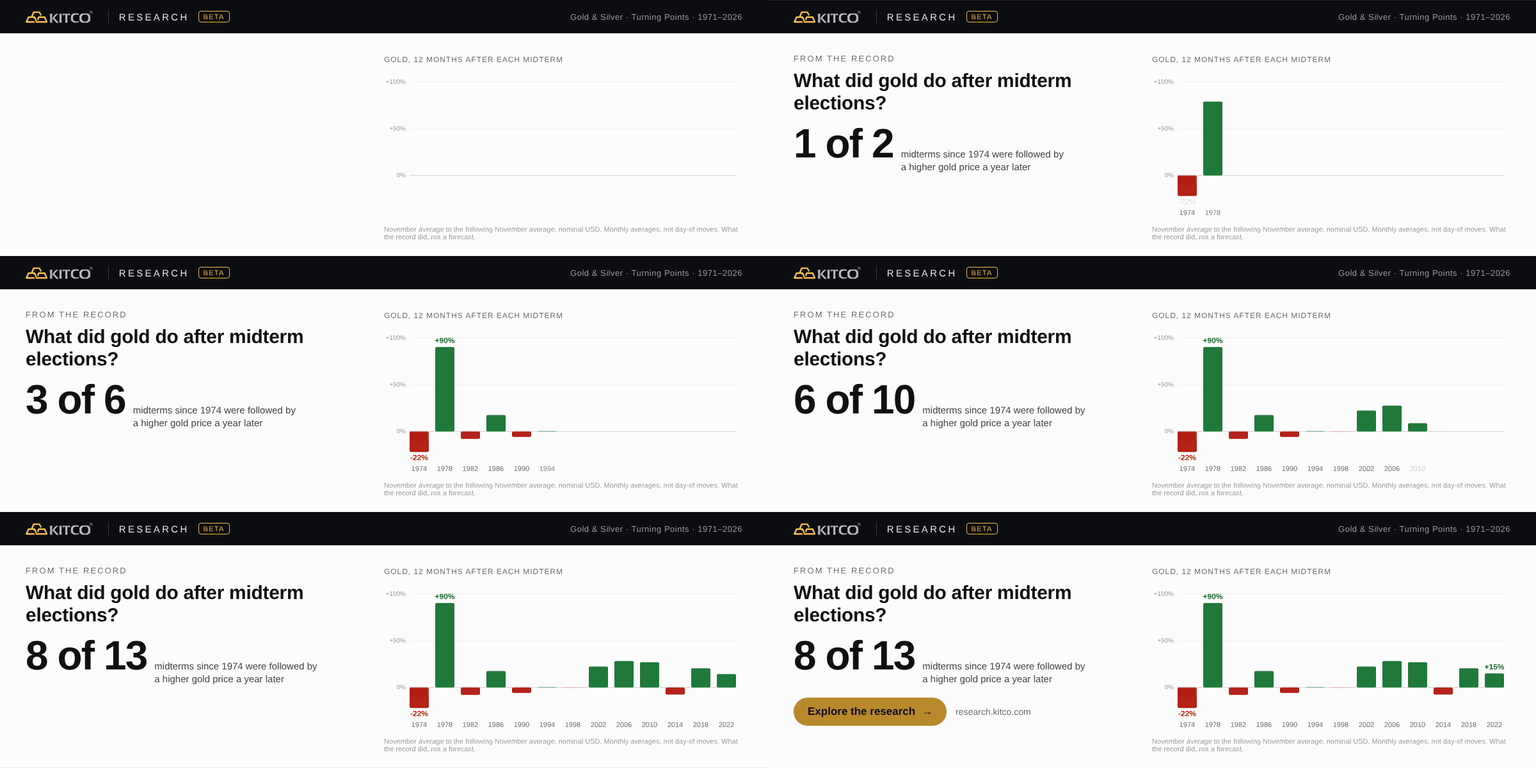
Market positioning now reflects a more difficult environment for non-yielding precious metals. Gold’s recovery following last week’s Democratic midterm election victories had been supported by declining Treasury yields and expectations that divided government could restrain additional fiscal expansion. Tuesday’s inflation surprise reversed part of that bond-market rally and demonstrated that the immediate Federal Reserve outlook remains more sensitive to inflation and employment than to congressional control. Silver experienced greater selling pressure as higher borrowing costs, weaker equities and concerns about industrial demand compounded the decline across precious metals.
The week’s remaining U.S. economic calendar includes Thursday’s weekly initial jobless claims report and Friday’s October producer price index, both scheduled for release at 8:30 a.m. EST. Investors will examine producer prices for evidence of persistent input-cost inflation and potential transmission into consumer prices. U.S. Treasury markets will be closed Wednesday for Veterans Day, although equity markets will remain open. Reduced Treasury-market liquidity could influence trading conditions, while Federal Reserve commentary and the next inflation report will remain important catalysts for gold, silver, the dollar and bond yields.
The Strait of Hormuz and U.S.-Iran situation remained a major influence on global energy markets Tuesday, although expectations for additional U.S. military action eased following comments from President Donald Trump and Secretary of State Marco Rubio. Trump indicated Monday that he would defer further strikes against Iran after appeals from regional governments, including Qatar, while Rubio said Tuesday that U.S. sanctions and the naval blockade were exerting sufficient pressure without the need for major combat operations. The comments encouraged traders to reduce some of the geopolitical risk premium in crude oil prices, extending Monday’s sharp decline.
However, expectations for a near-term diplomatic settlement remain uncertain. Iran’s senior security official Mohsen Rezaei said Tuesday that formal negotiations were not taking place between Tehran and Washington, challenging earlier suggestions of progress toward an agreement. The principal disputes remain sanctions relief, Iran’s nuclear activities, the U.S. naval blockade and the conditions for restoring normal commercial shipping through the Strait of Hormuz. Regional mediation continues, but neither side has confirmed a binding settlement or a timetable for unrestricted maritime access.
Crude oil futures settled lower Tuesday, although prices recovered from steeper intraday losses after Iranian officials questioned the prospects for negotiations. Brent crude declined $1.08, or 1.17%, to settle at $91.49 a barrel, while Nymex WTI fell $0.81, or 0.93%, to settle at $86.04. Both benchmarks recorded their lowest settlements since Aug. 31, extending the decline in energy prices as traders reassessed the threat to Middle Eastern petroleum supplies.
North American equity markets finished lower Tuesday as the stronger-than-expected inflation report pushed Treasury yields higher and renewed concerns about the outlook for monetary policy. The Dow Jones Industrial Average declined 157.86 points, or 0.30%, to close at 52,231.89. The S&P 500 lost 29.01 points, or 0.38%, to finish at 7,520.93, while the Nasdaq Composite fell 187.26 points, or 0.74%, to 25,065.87. The Russell 2000 declined 19.44 points, or 0.68%, to close at 2,821.38. The losses followed Monday’s broad market rally, when lower crude oil prices and renewed buying in technology shares supported a recovery from the previous week’s steep selloff.
Canada’s S&P/TSX Composite Index finished lower Tuesday, declining 275.81 points, or 0.76%, to close at 36,170.45, retreating from Monday’s highest closing level since Sept. 4. Materials shares led the decline, falling approximately 3.9% as weaker precious metals and copper prices pressured mining companies. Consumer discretionary stocks lost 0.8%, while the interest-rate-sensitive real estate sector declined 0.7%. Energy shares gained approximately 1.1%, providing some offset to the broader market weakness despite lower crude oil prices. The Canadian benchmark’s decline reflected concerns that tighter U.S. monetary policy could weigh on economic activity and commodity demand in Canada’s largest export market.
European equity markets finished mostly higher Tuesday as lower crude oil prices provided relief from inflation and corporate cost concerns, offsetting some of the pressure from the U.S. consumer inflation surprise. The pan-European Stoxx 600 advanced 0.27% to close at 658.32, while Germany’s DAX gained 0.31% to 26,347.45. France’s CAC 40 rose 0.55% to 8,278.59, and Italy’s FTSE MIB advanced 0.69% to 51,755.08. The U.K.’s FTSE 100 underperformed, declining 0.29% to finish at 10,751.59. Investors also assessed comments from Bank of England Deputy Governor Clare Lombardelli suggesting that U.K. interest rates may need to remain higher than some policymakers anticipate.
The key outside markets see Nymex WTI crude oil futures lower after settling at $86.04 a barrel, while Brent crude futures finished at $91.49. The benchmark 10-year U.S. Treasury yield rose sharply and briefly exceeded 5.00%, while the two-year yield climbed toward 4.75% before trading near 4.725%. The U.S. dollar strengthened following the consumer inflation figures, adding to the pressure on precious metals as expectations for additional Federal Reserve tightening increased. (Kitco Global Index shows how much of today’s gold move is the dollar versus the gold market itself.)
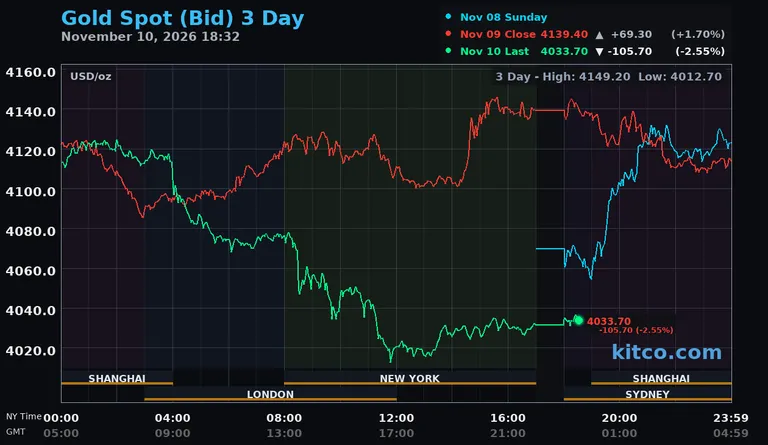
Technically, spot gold bulls’ next upside price objective is to push prices back above the previously identified $4,051.45 to $4,088.51 resistance zone, with a sustained move through the upper boundary targeting $4,147.62 and then $4,200.09. Bears’ next near-term downside price objective is a break below the $4,020.00 to $4,000.00 support zone, with deeper downside targets at $3,910.00 and then $3,890.00. First resistance is seen at $4,051.45 and then at $4,088.51. First support is seen at $4,020.00 and then at $4,000.00.
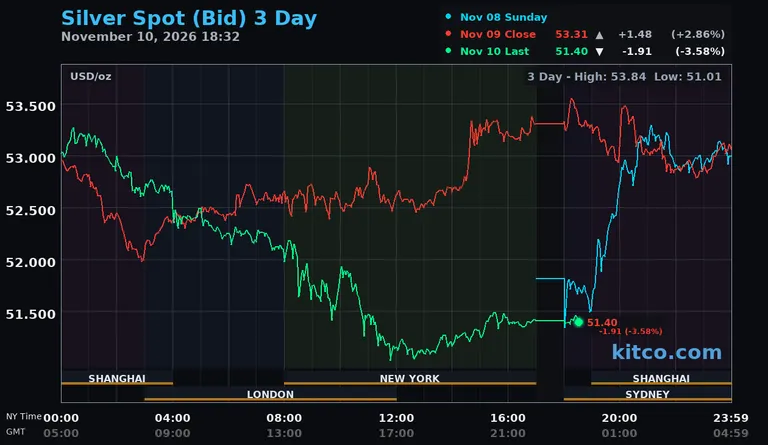
Spot silver bulls’ next upside price objective is to drive prices back above the $53.420 to $54.640 resistance zone, with a sustained move through the upper boundary targeting $55.000 and then the broader $56.000 to $57.000 resistance area. The next downside price objective for the bears is a break below $51.000, with deeper downside targets at $50.010 and then $48.000. First resistance is seen at $53.420 and then at $54.640. Next support is seen at $51.270 and then at $51.000.
See live precious metals prices for gold, silver, platinum and palladium — in USD, CAD and 12 more currencies.
Disclaimer: The views expressed in this article are those of the author and may not reflect those of Kitco Metals Inc. The author has made every effort to ensure accuracy of information provided; however, neither Kitco Metals Inc. nor the author can guarantee such accuracy. This article is strictly for informational purposes only. It is not a solicitation to make any exchange in commodities, securities or other financial instruments. Kitco Metals Inc. and the author of this article do not accept culpability for losses and/ or damages arising from the use of this publication.