
One Ounce of Silver Just Sold for $46,125. Why Collectors Fought for It
A modern Mexican bullion coin just delivered the kind of auction result once reserved for classic rarities.
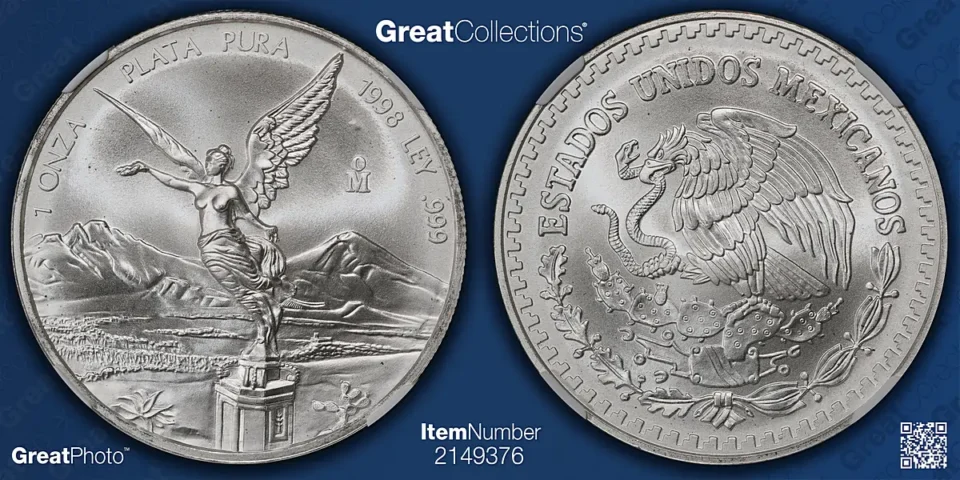
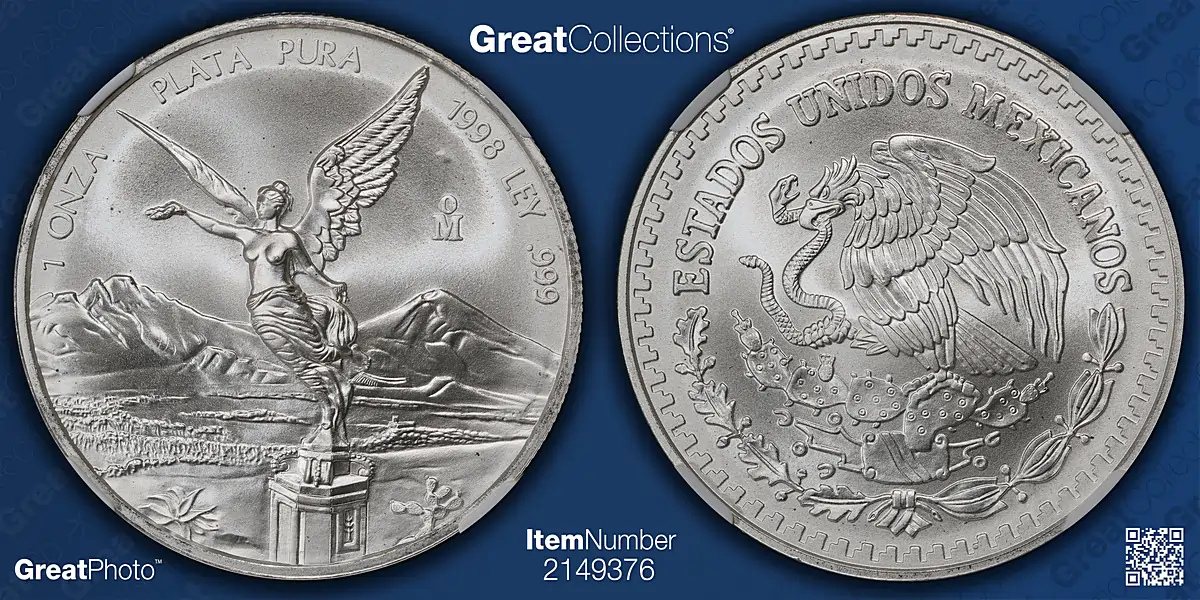
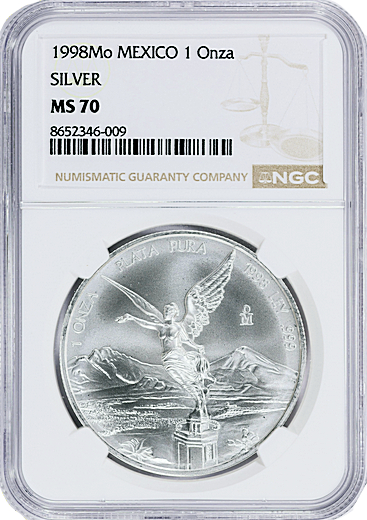
On June 7, 2026, GreatCollections sold a 1998-Mo Silver Onza Libertad graded NGC MS-70 for $46,125. The coin attracted 23 bids. Moreover, 45 GreatCollections members tracked the lot before the auction closed.
The result marks a dramatic new stage for the modern Mexican coin market. It also confirms the growing power of registry-set competition, condition rarity, and international demand.
The coin did not contain rare metal. It held one troy ounce of .999 fine silver.
However, collectors did not bid on its bullion value. They competed for the absolute key date of the one-ounce Silver Libertad series in a perfect certified grade.
A $46,125 Silver Libertad Changes the Conversation
Mexico struck only 67,000 one-ounce Silver Libertads in 1998. That figure makes the issue the lowest-mintage regular one-ounce business strike in the series through 2024.
The auction coin carried the KM-613 catalog number. It weighed 31.1 grams and measured 40 millimeters in diameter.
NGC graded it MS-70, the highest grade on the Sheldon numerical scale. At the time of the auction, GreatCollections reported that the coin tied nine other NGC examples and five PCGS examples for the finest certified grade.
Therefore, the coin was not unique in MS-70. Still, only a tiny number of certified examples had reached that level.
That distinction matters. Bullion coins often suffer contact marks during production, packaging, shipping, and storage. Consequently, a coin can remain fully Mint State yet fall short of perfection because of a small abrasion or surface mark.
The 1998 Libertad combines low original production with an unusually high condition barrier. As a result, demand rises sharply at the top of the grading scale.
GreatCollections Sees Global Demand for Mexican Coins
GreatCollections reports that bidder interest in modern Mexican coins has grown significantly during the past five years. That demand includes both silver and gold Libertads.
However, the auction house saw activity accelerate during the first half of 2026. Bidders now compete from markets around the world.
Ian Russell, president of GreatCollections, compared the trend with the expansion of the American Silver Eagle market.
“The Mexican Libertad series is following the same path we watched the American Silver Eagle take over the last decade — collectors are chasing the backdated key dates to finish their sets,” Russell said. “The difference is supply. Nobody put away monster boxes of the 1998 Onza the way they did with Silver Eagles, so when a coin like this MS-70 comes up, the bidding tells you exactly how much the market has progressed.”
The comparison explains part of the current price movement.
Collectors and dealers stored large quantities of American Silver Eagles in original monster boxes. Therefore, substantial supplies of many backdated issues survived in bulk.
Silver Libertads followed a different path. Mexico generally produced them in much smaller numbers. In addition, buyers did not preserve the same volume of early issues in unopened institutional quantities.
Consequently, today’s supply can become very thin when collectors seek a specific date and grade.
The 1998 Libertad Price Rise Extends Across Several Grades
The MS-70 result gained the most attention. Nevertheless, GreatCollections’ auction history shows broad price growth across the grading scale.
1998 Silver Libertad in MS-69
GreatCollections reported these selected results:
- June 2023: PCGS MS-69 — $1,114
- June 2024: NGC MS-69 — $1,688
- November 2025: NGC MS-69 — $3,600
- June 2026: NGC MS-69 — $5,063
Accordingly, the selected MS-69 results rose by more than four times between June 2023 and June 2026.
The grading service changed between some sales. Individual coins may also differ in appearance. Even so, the sequence shows a clear rise in the amount bidders would pay for high-grade examples.
1998 Silver Libertad in MS-68
The same pattern appears one grade lower:
- November 2022: PCGS MS-68 — $686
- January 2026: PCGS MS-68 — $2,925
- June 2026: PCGS MS-68 — $3,150
Thus, a grade that brought less than $700 in late 2022 crossed the $3,000 mark by June 2026.
1998 Silver Libertad in MS-67
GreatCollections also reported:
- November 2022: PCGS MS-67 — $632
- May 2025: NGC MS-67 — $1,098
Here again, the selected results show rising demand beyond the finest grades.
Finally, the June 2026 NGC MS-70 brought $46,125. That result placed the perfect-grade coin in an entirely different price category.
Auction results can vary because of eye appeal, holder type, market timing, bidder participation, and other factors. Still, these figures show that the market did not rise only at the top. Buyers pushed prices higher across several certified grades.
Mexico Created a Bullion Coin Unlike Any Other
The modern Silver Libertad debuted in 1982. Banco de México authorizes the series, while the Casa de Moneda de México strikes the coins.
The Mexican Mint traces its origin to 1535, when the Spanish Crown established a mint in Mexico City. It ranks as the oldest minting institution in the Americas.
The Libertad also differs from most government-issued bullion coins because it carries no fixed face value. Instead, Mexican law ties its monetary value to its precious-metal content and the prevailing market price.
Therefore, the coin does not display a denomination such as one peso, five pesos, or 10 pesos. Its inscriptions identify its weight and fineness instead.
The 1998 reverse reads:
1 ONZA PLATA PURA 1998 LEY .999
That inscription translates to one ounce of pure silver, dated 1998, with .999 fineness.
This structure gives the Libertad an identity that sits between bullion, national coinage, and modern numismatic art.
The Silver Onza Came Before the Libertad
Mexico’s modern bullion story did not begin in 1982.
The Mexican Mint struck an earlier one-ounce silver piece in 1949. Production later resumed in 1978, 1979, and 1980.
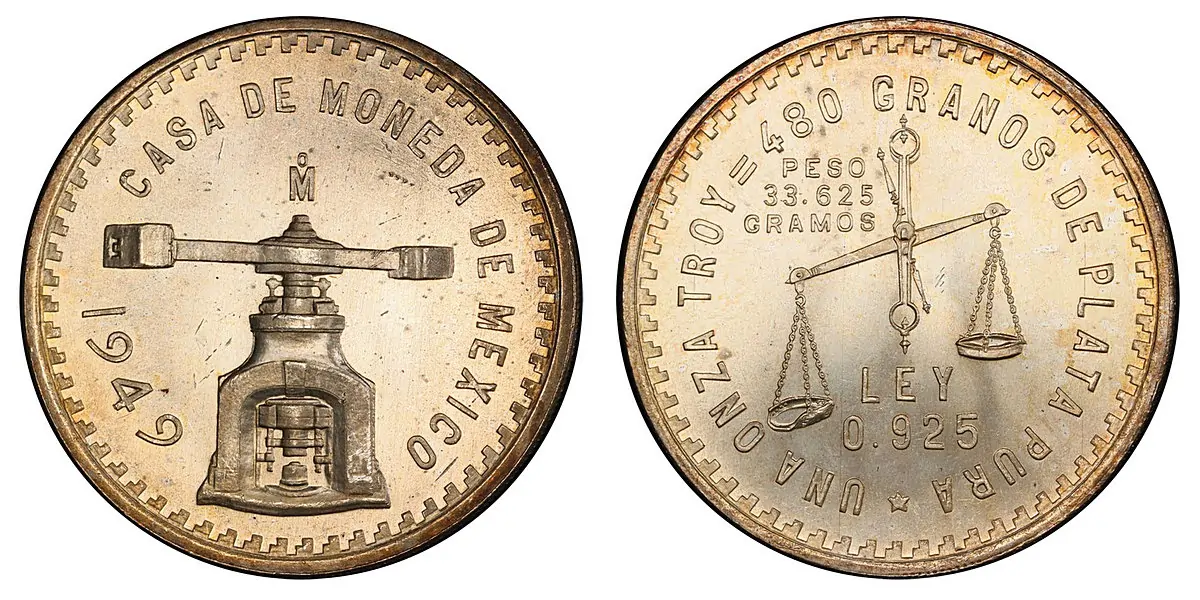
Collectors often call these coins 0 pieces or “Tejos.” Their designs differ sharply from the later Libertad.
The obverse features a screw coin press. Meanwhile, the reverse shows a balance scale. The coins contain .925 fine silver, but their heavier total weight provides one full troy ounce of pure silver.
These early Onzas established a foundation for the program that Mexico redesigned in 1982.
Because sovereign silver bullion programs remained uncommon at that time, the Libertad became one of the earliest major modern government-issued silver bullion series. It preceded the American Silver Eagle, introduced in 1986, and the Canadian Silver Maple Leaf, introduced in 1988.
The Thick “Gordita” Libertads of 1982 – 1995
The first Silver Libertads carried a compact and deeply sculpted design.
On the reverse, Winged Victory faces forward. Collectors also know the figure as the Angel of Independence because the design draws from the monument on Mexico City’s Paseo de la Reforma.

Behind Victory rise two famous volcanoes: Popocatépetl and Iztaccíhuatl. Their presence connects the coin with one of Mexico’s best-known legends of love, death, and eternal devotion.
The obverse displays Mexico’s national emblem. An eagle stands on a cactus while holding a serpent.
The early one-ounce coins measured 36 millimeters in diameter. Their smaller diameter gave them a noticeably thick profile.
For that reason, collectors often call the 1982–1995 pieces “Gorditas,” a Spanish nickname that loosely translates as “chubbies.”
The name may sound informal. However, it now serves as a useful shorthand for the first major Libertad design type.
A New Libertad Design Arrived in 1996
Banco de México changed the one-ounce coin in 1996.
The Mint widened the diameter from 36 millimeters to 40 millimeters. At the same time, it made the coin thinner.
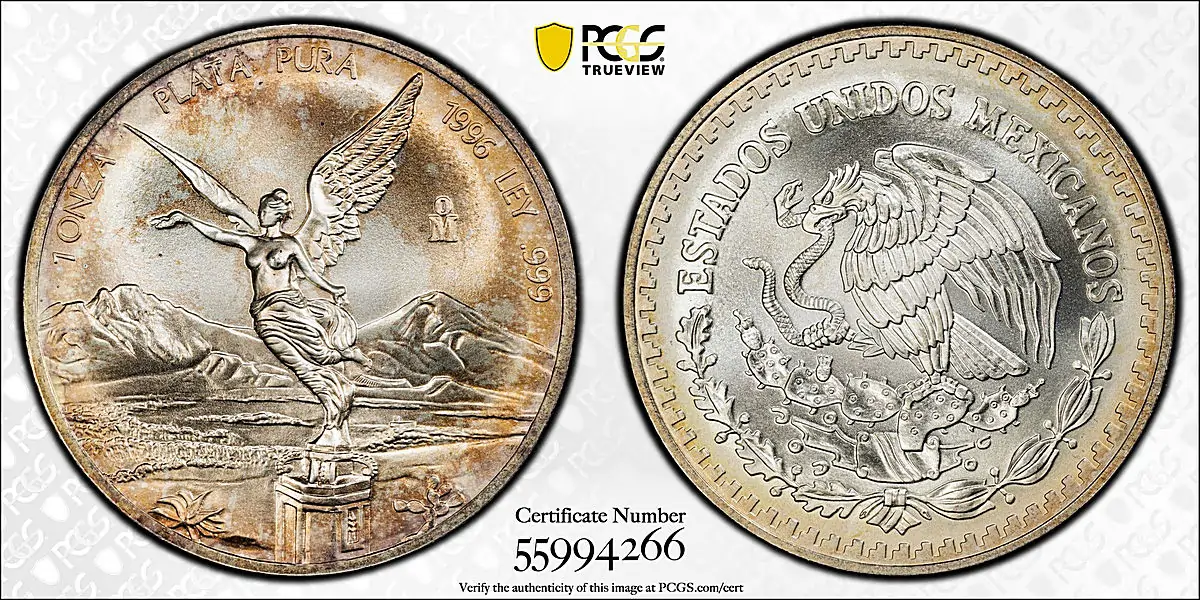
The larger surface created more room for the design. Winged Victory now appears in a three-quarter profile, while part of the monument’s column appears beneath her.
The volcanoes remain in the background. Yet the wider format gives the scene a broader and more cinematic appearance.
The 1998 issue belongs to this redesigned type. Therefore, its rarity coincides with one of the most important visual transitions in the series.
Mexico changed the obverse again in 2000 for the one-ounce and larger silver coins. The current national coat of arms appears in the center. Ten historical versions of the emblem surround it.
As a result, the obverse became a compact timeline of Mexican national heraldry.
The Libertad Series Expanded Beyond One Ounce
Mexico initially offered the modern silver program as a one-ounce coin. However, the lineup expanded as collector demand grew.
Fractional silver Libertads appeared during the early 1990s. The range eventually included:
- 1/2 ounce
- 1/4 ounce
- 1/10 ounce
- 1/20 ounce
Mexico later added two-ounce and five-ounce coins. The program then expanded to a one-kilogram format.
Banco de México now lists silver Libertads in weights from 1/20 ounce through one kilogram. Available formats vary by size and year.
The Mint has also produced Brilliant Uncirculated, Proof, Reverse Proof, Antique Finish, and Proof-like pieces. However, not every weight appears in every finish each year.
These variations give collectors many possible ways to build a set. At the same time, they create numerous low-mintage issues and condition rarities.
Why Libertad Mintages Can Surprise Collectors
The American Silver Eagle program often produces bullion coins by the millions or tens of millions.
The Silver Libertad program works differently.
Mexico’s annual production can change sharply from one year to the next. Banco de México responds to production decisions, market conditions, distribution needs, and other economic factors.
Therefore, the series does not follow a predictable mintage pattern.
That volatility creates sudden key dates. A year that appears ordinary at release can become difficult once collectors understand the final production total.
The late 1990s provide the strongest example.
Collectors often group the following one-ounce business strikes together:
- 1997: 100,000 coins
- 1998: 67,000 coins
- 1999: 95,000 coins
Many Libertad specialists call these dates the “Holy Trinity” of the one-ounce Brilliant Uncirculated series.
Among them, the 1998 remains the recognized key date based on its 67,000-coin mintage.
However, mintage alone does not explain the $46,125 result. Survival, preservation, certified population, registry demand, and the availability of visually superior coins also influence value.
The 1998 Libertad Has Become a Market Test
PCGS identified the 1998 as the key date of the regular one-ounce Silver Onza series in a 2022 analysis. At that time, PCGS noted that ungraded examples had sold for only about $140 to $220 in 2016. By 2022, attractive raw pieces traded near $600.
The market moved much further after that.
In May 2022, a PCGS MS-70 example reportedly sold for $15,700 through an eBay transaction recorded by PCGS Auction Prices.
Four years later, the GreatCollections NGC MS-70 brought $46,125.
That comparison does not prove that every MS-70 example tripled in value. Different coins, venues, holders, and market conditions can produce different results.
Nevertheless, the numbers show how quickly collectors have reassessed the issue.
More importantly, the GreatCollections sale attracted sustained bidding rather than a single uncontested offer. The 23 bids show that more than one participant recognized the coin’s significance.
Registry Competition Meets a Thin Supply
Modern coin markets can move quickly when several forces converge.
The 1998 Libertad currently benefits from at least four:
First, collectors recognize it as the regular one-ounce series key.
Second, the original mintage stands at only 67,000 coins.
Third, high-grade pieces face a condition challenge because silver bullion coins often acquire contact marks.
Finally, registry-set collectors need the date to complete competitive certified sets.
That final point can transform the market. A collector may find many common-date Libertads without difficulty. However, the entire set remains incomplete until the collector obtains the 1998.
Therefore, one date can become the gateway to the whole series.
The June 2026 sale shows what can happen when a top-grade example reaches an international auction platform while several determined buyers remain active.
A New Level for Modern Mexican Coins
The $46,125 GreatCollections result does not mean every modern Libertad will rise at the same pace.
Nor does it guarantee future prices.
However, it demonstrates that buyers now treat elite modern Mexican coins as serious numismatic properties. They consider mintage, grade, population, design type, and set completion. They also compete globally.
The 1998 Silver Libertad once looked like a low-mintage bullion coin from the recent past.
Today, it anchors one of the most active modern world-coin series.
Its silver value remains modest. Its numismatic value does not.
The difference between those two figures explains the modern Mexican coin market better than any price chart could.